Peter Obi’s Latest Political Shift: Strategy, Survival, or Setback?
A major political shift involving Peter Obi is sparking debate across Nigeria, raising questions about strategy, trust, and the future of opposition politics ahead of 2027.
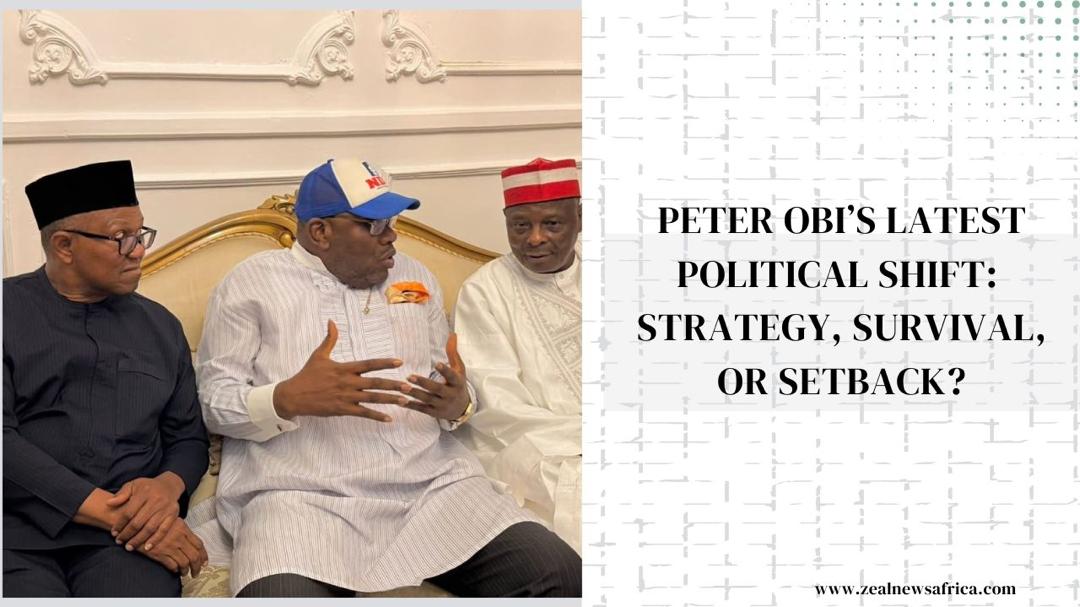
The recent political move by Peter Obi has brought him back into the center of national attention.
Reports of his exit from the African Democratic Congress (ADC) and move to the Nigeria Democratic Congress (NDC) have sparked discussion across Nigeria, especially as the country begins to prepare for the 2027 elections.
Because of his strong support base, especially among young Nigerians, any decision he makes quickly becomes a major topic of debate.
This development has created mixed reactions, and some people believe it is a smart political strategy that will help him stay relevant and better position himself for future elections.
Others, however, feel it raises questions about his consistency and political direction. They wonder whether such changes show flexibility or a lack of stable ideology.
In Nigeria, party switching is not new, but Obi’s case stands out because of his popularity and influence.
His actions are now being closely watched, as many people try to understand what it means for the future of opposition politics and the 2027 elections.

Strategic Repositioning Ahead of 2027
One major way to understand the move by Peter Obi is to see it as a strategic attempt to reposition himself ahead of the 2027 general elections.
In Nigerian politics, success is rarely determined by individual popularity alone. It often depends on strong party structures, wide-reaching alliances, financial backing, and the ability to form coalitions that can compete at a national level.
From this perspective, a shift to a party like the NDC can be interpreted as a calculated decision to improve political strength rather than a simple change of loyalty.
If the new platform offers better organization, fewer internal conflicts, and a clearer pathway for coalition-building, it becomes easier for a politician to compete effectively on a national stage.
In a highly competitive political environment like Nigeria’s, such moves are often seen as part of long-term planning rather than short-term reactions.
Another key factor is political influence, because by joining new political forces can help expand reach beyond an existing support base.
Even strong grassroots support needs wider national structure to succeed. By repositioning, Obi may be trying to increase his influence in areas where he was previously weaker, which is often important for serious presidential ambition.
Nigerian politics is largely based on coalitions, where parties and candidates form alliances before elections to increase their chances of winning.
In this kind of system, switching political platforms can be part of broader negotiations and strategic partnerships, and his move can therefore be seen as an effort to stay flexible and relevant within these changing alliances.
However, strategic repositioning also comes with risks. It may create doubt among supporters, as some people could question whether the move is based on national interest or personal ambition.
Because of this, maintaining public trust is just as important as building political alliances.

Ultimately, this suggests that Obi’s move is not just a simple party switch, but part of a broader effort to prepare for a competitive 2027 election.
Its success will depend on whether it leads to stronger political support, voter confidence, and lasting influence.

Public Trust and the Question of Consistency
Despite possible strategic benefits, party defection often raises serious concerns about credibility.
In the eyes of many Nigerians, especially younger voters, politics is no longer just about winning elections, it is also about values, consistency, and clear direction.
As a result, moves like Obi’s can quickly spark debates about whether leaders are staying true to their principles or simply adapting to political convenience.
For many supporters, consistency is closely tied to trust. When a political figure changes platforms, even for strategic reasons, it can create confusion about what they truly stand for.
This is especially important in a political environment where voters already feel disappointed by frequent party switching among politicians.
Each new shift can strengthen the belief that ideology is weak in Nigerian politics, and that decisions are often driven more by ambition than by policy or belief.
At the same time, public trust is not always completely lost when such changes happen, and much depends on how the decision is communicated.
If he clearly explains the reasons behind his move and shows that it is aimed at improving governance or strengthening national interest, some supporters may still remain loyal.
Transparency plays a major role in how the public interprets political decisions.
However, trust is not built on explanations alone, it is also built on history and perception. Leaders who are seen as consistent over time tend to enjoy stronger emotional support, while those who frequently change political direction risk being viewed as unpredictable.
In politics, perception can sometimes matter as much as action, because voters often interpret decisions through emotion and past experience.
Ultimately, the challenge for any political figure making such a move is balancing strategy with credibility.
While political realignment may be necessary in a competitive system, it must be handled carefully to avoid weakening the connection with supporters.
In his case, the key issue is not just the party he joins, but how convincingly he can maintain trust while navigating a changing political landscape.
What It Reveals About Nigeria’s Political System
Obi’s move shows a common trend in Nigerian politics where politicians often change parties easily.
This happens because many parties do not have strong or clear ideologies, and politics is often based more on individuals than on party principles.
When politicians switch parties frequently, it can make the political system look unstable and confuse voters about what each party stands for.
Over time, this can reduce people’s trust in political parties and weaken interest in politics.
It also shows that many Nigerians now focus more on individual politicians rather than party ideas.
While this makes popular figures more influential, it reduces the strength of party systems.
Overall, his move reflects a bigger problem in Nigeria’s politics, where personal ambition and alliances are often more important than clear political beliefs.
Conclusion
Peter Obi’s recent political shift is more than just a headline, it is a moment that captures the complexities of Nigerian politics.
Whether seen as a smart strategy, a necessary adjustment, or a questionable decision, its true impact will depend on what follows.
If the move leads to stronger alliances, clearer direction, and meaningful results, it could reinforce Obi’s position as a key political figure.
However, if it fails to deliver tangible outcomes, it may deepen public skepticism about political defections.
In the end, Nigerians will judge not just the decision itself, but the results it produces in the journey toward 2027.