Olodo Core: Is Nigeria's Educational System Fueling Anti-Intellectualism?
When WAEC tightened anti-malpractice rules in 2025, six in ten Nigerian students failed their secondary school exit exam. Nigeria built an education system that rewards the certificate, not the learning. What are these?
There is a kind of student Nigeria has always celebrated.
Not the one who reads until midnight. Not the one who argues with the teacher because the textbook is wrong. Not the one who asks questions nobody has thought to ask yet.
The one Nigeria celebrates is the one who passes. Full stop. Five credits. WAEC done. JAMB cleared. University secured. The certificate is the destination, and everything that happens between enrolment and graduation is just the inconvenient distance between two stamps on a paper.
We gave this celebration a name without realising it. We called the child who did not understand, but still managed to pass cleverly. We called the child who understood everything but failed unlucky.
And we reserved our deepest, most private contempt for the child who asked too many questions and disrupted the lesson.
We called that child trouble.
That child grew up. Nigeria is living with the results.
What the Numbers Are Saying
In 2025, only 38.32 per cent of the 1,969,313 candidates who sat the WAEC examination obtained credit passes in five subjects, including English Language and Mathematics. This represents a staggering 33.8 per cent drop from the 72.12 percent success rate recorded in 2024 and is the lowest pass rate in over a decade.
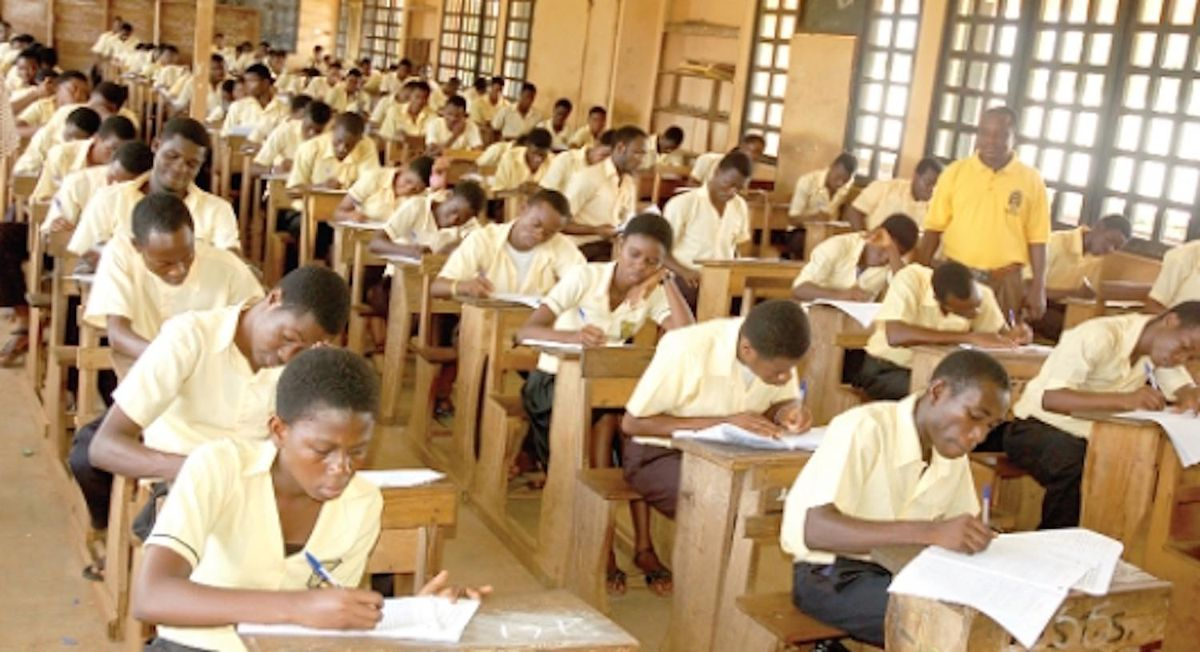
The initial explanation was that WAEC had tightened its anti-malpractice measures, which is almost certainly true. But read what that explanation is actually saying.
It is saying that when Nigeria removed the cheating infrastructure, more than six out of ten students could not pass their secondary school exit examination. The cheating was not a deviation from the system. It was load-bearing. Take it away, and the structure collapses.
WAEC withheld the results of 191,053 candidates over suspected malpractice during the 2025 diet — roughly one in ten of those who sat the examination.
In 2024, 215,267 results were similarly held back. NECO withheld 12,030 results in 2023 and 8,437 in 2024.
These are not outliers. They are the system working as designed — not the official design, but the actual one. The one that produces certificates rather than knowledge. The one where the miracle centre down the road is not a scandal but a service. The one where parents do not lie awake worrying their child does not understand mathematics. They lie awake worrying their child might not pass it.
Understanding and passing are two different things in Nigeria. We decided a long time ago which one matters more.
The Miracle Centre as Infrastructure
Social Insight
Navigate the Rhythms of African Communities
Bold Conversations. Real Impact. True Narratives.
In Nigeria, certificates often carry more weight than actual competence. Parents, aware of the hyper-competitive job market and grim youth unemployment statistics, are willing to pay for anything that increases their child's chances of obtaining a good grade. In such an environment, the certificate is seen as a ticket out of poverty, and if the honest route seems uncertain, the shortcut becomes dangerously attractive.
This is the part of the conversation that makes comfortable people uncomfortable, so it usually gets skipped. The miracle centre is not a moral failure of individual families. It is a rational response to a system that rewards the certificate and not the learning.
When a company's job advertisement says "minimum of second class upper" and then never tests whether the applicant actually knows anything about the role, it has told every Nigerian parent exactly what to chase. Not knowledge. The paper that says you have it.
For students, miracle centres offer an escape from years of educational neglect. Public schools in many states are overcrowded, understaffed, and underfunded.
A student who spent three years in a classroom with 80 other students, one textbook between four of them, a teacher who hasn't been paid in two months, and a curriculum designed in 1985, is not choosing ignorance when they walk into a miracle centre. They are making the only calculation available to them.

The system failed them first. The miracle centre just made peace with the failure.
What Gets Produced
The downstream consequences of a certificate-obsessed education system are not abstract. They show up in hiring managers who discover that a first-class graduate cannot write a coherent paragraph.
In hospitals, clinical decisions are made by doctors whose understanding of pharmacology is thinner than their transcripts suggest. In engineering firms, structures are designed by people who memorise formulas without understanding the physics behind them.
Overseas, some admissions officers and professional bodies increasingly triangulate Nigerian transcripts with standardised tests, interviews, portfolios and proctored assessments because they cannot rely on grades alone.

When a national system becomes synonymous with leakage, impersonation or centre-wide collusion, honest students from that system pay the price through heightened scepticism and tougher verification hurdles.
The students who actually learned pay for the reputation built by the ones who didn't. That is the cruelest part of this. Intellectual seriousness is being punished twice in Nigeria.
First inside the system, where it offers no competitive advantage over the student who bought their way through. Then outside it, where Nigerian credentials are treated with institutional suspicion because the world has noticed what the system produces.
The UNILAG Vice-Chancellor, speaking at the 2025 Education Writers Association of Nigeria summit, said Nigeria must rethink its deep-rooted obsession with certificates. The country's education system must begin to reward competencies, skills, and the right attitudes rather than paper qualifications alone. The culture of attaching excessive value to degrees has fuelled both unhealthy competition and widespread exam malpractice.
The Anti-Intellectual Culture That Grew From It
Anti-intellectualism in Nigeria does not look the way it looks in the rest of the world. It does not announce itself. It does not burn books or mock universities. It is far more subtle and far more effective than that.
It shows up in the staffroom where the teacher who makes students think is called difficult, and the one who gives them the answers to memorise is called good. It shows up in the family gathering where the cousin who dropped out to build a business is celebrated, and the one who stayed in school to pursue a PhD is pitied for not yet making money.
Social Insight
Navigate the Rhythms of African Communities
Bold Conversations. Real Impact. True Narratives.
It shows up in the comment section whenever a Nigerian intellectual makes a complicated point, where the most liked response is always some version of: this grammar will not feed you.
That last one is doing a lot of work. The dismissal of intellectual seriousness as impractical, as foreign, as somehow disconnected from real Nigerian life, is itself the product of a system that spent sixty years teaching Nigerians that thinking is less valuable than the paper that says you thought.
We produced a generation that went to school without becoming educated. Then we were surprised when they did not value education.

The Fix That Is Not Coming
The Federal Government unveiled sweeping anti-malpractice reforms in late 2024, targeting 2026 implementation. The government has also directed WAEC and NECO to adopt Computer-Based Testing by 2026.
Computer-based testing will make cheating harder. It will not make learning more valued. Surveillance is not a curriculum. Cracking down on miracle centres does not replace the functional classrooms, paid teachers, current textbooks, and examination systems that actually test understanding rather than recall, which the miracle centres exist to compensate for.
The 2025 WAEC results, where six in ten students failed when the cheating scaffolding was removed, are not a WAEC problem. They are a mirror. They show what sixty years of treating education as a certification process rather than an intellectual one has actually produced.
A country full of people who went to school. And not enough people were taught to think.
Olodo is what we called the child who didn't understand. We turned it into a punchline. We should have turned it into a policy emergency.
We still can. The question is whether we have the intellectual seriousness to do it.