OPay Will Now Pay You Back Up to ₦5 Million If Someone Steals From Your Account
Nigerian fintechs lost billions to fraud in 2024. OPay's XtraCova is a structured reimbursement product covering phishing, identity theft, platform failures and more, with a ₦5M ceiling and a defined claims process.
Nobody thinks it will happen to them.
You're careful. You don't click suspicious links. You don't share your PIN, but phishing attacks don't always need your cooperation, same as malware won’t come knocking on your door to ask permission.
A stolen phone in the wrong hands can drain an account in minutes. And when it happens, most fintech platforms hand you a customer service number and wish you luck.
OPay just decided to do something different.
XtraCova and What It Actually Does
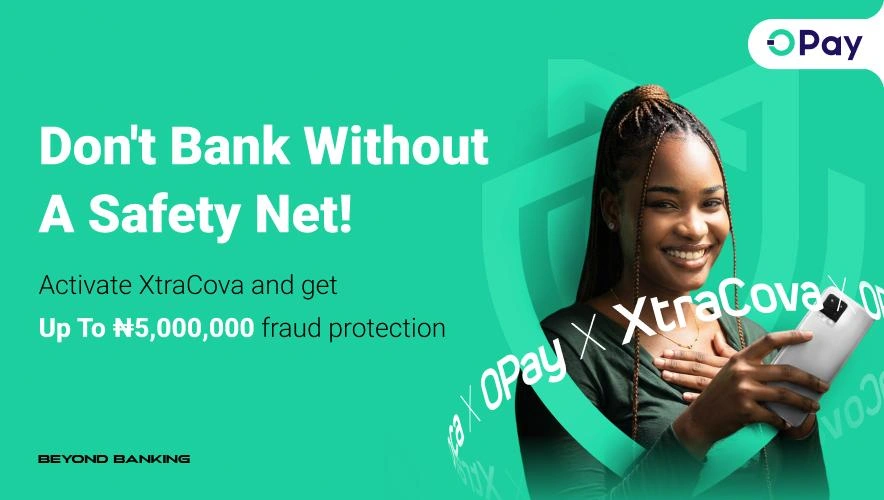
The company has launched XtraCova, a funds protection product that reimburses users up to ₦5,000,000 per validated claim when money leaves their account without their knowledge or consent.
Not a vague promise buried in a terms and conditions document. An actual structured product, with a defined ceiling and a claims process to back it up. It's live right now, sitting inside the OPay app under the Security Center section.
Two Scenarios. One Safety Net.
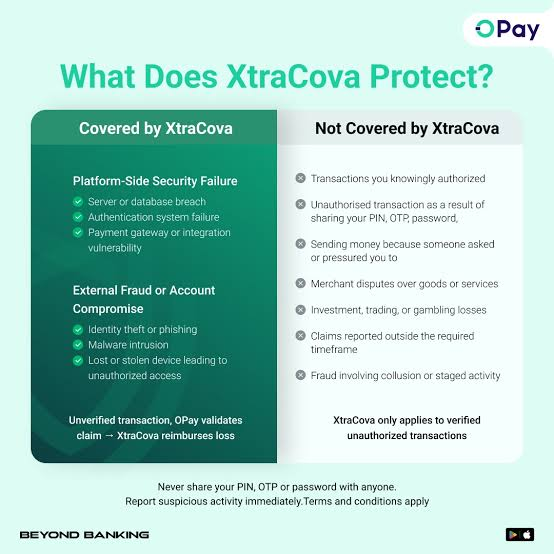
XtraCova draws a clear line around two scenarios that tend to cost customers the most.
The first is platform-side failures: system vulnerabilities, infrastructure breakdowns, authentication control failures. The kind of thing that has nothing to do with anything you did, but still empties your wallet.
The second is external fraud: phishing attacks, identity theft, malware, or unauthorised access through a lost or stolen device. Both are covered under a single structured claims process.
You submit a claim. OPay investigates. If the transaction is confirmed as unauthorised and all policy conditions are met, you get your money back. Up to ₦5 million of it.
The product arrives at a moment when the numbers are impossible to ignore. Nigeria's CBN has confirmed that financial fraud surged 45% within a single year, with 70% of resulting losses traced directly to digital channels. The cases are not abstract.
Between 2024 and 2025, more than 5,000 OPay accounts alone were compromised through phishing and SIM swap fraud. Refunds were issued in many cases, but the damage to confidence was already done.
XtraCova is OPay's structured answer to that pattern, built to get ahead of it rather than respond after the fact.
The Timing Is Deliberate
Nigeria's digital payments market has grown at a pace that has outrun most of its consumer protections. More users mean more transactions. More transactions mean more surface area for fraud to exploit.
The scale of the problem tells the story clearly. Nigerian financial institutions lost ₦52.26 billion to fraud in 2024, compared with ₦11.6 billion in 2020. Fewer cases are being reported, but the losses per incident are climbing sharply, which points to a more targeted, more sophisticated kind of fraud than what plagued the system five years ago.
NIBSS data shows that SIM swap fraud, account compromise, and phishing attacks are among the fastest-evolving schemes, with fraudsters constantly refining their methods to bypass existing safeguards.
OPay is not a small target inside this landscape. Launched in 2018, it has scaled into one of the most widely used financial platforms in Nigeria, handling money transfers, bill payments, merchant payments, card services, and more.
It's licensed by the CBN and carries NDIC insurance coverage on the same terms as commercial banks. That kind of infrastructure attracts volume, and volume attracts risk.

Elizabeth Wang, OPay's Chief Commercial Officer, put it directly: "Trust is the foundation of digital finance." Launching a product that puts real money behind that statement is a different order of commitment from a security awareness campaign or a terms update.

A Floor That Others Now Have to Match
Consumer protection in Nigerian fintech has largely been reactive. Something goes wrong, you complain, you wait, you maybe get a resolution. XtraCova flips that dynamic by building the safety net before anything goes wrong, formalising what reimbursement looks like, how much it covers, and exactly how to claim it.
The wider context makes this more significant than it might first appear. Nigeria ranks 110th out of 112 countries in the 2025 Sumsub Global Fraud Index, reflecting weak institutional responses and higher exposure to online and financial crime.
A product like XtraCova quietly chips away at that distrust. Not through messaging, through accountability. When one major platform raises the floor on what consumer protection actually looks like in practice, others face a choice: match it or fall visibly behind.
For the millions of Nigerians still cautious about moving their financial lives fully onto mobile apps, the question was never whether digital payments were convenient. Everyone knows they are. The question was always what happens when something goes wrong. OPay just put a number on its answer.