FG Bans ‘Dr’ for Honorary Degree Holders, But Titles Remain Nigeria’s Favourite Status Symbol
Nigeria’s Federal Government has banned honorary doctorate recipients from using “Dr” before their names, reigniting debate on title culture, social status, and the blurred line between recognition and academic qualification.

In Nigeria, “Dr” has long lived a double life as it is sometimes earned in lecture halls, sometimes awarded on ceremonial stages and now the Federal Government is now trying to separate the two.
A new directive, approved by the Federal Executive Council and announced by the Minister of Education Tunji Alausa, bans honorary doctorate holders from using the “Dr” prefix. Instead, the recognition must sit after the name, clearly marked as honorary.
The government also says misusing the title may now be treated as academic fraud, escalating what was once an etiquette issue into a question of misrepresentation.
The change also comes with a formatting requirement: honorary awards must now appear after a person’s name, clearly marked as honorary, such as LL.D (Honoris Causa) or D.Lit (Hon.), rather than being used as a professional prefix.
Not every doctorate is earned the same way

An honorary doctorate is not an academic qualification in the traditional sense.
It does not involve coursework, examinations, research supervision, or the long process of defending a thesis.
Instead, it is a symbolic recognition awarded by universities to individuals who have made notable contributions in fields such as public service, business, arts, or philanthropy.
An earned doctorate, by contrast, is built through structured academic work, years of study, original research, and formal evaluation. It is a qualification that reflects training and contribution to knowledge within a discipline.
Why “Dr” carries more weight than expected

The debate around this policy is not really about formatting. It is about what the title “Dr” does in everyday social interaction.
In many settings, the prefix quietly changes how a person is received.
It can influence tone in conversation, shape assumptions about expertise, and alter the level of seriousness attached to what someone says even before their background is questioned.
In professional and public spaces, titles often act as shortcuts.
They compress years of education, experience, or recognition into a single label that precedes a name.
“Dr” is one of the most powerful of those labels because it is widely associated with academic depth and professional authority.
This is where honorary doctorates complicate perception. While they are legitimate recognitions, they do not reflect academic training.
Titles are a big part of social life
In Nigeria, titles are not just formal labels. They often carry social meaning and can influence how people are treated.

It is common for introductions to include multiple titles, especially in formal events. These titles can signal respect, status, or achievement.
This is why honorary doctorates became sensitive. When the same title is used for both earned and honorary degrees, the line between recognition and credential starts to fade in public understanding.
Why the government stepped in

The Federal Government’s move is framed as an attempt to restore clarity between academic standard and ceremonial recognition.
For over a decade,concerns over the commercialisation and politicisation of honorary degrees have been raised in Nigeria's academic community, with universities often accused of awarding the degrees to wealthy donors and public officials in exchange for financial patronage rather than merit.
By stopping honorary degree holders from using “Dr,” it is trying to clearly separate academic qualifications from honorary recognition.
Universities are also expected to follow stricter rules when awarding honorary degrees, and make sure they are properly labelled.
The idea is to make it clear what is earned through study and what is given as recognition.
What this really changes and what it doesn’t
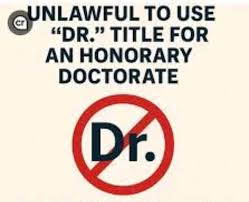
This rule will change how honorary degrees are presented in official use. People who receive them will still be recognized, but they cannot use “Dr” in front of their names anymore.
However, in practice, titles are not only used in official documents. They appear in introductions, social media profiles, event announcements, and more.
So while the rule changes official usage, it may not immediately change how people view or use titles in society.
The ban on using “Dr” for honorary degree holders is ultimately about drawing a line between recognition and qualification. But it also exposes something deeper about how status is communicated in public life.
Titles are not just administrative labels in Nigeria, they are part of how identity is presented and received.
Even with new rules in place, the value people place on titles is unlikely to disappear anytime soon.