Failed African Fintech Startups and the Business Ideas Worth Rebuilding (Part 1)
A deep dive into failed African fintech infrastructure startups, why they shut down, and the ideas behind APIs, wallets, and payment systems that founders can still rebuild and scale today.
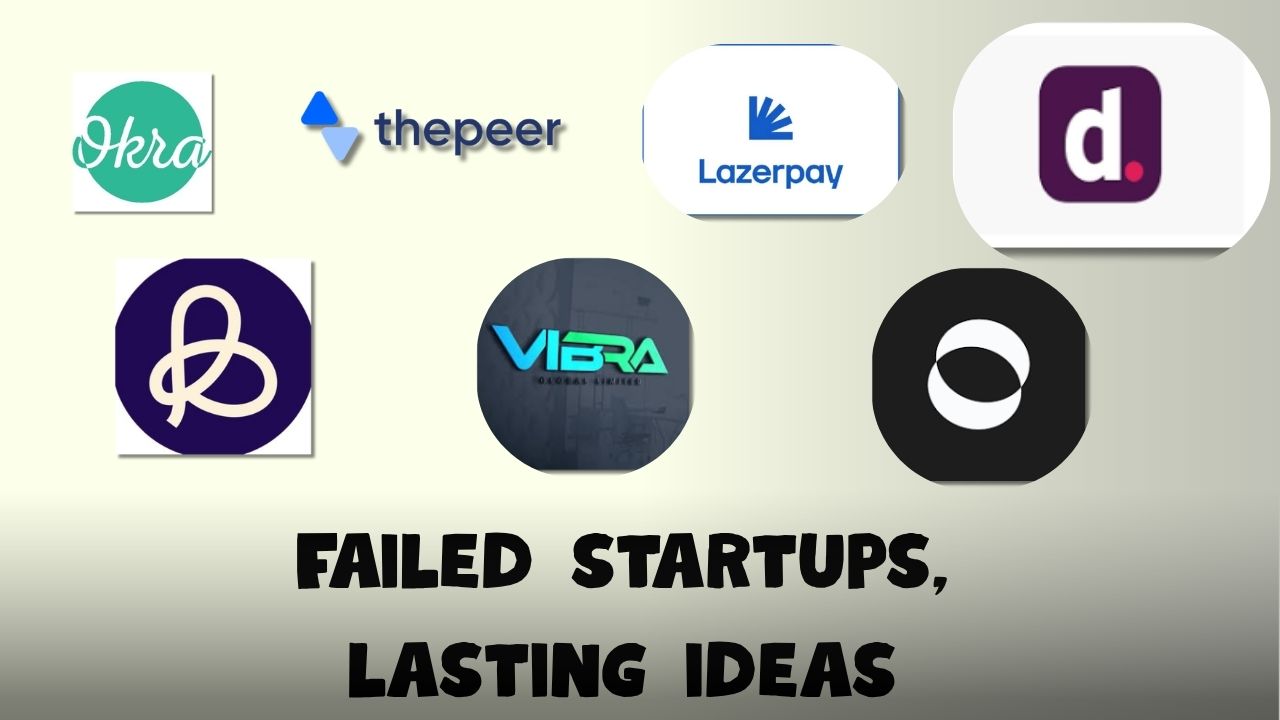
Fintech has been one of Africa’s most heavily funded sectors over the past decade, driven by the rapid rise of mobile money, digital payments, and investor interest in financial infrastructure.
Yet behind the success stories sits a growing list of well-funded startups that have shut down.
Between 2023 and 2025, several African fintech companies collapsed despite strong early momentum.
While the reasons vary, from regulatory pressure and currency volatility to weak monetisation and scaling challenges many of the ideas behind them still remain relevant today.
This Part 1 focuses on fintech infrastructure startups that attempted to build the foundational systems of African finance: APIs, wallets, crypto rails, and interoperability layers.

Each case highlights not only what failed, but what can still be rebuilt differently.
Okra (Nigeria)
Founded: 2019 | Closed: 2025 | Raised: $16.5M
Founders: Fara Ashiru Jituboh, David Peterside
Business model:
Open banking API infrastructure allowing secure connection between bank accounts and third-party financial apps.
Why it failed:
Okra struggled with high operational costs because its infrastructure expenses were largely USD-denominated, while revenue was earned in naira. As the naira weakened, costs rose sharply. In addition, API monetisation grew slower than expected, and a pivot into local cloud infrastructure (Nebula) failed to achieve meaningful adoption.
Idea worth rebuilding:
Open banking remains a strong opportunity in Africa, but future models must prioritise local currency resilience, lower infrastructure costs, and deeper enterprise integration beyond simple API access.
Thepeer (Nigeria)
Founded: 2021 | Closed: 2024 | Raised: $2.3M
Founders: Kosisochukwu Chike Ononye, Micheal Okoh
Business model:
Wallet interoperability API enabling seamless transfers between different fintech wallets and neobanks.

Why it failed:
Thepeer faced integration barriers with wallet providers, slow digital wallet adoption across users, and regulatory uncertainty around wallet-based transfers. These challenges limited network effects, which were essential for its model to scale.
Idea worth rebuilding:
Wallet interoperability is still an unsolved problem in African fintech, but success depends on regulatory alignment and ecosystem partnerships, not just API infrastructure.
Lazerpay (Nigeria)
Founded: 2021 | Closed: 2023 | Raise: $1.1M
Founders: Njoku Emmanuel, Abdulfatai Suleiman, Prosper Ubi
Business model:
Crypto payment gateway allowing businesses to accept cryptocurrency through APIs, checkout links, and plugins.
Why it failed:
After the 2022 crypto market downturn, transaction volumes dropped significantly. Combined with unstable funding and regulatory uncertainty in Nigeria’s crypto space, merchant adoption slowed to unsustainable levels.
Idea worth rebuilding:
Crypto payment infrastructure still has long-term potential in Africa, especially for cross-border settlement, but it must move beyond retail merchant adoption into backend financial rails.
BuyCoins Pro (Nigeria)
Founded: 2017 | Closed: 2024 | $1.2M
Founders: Timi Ajiboye, Ire Aderinokun, Tomiwa Lasebikan
Business model:
Retail cryptocurrency exchange for buying, selling, and holding digital assets.
Why it failed:
The global crypto crash in 2022 led to a sharp decline in trading activity. At the same time, regulatory uncertainty in Nigeria reduced liquidity and made it harder to sustain operations.
Idea worth rebuilding:
Retail crypto trading is highly cyclical, but institutional crypto infrastructure, payments, custody, and cross-border settlement, remains a more stable long-term opportunity.

Bundle Africa (Nigeria)
Founded: 2019 | Closed: 2023 | Raise: $450K
Founder: Yele Bademosi
Business model:
Crypto savings, trading, and peer-to-peer wallet platform enabling users to store and transact in digital assets.
Why it failed:
The prolonged crypto downturn reduced user engagement and trading activity. Strategic restructuring also led to the shutdown of its core crypto products as the company pivoted away from its original model.
Idea worth rebuilding:
Crypto adoption in Africa is more sustainable when positioned as savings and currency protection, rather than speculative trading platforms.
Vibra (Nigeria)
Founded: 2021 | Closed: 2023 | Raised: $6M
Founders: Vincent Li, Allen Ng
Business model:
Peer-to-peer crypto trading platform combined with education-driven onboarding to increase adoption across African markets.
Why it failed:
Despite strong early funding, Vibra struggled to achieve product-market fit across multiple African countries. User acquisition costs remained high, and scaling adoption beyond early users proved difficult.
Idea worth rebuilding:
Financial education is critical for fintech adoption, but it must be separated from high-risk financial products to improve trust and regulatory acceptance.
Dash (Ghana)
Founded: 2019 | Closed: 2023 | Raised: $86.1M
Founder: Prince Boakye Boampong
Business model:
Mobile money interoperability platform connecting bank accounts and mobile wallets across multiple African countries.
Why it failed:
Dash faced regulatory licensing issues in key markets, alongside internal inconsistencies in reported user and transaction metrics. These challenges ultimately led to suspension of operations and shutdown.
Idea worth rebuilding:
Mobile money fragmentation remains one of Africa’s biggest fintech challenges, but solving it requires regulatory cooperation between markets, not just technical integration layers.
KEY INSIGHT

Across these infrastructure-focused fintech startups, a clear pattern emerges.
Most of the ideas were not fundamentally flawed, they were early, complex, and dependent on systems (regulation, currency stability, adoption maturity) that were not fully ready.
High infrastructure costs, fragmented financial systems, and slow ecosystem alignment shaped their outcomes more than product quality alone.
Part 2 shifts focus to the consumer and SME-facing fintech startups built on top of these systems and why many of them failed under real-world market pressure.