Earth's Secrets (Part 3): The Eye of the Sahara — Africa’s Great Geological Mystery
Hidden in the sands of Mauritania, the Eye of the Sahara is a 50-km-wide spiral so massive it can only be seen from space. Is it nature’s fingerprint—or the lost city of Atlantis?
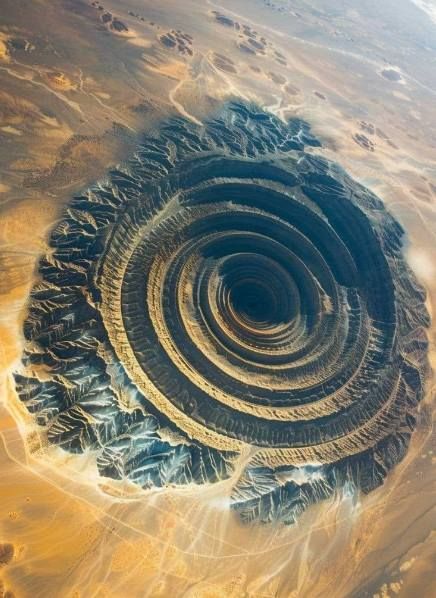
In the middle of the vast, wind-scoured wilderness of Mauritania, deep within the western reaches of the Sahara Desert, lies one of the Earth’s most enigmatic geological formations — a colossal spiral carved into the planet’s crust, so perfectly circular and massive that it remained unnoticed from ground level for centuries.
It wasn’t until humans left the surface of the Earth and looked down from the heavens that its true shape became visible. Orbiting astronauts, peering out of spacecraft windows during early Gemini and Apollo missions, first spotted what appeared to be a gigantic eye — an immense, swirling formation embedded in the desert floor, gazing up at them.
This hauntingly symmetrical formation is now known as the Richat Structure, more famously dubbed the Eye of the Sahara. Measuring between 40 and 50 kilometers across (roughly 25 to 30 miles), it is visible from space without the need for magnification.
From orbit, the surrounding terrain fades into monotony, but the Eye stands out with its concentric rings — layer after layer of Earth’s skin peeled back in a mesmerizing bullseye.
For decades, the Eye has sparked curiosity, confusion, and controversy. Its mystery lies not just in its form but in its origins, its age, and its seeming contradiction with its surroundings.
Why is this perfect spiral here, in the heart of the Sahara? What forces could have created such a shape on such a scale? And why is it still so little known to the world outside of astronauts, geologists, and YouTube conspiracy theorists?
A Geological Enigma Born from Deep Time
For a long time, the Eye of the Sahara remained a cartographic anomaly. Early maps marked it vaguely; local nomads knew of the rocky outcrop but saw it as no different from the countless other sandstone ridges dotting the desert. It wasn't until space travel offered a bird’s-eye view of Earth that the formation’s shape truly stunned observers.
At first glance, the Richat Structure looks like the result of a meteor impact. Its circular shape, sheer size, and position in the barren desert gave rise to speculation that it might be a massive impact crater. This theory seemed plausible — many other circular depressions on Earth, such as the Chicxulub crater in Mexico (believed to have killed the dinosaurs), were formed this way.
But when geologists studied the Richat Structure in detail, they found no evidence of impact: no melted rock, high-pressure quartz, or shocked minerals. There were no traces of meteoritic material, and the ground lacked the deformation patterns typical of impact sites. The crater theory was ruled out.
Another theory proposed that the Eye was the caldera of an extinct volcano. Circular landforms are sometimes produced when a volcano collapses after a massive eruption. However, geologists found no volcanic rock or ash, and the subsurface geology didn't match that of a volcano.
Eventually, a scientific consensus emerged: the Eye is a deeply eroded geological dome — a symmetrical anticline where sedimentary rock layers, some more than 500 million years old, were uplifted and later eroded over time. These forces may relate to the rifting of the ancient supercontinent Pangaea.
Over millions of years, softer layers like limestone and sandstone wore away faster than harder quartzite, creating the concentric rings we see today. Each ring reflects a different geological era, including the Precambrian — making the site a natural archive of Earth’s deep history. It offers a window into the planet’s ancient past.
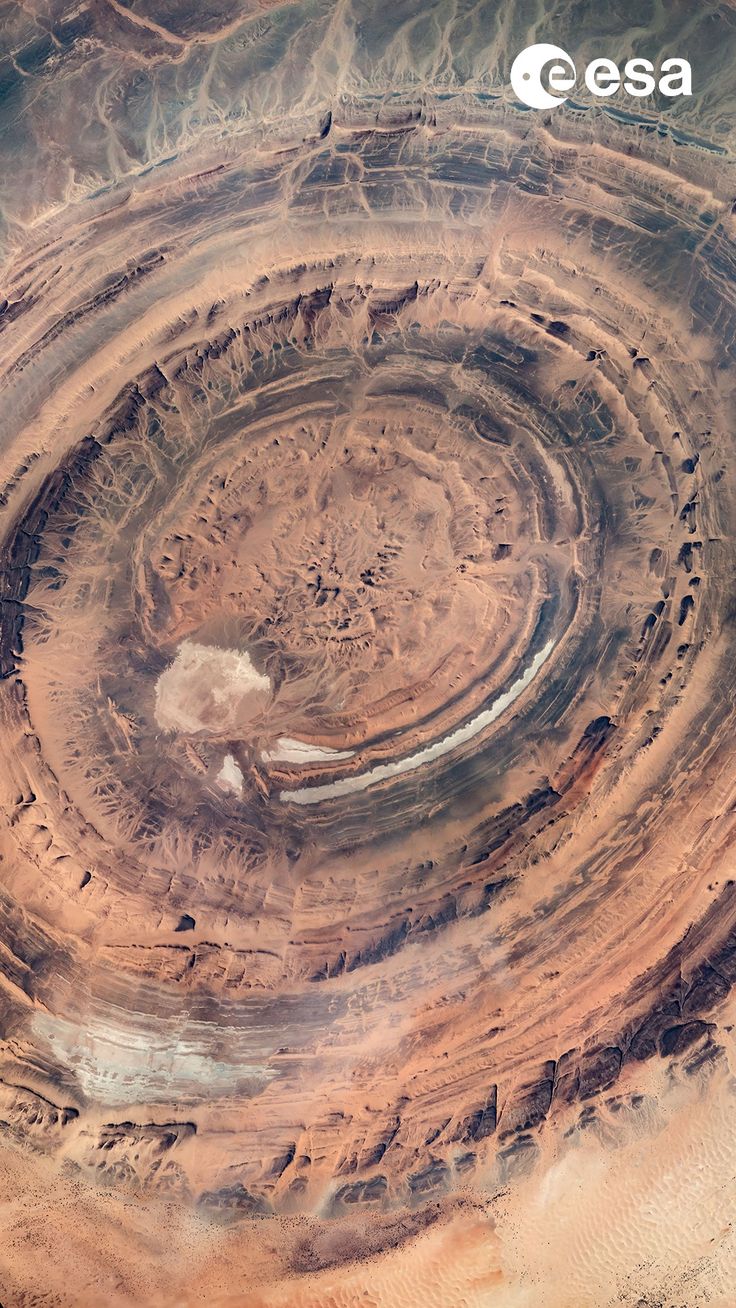
The Eye’s Anatomy
History
Rewind the Stories that Made Africa, Africa
A Journey Through Time, Narrated with Insight.
At its center, the structure contains igneous rocks such as rhyolites and gabbros — evidence of hydrothermal activity. This suggests that superheated fluids once moved through the area, chemically altering nearby rocks.
The rings vary in color, elevation, and texture — some smooth and gray, others jagged and red — depending on mineral content. The symmetry comes from uniform erosion, acting equally in all directions. It’s a rare, naturally occurring masterpiece.
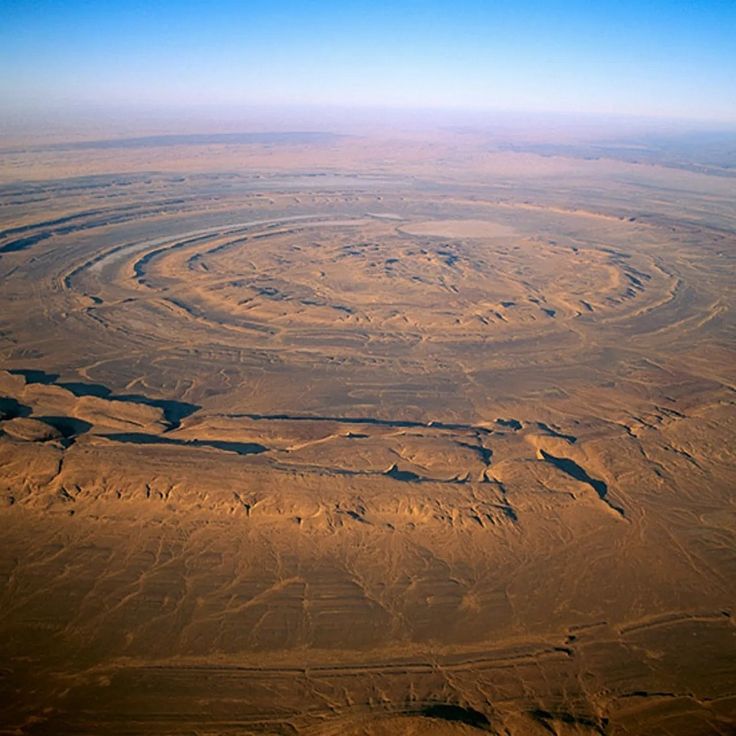
What makes the Richat Structure so compelling is the contrast between its orderly geometry and the chaotic terrain of the surrounding Sahara. In a desert of dunes and dry valleys, the Eye looks like intentional design — a spiral of order carved by time.
The Atlantis Theory and the Rise of the Internet Mystique
With its perfect rings, remote location, and mysterious origins, it wasn’t long before the Eye was linked to the legend of Atlantis.

The Greek philosopher Plato described Atlantis as a powerful civilization “beyond the Pillars of Hercules” with concentric rings of water and land, centered around an island — and said it was destroyed in a single day.
Modern theorists argue that the Eye’s structure, location, and river patterns align with this description. YouTube documentaries and alternative historians have popularized the idea that this could be the true site of Atlantis.
However, mainstream science disagrees. There is no archaeological evidence — no pottery, no buildings, no signs of civilization. Most scholars view Plato’s Atlantis as mythological allegory, not a literal place. Still, the theory has rekindled global fascination with the Eye.
The Eye and Space Exploration
The Eye has become a favorite landmark for astronauts, often mentioned in ISS mission logs. From above, the Eye looks like a cosmic fingerprint stamped into the Earth.
Its visibility from space, combined with its unusual shape, makes it ideal for geological comparison. The Eye is studied as an analogue for Martian landforms, helping scientists understand erosion and crustal uplift on Mars.
An Untapped Tourism Frontier
Despite its magnitude and mystery, the Eye remains largely untouched by tourism. The nearest town, Ouadane, lies over 40 kilometers away, and the area lacks roads, hotels, or signage.
Reaching the site requires 4x4 vehicles, local guides, and a willingness to rough it. For now, it’s mostly visited by geologists, explorers, and a few adventurous travelers.
Still, some believe the Eye could become a centerpiece of Mauritania’s tourism industry, as interest in African heritage sites grows. Challenges remain, including concerns about preservation, accessibility, and environmental impact.
History
Rewind the Stories that Made Africa, Africa
A Journey Through Time, Narrated with Insight.
The Eye as a Time Machine
More than a curiosity, the Eye is a monument to deep time. It reflects Earth’s tectonic movements, ancient climates, and eras long before humans existed.
Its rings are like pages in a geological book — telling stories of oceans that vanished, continents that split, and forces we still struggle to fully understand.
In a world where everything seems mapped and measured, this giant, swirling eye reminds us that some mysteries still lie in plain sight — ancient, quiet, and watching us from below, just as we once watched it from above.