A UK Company Wants to Build an AI Data Centre Using 50,000 Lamp Posts in Nigeria
Conflow Power Group has signed a deal with Nigeria’s Katsina State Government to deploy 50,000 solar-powered smart lamp posts that collectively deliver 13.75 petaOPS of computing power without pulling a single watt from the grid. Here is the full story.

SpaceX wants to put data centres in space, and Microsoft tried sinking them underwater. Now a company from Warwickshire in the UK has looked at Nigeria’s lamp posts and decided that is where the next generation of AI computing infrastructure should live.
This sounds like the kind of idea that gets laughed out of a boardroom. It is not. Conflow Power Group has already signed a deal with Nigeria’s Katsina State Government to deploy 50,000 solar-powered smart lamp posts called iLamps across the state.
The agreement is real, the technology exists, and if the full vision holds, it could become the largest distributed AI computing network on the African continent.
Now this is what is actually happening and why it actually means more than it might initially seem.
The Problem With Building a Traditional Data Centre in Nigeria
To understand why lamp posts are even part of this conversation, you need to understand what building a conventional data centre in Nigeria actually involves.
A traditional data centre typically needs 300 megawatts of grid power, millions of litres of cooling water, and years to build.Nigeria’s national grid provided just 5,639 megawatts in 2025 against an installed capacity of 13,625 megawatts, which means the country is running at less than half of what it should theoretically be able to generate.
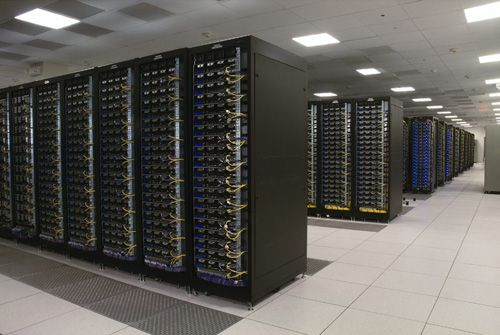
Nigeria currently has a data center capacity of 136.7 megawatts and its data center capacity would have to increase more than six times to match the US level relative to internet usage.
Compared to places like Dubai, where clearances can be issued in 48 hours, setting up a data centre in Nigeria can take months. The approvals required include building permits, environmental permits, electricity connections, and water sanctions, all of which take longer largely due to bureaucratic hurdles.
The result is a country with one of Africa’s most active digital economies and a data infrastructure that is nowhere near keeping pace with it. Out of Nigeria’s active data centres, 10 are located in Lagos, while one operates in Abuja. Lagos dominates the landscape, hosting nearly 70% of Nigeria’s existing and planned capacity. The rest of the country, including the entire north, is largely unserved.
That infrastructure gap is exactly what Conflow Power Group is trying to exploit with a completely different approach.
How 50,000 Lamp Posts Become a Data Centre
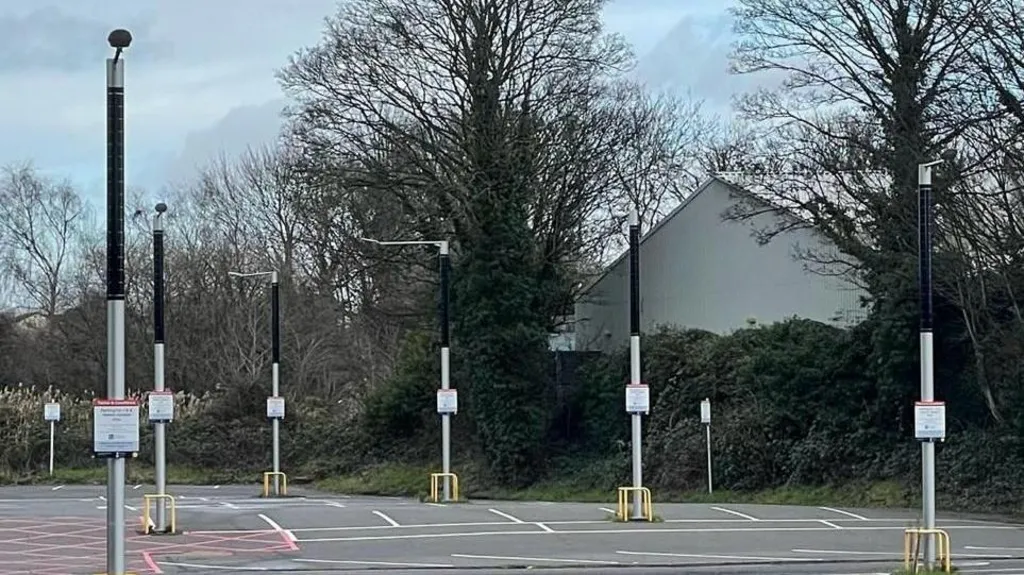
Each iLamp unit runs on a cylindrical solar panel and battery, powering a low-energy Nvidia chip that draws just 15 watts. Networked together, Conflow Power Group says the units would deliver 13.75 petaOPS of combined computing power without pulling a single watt from the grid.
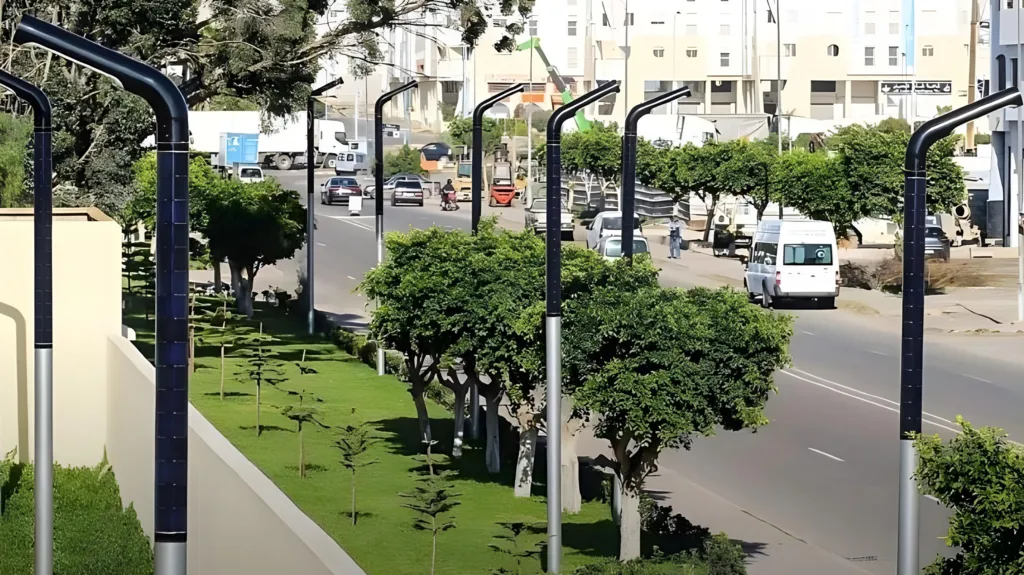
15 watts per unit. No grid dependency. No cooling water. No multi-year construction timeline.No bureaucratic approval process for a single large facility. The entire infrastructure is distributed across 50,000 individual points, each one self-powered by solar energy, each one contributing a small slice of computing capacity to a collective network.
The Katsina deployment is the starting point. If all ongoing negotiations across seven Nigerian states, universities, and institutions are finalised, the total network could exceed 300,000 iLamp units, forming the largest distributed AI computing network on the continent.
Computing collectively at a scale that would be impossible to achieve through conventional means in a country where the grid cannot reliably power the facilities that already exist.
What the iLamp Network Can and Cannot Do
This is where it is worth being honest about what this technology actually is and is not.
Experts say the iLamps will not replace conventional data centres for heavy AI workloads, since the distance between posts makes communication too slow for demanding tasks. But they could serve as useful access points for lighter AI tasks, functioning similarly to mobile phone masts.
So this is not a replacement for the kind of infrastructure that runs large language models or processes complex financial transactions at scale. The latency created by distance between individual units makes it unsuitable for workloads that require tight, high-speed communication between processing nodes.
What it is suitable for is edge computing. Lighter AI tasks. Local data processing that does not need to travel to a centralised facility. The kind of computing that brings services closer to users in areas that conventional data centres have never reached and probably never will reach given the economics involved.

For the 14 states in northern Nigeria that currently have essentially no data centre infrastructure, even a distributed network of low-power computing nodes represents a meaningful step forward.
It is not the same as having a hyperscale facility. But it is considerably better than nothing, and it runs on solar power in a region that gets significant sunshine year-round.
Why Is This Important for Nigeria’s Digital Future?
Nigeria’s data centre market is growing fast regardless of what happens with the iLamp project. The Nigerian data centre market was valued at $322.65 million in 2025 and is forecast to reach $782.82 million by 2031. Global players are already moving. Equinix operates two data centres in Nigeria and plans to build a third, with $22 million invested in the first phase. MTN, Airtel, and Digital Realty are all building or expanding facilities.
But all of that investment is concentrated in Lagos. The economics of conventional data centre construction make it almost impossible to justify building in Katsina, Sokoto, Zamfara, or any of the states in the north where digital infrastructure is most absent and arguably most needed.
The iLamp model does not solve the heavy infrastructure problem. It approaches the access problem from a completely different angle, using distributed solar-powered computing to bring some level of digital infrastructure to places that the traditional investment thesis will never reach.
Whether it works at the scale Conflow Power Group is projecting depends on how the Katsina deployment performs, whether the negotiations across seven states close, and whether the computing capacity delivered actually meets the needs of the communities and institutions it is supposed to serve.
But the underlying logic is sound. Nigeria has a power problem that is not being solved fast enough. It has a data infrastructure gap that is concentrated outside Lagos. And it has abundant solar energy that is currently being underutilised as a computing resource.
Lamp posts are an unconventional answer, but maybe they might also be a practical one.