Why Is the Keyboard Not Arranged in Alphabetical Order?
Why isn’t your keyboard alphabetical? The surprising history of QWERTY reveals how broken machines, clever hacks, and 19th-century design shaped the way billions type today. Learn the shocking truth behind every keystroke.
The first lie most of us were told about intelligence is that order equals logic. Alphabetical order feels natural. It feels fair. It feels like how things should be. Yet every day, billions of people place their fingers on a keyboard that openly defies the alphabet without question.
A, B, C never stood a chance. Instead, we accepted QWERTY as normal, memorized its chaos, and built entire careers around it. The real story of why the keyboard is not alphabetical is not about convenience or design elegance.
It is about machines that kept breaking, decisions made under pressure, and how one workaround quietly shaped modern communication forever.
The Alphabet Was Never the Goal
When early inventors worked on typing machines in the 19th century, they were not trying to make writing easier for humans. Their concern was mechanical survival. The earliest typewriters used metal type bars that swung upward to strike ink onto paper.
Each letter had a physical arm. When two commonly used letters were placed too close together and typed in quick succession, those arms would collide and jam.
Alphabetical layouts made this problem worse.
English has predictable patterns. Letters like T and H or E and R appear together constantly. On an alphabetical keyboard, these letters sat side by side.
The faster a typist became, the more frequently the machine failed. Jams slowed work, damaged equipment, and frustrated users. The problem was not user error. It was structural.
Designers quickly realized that the alphabet was mechanically dangerous.
So the goal shifted. Instead of logical order, inventors prioritized separation. Letters that appeared together in common words were deliberately pushed apart.
This forced typists to slow down just enough to keep the machine functional. The keyboard became less intuitive, but the machine became usable.
In this moment, alphabetical logic lost to mechanical necessity.
How QWERTY Was Engineered to Be Awkward
History
Rewind the Stories that Made Africa, Africa
A Journey Through Time, Narrated with Insight.
Christopher Latham Sholes, one of the key figures behind the modern typewriter, did not accidentally scramble the keyboard. The QWERTY layout was carefully constructed through trial and error. Early prototypes went through multiple revisions as engineers studied which keys caused jams most often.
The solution was counterintuitive. Instead of grouping similar letters, they scattered them.
This is why:
Frequently paired letters were separated
Typing rhythms were intentionally disrupted
Certain keys were harder to reach on purpose
The keyboard was designed to introduce friction.
Contrary to popular myth, QWERTY was not created to slow typists for productivity control. It was created to keep machines from destroying themselves. Speed was sacrificed for reliability. Once this layout proved stable, it gained commercial backing.
In 1873, Remington, a major manufacturer, adopted the QWERTY layout. That decision mattered more than any design principle. Once typewriters entered offices, schools, and newsrooms, muscle memory became currency. Typists trained for months. Businesses standardized equipment. Changing the layout now meant retraining an entire workforce.
The keyboard stopped being a tool and became an institution.
The Moment Alphabetical Keyboards Failed
Alphabetical keyboards did not disappear quietly. They were tested repeatedly. Educators proposed them as beginner friendly alternatives. Early calculators experimented with them. Some teaching devices even used alphabetical layouts for children.
But data did not lie.
Alphabetical keyboards performed poorly in real typing conditions. Studies and practical tests showed that they:
Increased finger travel
Reduced hand alternation
Slowed experienced typists significantly
Increased physical fatigue over time
Typing is not about knowing letters. It is about rhythm, flow, and motor efficiency. Alphabetical order ignores how language actually works. It treats letters as isolated units rather than part of predictable patterns.
In professional environments, alphabetical keyboards simply could not compete.
Once speed, accuracy, and endurance were measured, alphabetical layouts lost every serious test. Efficiency favored layouts designed around language frequency, not childhood learning tools.
Better Systems Existed but Timing Won
By the 1930s, researchers had already identified flaws in QWERTY. The Dvorak Simplified Keyboard was developed using studies of English letter frequency, finger strength, and hand balance. It reduced finger movement dramatically and increased typing comfort.
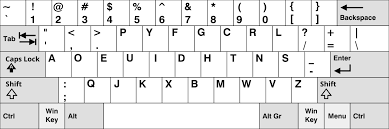
Colemak and other modern layouts followed similar principles decades later.
From a purely scientific perspective, QWERTY is inefficient.

So why did nothing change?
The answer is not ignorance. It is economics.
By the time better layouts appeared:
Millions of typists were already trained
Employers valued compatibility over improvement
Hardware manufacturers avoided fragmentation
Software defaults reinforced QWERTY dominance
Switching layouts required collective action. No single institution could force it globally. The cost of transition outweighed the benefits for most organizations. People adapted to inefficiency because it was familiar.
QWERTY survived not because it was the best, but because it arrived first and scaled fast.
The Keyboard as a Lesson in Technological Inertia
The modern keyboard is a fossil. It carries the imprint of a mechanical problem that no longer exists. Computers do not jam. Touchscreens have no moving parts. Voice input bypasses keys entirely.
Yet the same 19th century layout governs emails, codebases, social media, and global communication.
This persistence reveals something deeper about technology adoption.
Once humans internalize a system, logic becomes secondary. Muscle memory is powerful. Infrastructure resists change. What begins as a workaround can quietly become law.
The keyboard is not alphabetical because efficiency is contextual, not intuitive. It was built for machines before it was refined for humans. And once society synchronized around it, the cost of correction became too high.
Every time your fingers search for letters that should logically sit together but do not, you are touching a decision made to protect fragile metal arms over 150 years ago.
The alphabet lost. History won.
And we kept typing anyway.