The Great Emu War: When Australia Went to War with Birds And Lost
In 1932, Australia declared war on giant birds—and lost. Dive into the hilarious, true story of the Great Emu War and the soldiers who couldn’t stop the flock.
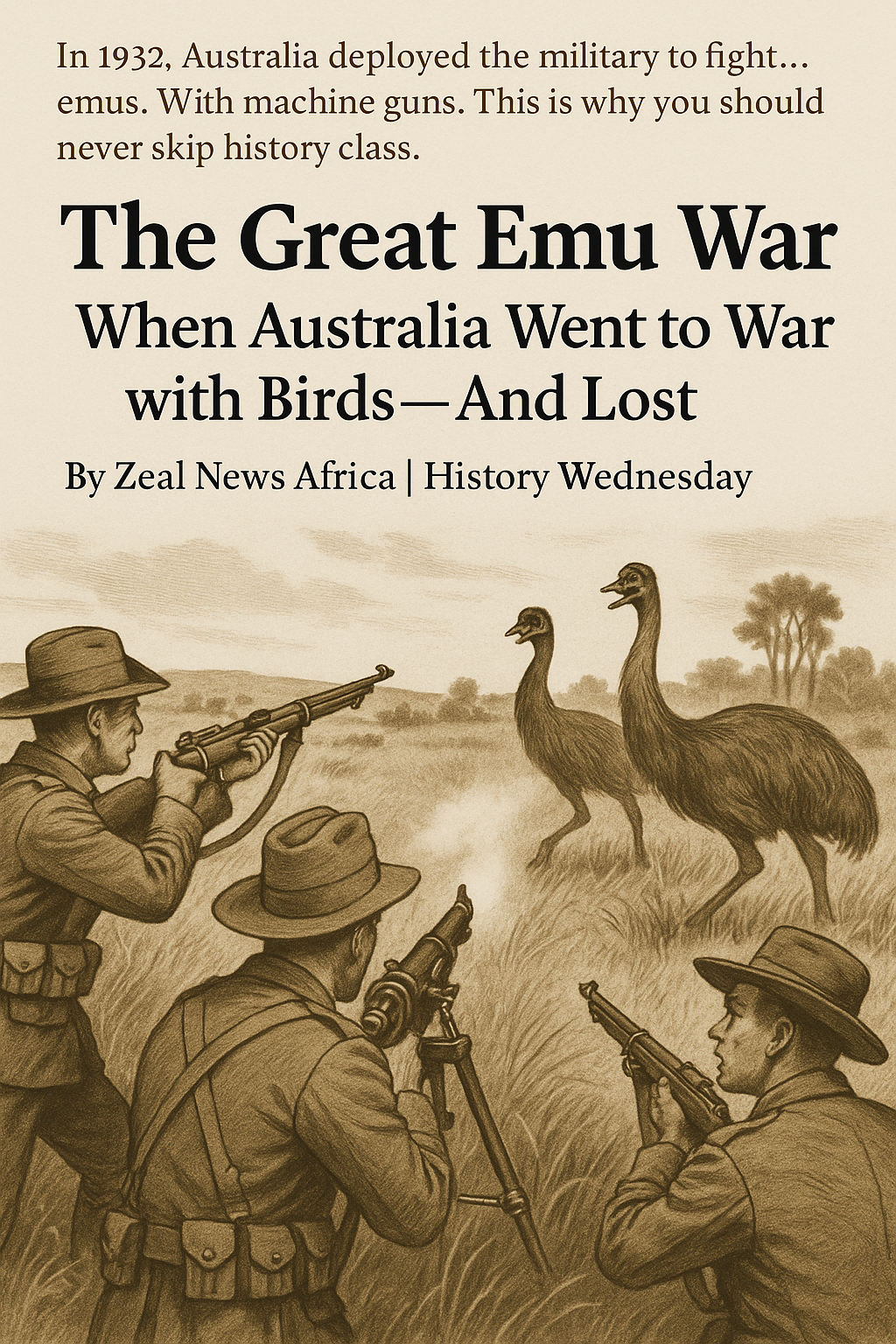
Imagine waking up one morning, throwing on your boots, grabbing your gear, and heading out to battle against... birds. Not just any birds, but towering, flightless emus sprinting across the outback like feathered tanks.
It sounds like the setup to a comedy sketch, but in 1932, this was the reality for a group of Australian soldiers tasked with waging war on a foe that refused to be defeated.
If Monty Python had written military history, the Great Emu War would be chapter one.
In the annals of military history, some wars are remembered for their tragedy. Others, for their triumph. But very few are remembered for their absurdity.
Welcome to one of the most bizarre military engagements in modern history—the Great Emu War of 1932. This was a conflict where the adversary wasn’t a hostile nation or rebel force… but a flock of giant, flightless birds.
Background: A Nation, A Bird, A Problem
The stage was post-World War I Australia. Thousands of veterans had returned home to Western Australia, where the government offered them land to farm as part of a soldier resettlement scheme.
But by the early 1930s, these struggling farmers found themselves battling two major enemies: the Great Depression and... emus.
The emu is a giant among birds, second only to the ostrich in size. Standing tall at about 5 to 6 feet, the average adult emu is roughly the height of a tall human, sometimes reaching over 6 feet.
Despite their impressive height, emus are flightless, with tiny wings that serve little purpose. What they lack in flight, though, they make up for in speed.

With powerful legs, emus can sprint up to 50 kilometers per hour, making them one of the fastest running birds on land.
They typically weigh between 30 to 45 kilograms, about the size of a large dog, and are known for their curious nature and surprising ability to swim.
History
Rewind the Stories that Made Africa, Africa
A Journey Through Time, Narrated with Insight.
Tall, swift, and endlessly fascinating, the emu truly commands attention in the wild.
After the great depression, the market collapsed. This caused a great drought and led to an unusually large migration of the birds, and the wheat field was directly in their path.
There is a warning not to feed birds, and this was exactly what happened. Once they found the large field of wheat and water reservoirs, there was no reason to keep moving.
Each year, during the birds’ migration from inland areas to the coast, tens of thousands of emus would sweep through farmland in Western Australia, trampling crops, knocking down fences, and causing mayhem in their wake.
Many farmers were already facing severe financial losses due to the great depression, and with the emus on their farms, it was worse. So they decided to get rid of them.

The Emus have, however, been prepared for years since they emerged during the time of massive carnivores like the 7-foot Megalania, Jaguar-sized Thylacoleo, also known as the Mursupal lion, Quinkana, a crocodile with a komodo dragon’s speed, and the Wonambi, a constrictor snake larger than the modern-sized Anaconda.

So, not only did the Emus survive, they thrived. For ex-soldiers trying to survive on marginal land, the emus became public enemy number one.
Calling in the Troops
Frustrated by the lack of government help, farmers demanded assistance from the federal government. Enter Sir George Pearce, then Minister of Defence, who—perhaps jokingly—authorized the deployment of soldiers armed with machine guns to deal with the birds.
Yes, really.
In November 1932, a small military force was dispatched to the Campion district, consisting of:
Major G.P.W. Meredith of the Royal Australian Artillery
Two soldiers
10,000 rounds of ammunition
The mission? Eliminate the emu threat.
The First Assault (and Immediate Failure)
The "war" officially began on November 2, 1932. At first, the soldiers tried ambushing a group of about 50 emus near Campion. But the birds, fast and agile despite their size, scattered in all directions. Only a few were taken down before the gun jammed.
They soon discovered that emus are surprisingly tactical. They traveled in small groups led by "scout" birds who would alert the others to danger. Major Meredith even observed:
“If we had a military division with the bullet-carrying capacity of these birds, it would face any army in the world.” — Major G.P.W. Meredith
Over the next few days, attempts were made to mount the machine guns on trucks. That failed too—the vehicles couldn’t keep up with the emus, and the bumpy terrain made aiming impossible.
Casualties and Chaos
Within the first week, the results were embarrassing. According to official estimates, 2,500 rounds of ammunition were fired, and only about 200 emus were killed.
That’s a 12.5 rounds-per-bird kill ratio. And the emus? They just kept coming. Thousands more continued to sweep across the region, undeterred by the army's presence.
Public and Political Backlash
The press caught wind of the operation and mocked it mercilessly. Newspapers worldwide ran headlines like: “Emus Defeat Machine Gunners” and “Australian Army Loses War Against Birds”

Even the Australian Parliament questioned the logic behind using military resources for bird control. One senator joked that perhaps medals should be awarded to the emus for bravery. By mid-November, after several failed ambushes and heaps of public ridicule, the government ordered the withdrawal of the troops.
But Wait… They Came Back
Farmers, however, weren’t amused. Their crops were still being destroyed, and the emus were thriving. So just days later, the military returned for Round Two of the Emu War.
History
Rewind the Stories that Made Africa, Africa
A Journey Through Time, Narrated with Insight.
This second campaign, running from November 13 to December 10, was slightly more effective, with about 986 confirmed kills and another 2,500 wounded, likely dying later, with over 9,800 bullets used.
That’s still more than 10 bullets per confirmed kill. Major Meredith again commented on the birds' ability to take bullets and keep running, saying they were like “Zulus… they can face machine guns with invulnerability.”
The End of the Emu War
By early December 1932, the operation was called off permanently. The Australian military hadlost its strange war against a bird. And the emus? They returned to their usual migration, leaving behind ruined fields and a battered military reputation.
In the end, the Emu War was declared a failure. No emu population was significantly reduced. The only winners were the birds.

Aftermath: From Guns to Fences
After the fiasco, the Australian government refused to deploy soldiers again. Instead, they offered bounties for emu kills and eventually invested in rabbit-proof fencing to help keep emus out of farmland.
Later technological and environmental efforts would control the emu issue far more effectively, and without making the government look ridiculous in the process.
What Makes the Emu War So Fascinating?
The Emu War is often cited in popular culture, documentaries, and memes as a perfect example of bureaucratic absurdity. But beneath the humor lies a real historical lesson:
It highlights the struggles of post-war resettlement in Australia
It exposes the gaps in rural support systems during economic depression
Ultimately, the Emu War is a case study in:
Human overconfidence
The unpredictability of nature
And how sometimes, no matter your weapons or strategy, you just can’t beat birds with brains.
And it serves as a humbling reminder that nature doesn’t always yield to bullets
It also birthed a new genre of “quirky war history,” where battles weren’t always fought between armies, but sometimes between humans and the environments they tried to control.
Final Thoughts
The Great Emu War remains one of history’s most surreal military episodes. While it didn’t claim many human lives or shift global politics, it endures because it’s so utterly, wonderfully absurd. In a time when governments were grappling with economic collapse, Australia’s declaration of war on birds—and subsequent defeat—reminds us just how strange history can get.
So the next time you think you’re having a rough week, just remember: at least you didn’t lose a war to emus.