Why Can’t Nigerian Women Give Foreign Husbands the Citizenship Route Men Can?
A Nigerian man’s foreign wife can apply for citizenship through marriage, but a Nigerian woman’s foreign husband cannot. Here is what the law says and what could change.
Take two couples, for example.
Tunde is Nigerian, he marries Mei, who is Chinese.
Amaka is also Nigerian, she marries Daniel, who is British.
Both marriages are legal, and both Nigerians love their country equally.
But when it comes to Nigerian citizenship, only one of the foreign spouses has a door to knock on.
Mei can apply to become a Nigerian citizen because she married a Nigerian man. Daniel cannot use that same route because he married a Nigerian woman.
What the Constitution Actually Says

Section 26 of the 1999 Constitution deals with citizenship by registration. Section 26(2)(a) says it applies to “any woman who is or has been married to a citizen of Nigeria.”
Look at the word it uses: woman. It does not say spouse or person. So Mei qualifies for this route. Daniel, being a man, does not.
Does Marriage Make Mei a Citizen Automatically?
Marriage only gives Mei the right to apply. Under Section 26(1), the President must be satisfied that she is of good character, that she clearly intends to live in Nigeria, and that she has taken the Oath of Allegiance. If the President is not satisfied, she does not get citizenship.
So Tunde cannot simply marry a foreign woman and hand her a Nigerian passport, but the marriage has given her the privilege to qualify for citizenship.
So What Can Daniel Do?
Daniel is not locked out of Nigeria for good, he has two other options.
The first is naturalisation under Section 27, which is open to qualifying foreigners generally. It is much more demanding.
He must be an adult of good character, show that he intends to live in Nigeria, be accepted by the local community where he plans to settle, show that he has made or can make a useful contribution to Nigeria, and take the Oath of Allegiance.
He must also meet a residence requirement.
Either he has lived in Nigeria continuously for 15 years before applying, or he has lived there continuously for the 12 months before applying and has spent at least 15 years in Nigeria in total during the 20 years before that.
In plain terms, that is the best part of a decade and a half of life in the country.
The second is permanent residence.

Section 37(11) of the Immigration Act 2015 allows the Nigeria Immigration Service to issue permanent residence visas to foreign nationals married to Nigerians. Amaka can support Daniel’s application. This lets him live in Nigeria long term without becoming a citizen.

Is Anyone Trying to Change This?
Yes, and not for the first time.
In October 2024, the Speaker of the House of Representatives, Tajudeen Abbas, publicly called for equal citizenship rights for foreigners married to Nigerian women. In March 2025, a bill sponsored by Akin Alabi passed its second reading in the House.
It proposes to replace the word “woman” in Section 26(2)(a) with “person”, which would make the rule apply to husbands and wives alike.
The idea has also been tried before. Reports indicate that a similar amendment was put to a vote in the National Assembly in 2022 and did not succeed in the House of Representatives.
Why Hasn’t It Become Law?
Because passing a second reading is only an early step. A constitutional amendment needs the support of two-thirds of the members of both the Senate and the House of Representatives. It then needs the approval of at least two-thirds of the State Houses of Assembly. Only after that can it take effect.
People who want the change argue that Section 42 of the Constitution protects citizens from discrimination on grounds of sex, and that the current rule treats Nigerian women as having less to offer their spouses than Nigerian men. Others in the debate, according to reports, say citizenship should be guarded closely. So far, the Section 26 wording has not been changed.
If you hear that “a bill has passed second reading”, remember that it is not yet law. The wording of Section 26 stays as it is until the whole process is complete.
What Happened When Lawmakers Voted
The closest this idea has come to being decided was on March 1, 2022.
That day, lawmakers voted on a package of constitutional changes, and one of them would have opened Section 26 to foreign husbands. In the House of Representatives, reports put the result at135 votes for and 143 against.
A constitutional amendment needs two-thirds of the vote, so it fell far short. It did not even win a simple majority.
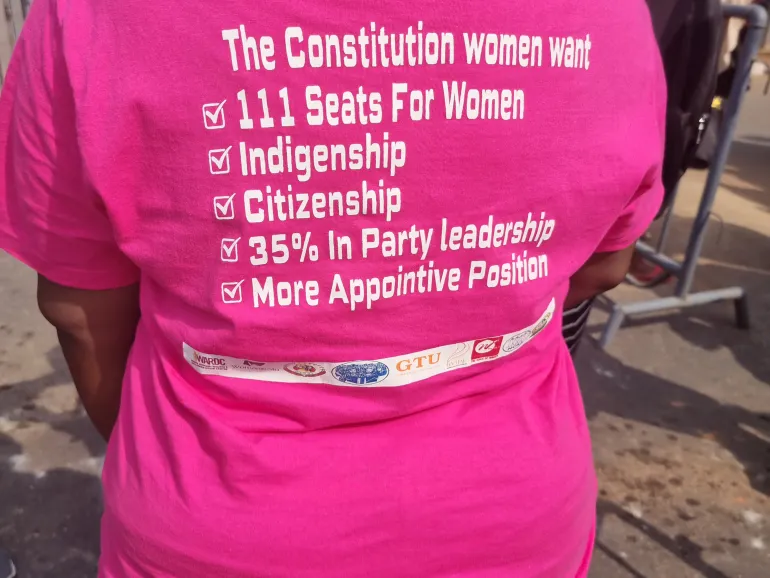
Caption: A Nigerian woman protests outside the Nigerian parliament [File: Chioma Agwuegbo, TechHerNG]
The reaction was quick as women’s groups protested at the National Assembly in the days that followed.
On March 8, International Women’s Day,the House said it would reconsider three of the rejected women-related bills, including this one. The wording of Section 26 has not changed since.
What do supporters say? They argue that the rule is discriminatory. A Nigerian woman is as much a citizen as a Nigerian man, they say, and Section 42 of the Constitution bars discrimination on grounds of sex. When the House took up the bill in February 2022, the lead debate document described the exclusion as insulting to Nigerian women.
What do opponents say? The honest answer is that the public record is thin. Reports say that lawmakers who rejected the gender bills that day cited socio-cultural and Islamic concerns, although those reasons were tied to the package as a whole and not to this proposal alone. Other lawmakers, according to reports,felt that citizenship should be guarded closely.
Is Nigeria the Only Country Like This?
No, but it is not where the continent is heading either.
A 2018 report by the Global Campaign for Equal Nationality Rights found that roughly 40 percent of African countries denied women the right to pass their nationality to a foreign spouse on equal terms with men.
Several countries have since changed course. Senegal amended its law in 2013, Niger followed in 2014, Lesotho reformed in 2018 and Guinea in 2019. The same campaign lists Algeria, Botswana and Kenya among the countries where women and men can pass nationality to their spouses and children equally.
Researchers who looked at the issue in Kenya, before its reform, recorded what the gap meant for families. When Kenyan women could not pass their nationality to husbands who had none, the whole household felt it, with poverty from lost job opportunities among the effects.
So the comparison cuts both ways.
Nigeria is not alone, but change has already happened in other African countries, which shows it is possible.