9 Countries Where It Is Illegal to Carry a Baby for Someone Else
Would you carry a baby for your sister or a stranger? In these nine countries, surrogacy is prohibited, with some laws carrying prison sentences and hefty fines.

Out of the kindness of your heart, you agree to carry your sister's baby because she cannot get pregnant herself, or perhaps a stranger offers you a huge amount of money to carry their child, and you decide it is an opportunity worth considering.
Whatever your reason, you might want to check the laws of the country you live in before making that decision.
The practice, known as surrogacy, involves a woman agreeing to carry and give birth to a child for another person or couple, who intend to raise the child as their own.
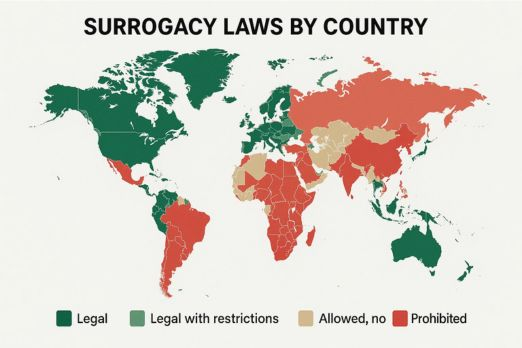
In some parts of the world, carrying a baby for someone else is prohibited, even when both parties agree to the arrangement.
Governments have different concerns about the practice.
Some fear that it could turn pregnancy into a business in which financially vulnerable women are exploited. Others are concerned about who should be recognised as a child's legal mother, what happens when the parties disagree, and whether a child can simply be handed over under a private agreement.
As a result, several countries have introduced laws prohibiting surrogacy or the medical procedures used to facilitate it.
1. Morocco
Morocco is one of the African countries where agreeing to carry a baby for another person can have serious legal consequences. The country expressly prohibits surrogacy under Law No. 47-14 of 2019, which regulates medically assisted reproduction.
Article 5 prohibits the use of human reproductive functions for another person's benefit or for commercial purposes, specifically including surrogacy. The restriction therefore covers arrangements that go beyond simply paying a woman to carry a pregnancy.
The consequences are particularly severe. Article 40 provides for imprisonment of 10 to 20 years and a fine of between 500,000 and one million Moroccan dirhams for carrying out practices prohibited under Articles 4, 5 and 7.
The law reflects the country's opposition to treating human reproductive functions as something that can be used or commercialised for another person's benefit.
So, even if a woman volunteers to carry a pregnancy for someone she loves, the fact that no money changes hands does not make the arrangement legal.
2. Italy
In Italy, even if you travel abroad to arrange surrogacy in a country where it is permitted, you could still face prosecution if they are an Italian citizen.
Italy prohibited surrogacy under Law No. 40 of 2004, which regulates medically assisted reproduction.
Under Article 12, anyone who carries out, organises or advertises surrogacy can face imprisonment of three months to two years and a fine of between €600,000 and €1 million.
The law became even more controversial in November 2024, when Italy passed Law No. 169, extending the prohibition to qualifying surrogacy-related conduct committed abroad by Italian citizens.
The government defended its restrictive position partly on the grounds of protecting the dignity of women and preventing the treatment of pregnancy as a commercial transaction.
It also considers surrogacy incompatible with its approach to adoption and the establishment of parenthood.
This means that an Italian citizen cannot simply avoid the country's prohibition by travelling to a destination where surrogacy is legal.

3. Germany
Germany takes a different approach by placing much of the legal responsibility on the medical professionals who facilitate surrogacy.
Under Section 1(1)(7) of the country's Embryo Protection Act, doctors are prohibited from transferring an embryo to a woman who intends to surrender the child permanently to another person after birth.
Medical professionals who violate this provision can face imprisonment of up to three years or a fine.
Germany also restricts surrogacy arrangements through its adoption placement legislation.
The reasoning is closely connected to the country's approach to parenthood and assisted reproduction. Its legal framework does not allow doctors to facilitate a process in which a woman is deliberately made pregnant with the intention that someone else will take over as the child's parent.
Interestingly, the relevant criminal provision targets the medical professionals involved, rather than automatically making the surrogate mother or intended parents criminals.
4. France
In France, even if a woman agrees to carry a baby for her sister without receiving a single payment, the agreement will not be legally recognised.
The country has prohibited surrogacy agreements since 1994. Article 16-7 of its Civil Code declares any agreement concerning the procreation or gestation of a child on behalf of another person null and void.
The restriction is connected to France's legal principles concerning the human body and human dignity. Its position is that pregnancy and childbirth should not become the subject of an enforceable agreement between individuals.
This means that a woman cannot legally sign a contract promising to carry a child and hand the baby over to another person after birth. The prohibition applies whether the arrangement is commercial or entirely voluntary.
5. Spain
Spain also refuses to recognise agreements in which a woman agrees to give birth to a child and surrender her maternal rights to another person.
Article 10 of Law 14/2006 on Assisted Human Reproduction Techniques declares surrogacy agreements null and void, whether the arrangement involves payment or not.
The law also establishes that the woman who gives birth is legally recognised as the child's mother, regardless of what she agreed to before the pregnancy.
This is particularly important because it means that intended parents cannot simply rely on a private surrogacy agreement to establish legal parenthood.
Even if the woman was carrying an embryo created using another woman's egg, the woman who gives birth is recognised as the mother under Spanish law.
Spain's position is therefore strongly connected to its legal understanding of maternity and the rights attached to childbirth.

6. Bulgaria
Bulgaria is another European country where surrogacy is expressly prohibited under its assisted reproduction regulations.
Paragraph 5.14 of Section IV of the Annex to Ordinance No. 28 on Assisted Reproduction, adopted in 2007, prohibits surrogacy.
The country's restrictions also reflect concerns about the surrender and transfer of children for financial gain. Articles 182a and 182b of its Penal Code address activities such as improperly arranging the surrender of children for adoption, mediating between prospective adopters and parents, and selling children.
These provisions should not be confused with a blanket criminal penalty for every woman who agrees to carry a pregnancy for another person.
Rather, they form part of Bulgaria's wider legal framework against the improper transfer and commercialisation of children.
The country's position is that assisted reproduction should not be used to create arrangements that circumvent its rules on parenthood and adoption.
7. Croatia
In Croatia, the law goes beyond simply refusing to recognise surrogacy contracts. It also prohibits people from advertising or offering to carry babies for others.
Article 31 of the country's Law on Medically Assisted Reproduction prohibits anyone from publicly advertising or otherwise seeking or offering the service of giving birth to a child for another person.
It also prohibits arranging or carrying out medically assisted fertilisation for the purpose of producing a child for someone else and handing the baby over after birth.
The restriction applies whether the woman receives payment or agrees to do it for free. Any contracts or agreements made for such arrangements are legally void.
This means that even a woman who wants to help a close friend or family member have a child cannot legally use Croatia's regulated assisted reproduction system to do so.
8. Lithuania
Lithuania also prohibits women from carrying pregnancies as surrogates, with its restrictions contained in Article 11 of its Law on Assisted Reproduction.
The country's reproductive framework does not permit the transfer of an embryo to a woman who intends to carry the pregnancy for another person.
One important aspect of Lithuania's position is its approach to legal motherhood. The woman who gives birth is recognised as the child's mother, even where the pregnancy involved an egg donated by another woman.
This makes it difficult to separate the act of giving birth from the legal responsibilities of motherhood in the way surrogacy arrangements generally require.
The country does allow a woman to give up a child for adoption after birth, but that is a separate legal process and cannot be arranged in advance through a surrogacy agreement.

9. Slovenia
Slovenia also makes it impossible for women to use its regulated fertility treatment system to become surrogate mothers.
Under Article 7 of its Act on Infertility Treatment and Biomedical Assisted Fertilisation Procedures, a woman who intends to act as a surrogate is not eligible for assisted reproductive technology.
In other words, even if a woman volunteers to carry a pregnancy for another person, she cannot legally access the country's regulated assisted reproduction procedures for that purpose.
The restriction is part of Slovenia's regulation of infertility treatment and assisted reproduction, which determines who can access these procedures and under what conditions.
Unlike Italy, which has introduced penalties that can extend to certain arrangements abroad, Slovenia's approach focuses on restricting access to the medical procedures needed to facilitate surrogacy.