OPINION: “Women Who Know Their Worth Don’t Last in Marriage” — Maybe That's not a Problem
A bold opinion on why self-aware women are often labeled as incompatible with marriage, and why choosing self-worth over endurance is not a problem, but progress.
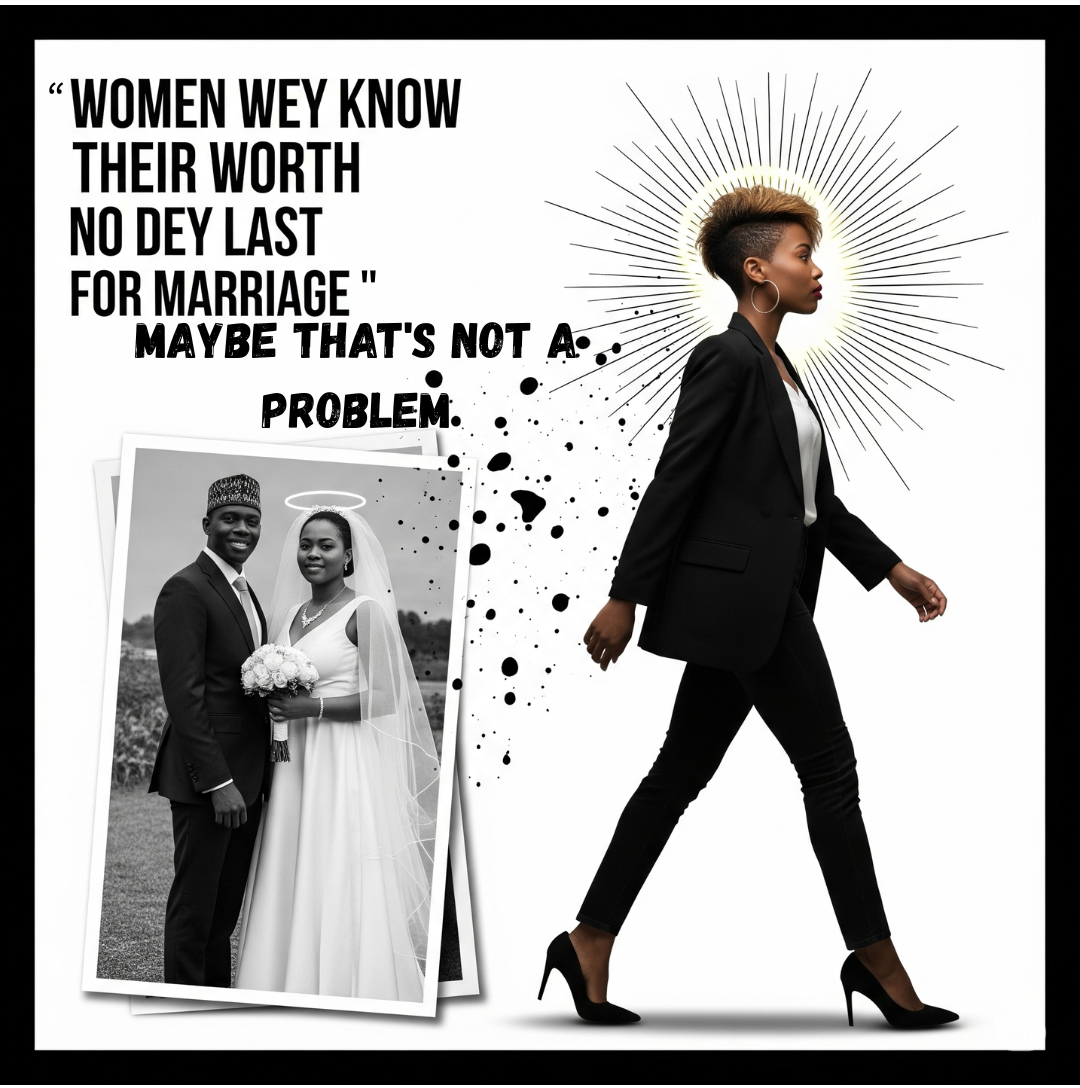
There’s a phrase that lingers in markets, echoes through salons, slips into wedding speeches, and resurfaces in online debates, sometimes said with a smirk, sometimes with concern, and often with scorn:
“Women wey know her worth no dey last for marriage.”

It sounds familiar, almost harmless, wrapped in the soft cloth of culture. But beneath its casual tone lies something corrosive, an unspoken rule passed down like a family heirloom: a woman’s self-assurance is a threat to the sanctity of marriage.
Because what it means is this: when a woman knows her worth, she becomes incompatible with an institution that still expects her to disappear.
In a world where patriarchy is passed on like ancestral land, a woman’s self-respect is branded rebellion. This phrase, whispered, laughed, or shouted, isn’t just a cliché. It’s a confession: our society is deeply unsettled by women who refuse to shrink.
The Audacity of Knowing Your Worth
What does it even mean to “know your worth”? It’s not just Instagram quotes or morning affirmations. It’s showing up for yourself without flinching. Setting standards and never apologizing for them. Choosing peace like rent’s due on it, because, honestly, peace is not a luxury; it’s a necessity.
Knowing that love should feel like a partnership, not a performance. Refusing to beg for space in rooms you already belong in. It’s the quiet power of not shrinking so someone else can feel tall.
Knowing your worth means you refuse to settle for crumbs when you deserve the whole loaf. You won’t stay silent just to keep the peace at the expense of your soul. You won’t pretend to be less than you are so someone else can feel more. You recognize that love isn’t about losing yourself, but standing side by side, equal, not diminished.
But in a society that still treats marriage like a trophy for endurance, that kind of self-awareness becomes dangerous. Because it means she might say no. It means she might walk away. It means she might not need saving or permission. And that shakes the table.
Let’s be real: a woman who doubts herself is easier to manage. Easier to love. Easier to keep. Especially when she thinks the relationship is the prize, and not herself.
That kind of confidence disrupts the script. It flips the narrative that women should be seen and not heard, that their dreams should be whispered and never shouted. It makes some uncomfortable, especially those who built their identity on control, on a hierarchy that places women beneath them.
Because a woman who knows her worth holds the power to walk away. And that truth is a threat. It unsettles the fragile egos still clinging to outdated roles. It forces a reckoning: if she won’t stay silent, what does that mean for the “man of the house”?
So instead of celebrating strength, we police it. We package it as “pride,” or “too much,” or “not wife material.” We weaponize guilt and tradition to keep women boxed in, quiet, and compliant. But here’s the real secret no one says out loud: the problem isn’t her knowing her worth. It’s that too many marriages were never built to hold her at all.
Marriage as Reward, Not Relationship

Too often, marriage is positioned as a prize for good behavior. Be quiet. Be soft. Be agreeable. Be patient. Tuck your ambition under your smile. Dull your fire. Then, maybe, you’ll be chosen. But if you’re too loud, too ambitious, too opinionated, too independent? Then you must be “one of those women.” The ones who “don’t last.”
This messaging doesn’t start in adulthood; it starts in childhood. Little girls are handed toy rings and plastic veils long before they understand what partnership means. They’re praised for helping Mummy in the kitchen while their brothers stretch out on the sofa. Taught to serve, not to speak. To adjust, not assert. To bend, never break.
Even their childhood errors are met with warnings: “Is that how you’ll behave in your husband’s house?”
So what happens when that little girl grows up and decides her voice isn’t a flaw, it’s a legacy? What happens when she dares to protect her peace like it’s sacred? When she walks away from spaces that bruise her spirit? When she says, without apology, “What about my happiness?”
She is called difficult. Disobedient. Dramatic. Damaged. Unstable. Rebellious. She becomes a cautionary tale to other women, a whispered warning: Don’t be like her.

But maybe we’re asking the wrong questions.
Maybe the real question is:
Why do we expect women to earn love through suffering?
Endurance Culture and the Worship of Sacrifice

There’s an entire generation of women who were raised on stories of endurance. Women who stayed in marriages where love was long dead, who wore smiles over broken hearts, who taught their daughters how to survive but not how to soar.
We call them strong. We give them awards at their 50th wedding anniversaries. But we rarely ask: At what cost?
Did she get to live? Did she get to rest? Did she get to be more than someone else’s shadow?
Endurance has been mistaken for virtue. But there is nothing noble about staying in a relationship that drains you. There is nothing graceful about swallowing pain just to keep the peace. There is nothing holy about disappearing so that a man can feel whole.
We need to stop teaching women that longevity is the same as happiness. A woman who leaves a marriage after five years of fighting for her soul may be far more fulfilled than one who stays for fifty in silence.
The Male Ego Is Not That Fragile… Or Is It?
We often tiptoe around this part, but let’s be honest: a large part of the discomfort with self-aware women stems from male insecurity.
It’s not that men don’t like intelligent, driven, or independent women. It’s that many haven’t been taught how to partner with them without feeling emasculated.
They were raised to believe that their worth lies in being needed. And if a woman doesn’t need you financially, emotionally, or socially, if she has her voice, bank account, dreams, and backbone, then what’s left?
Equality, that’s what. But equality requires emotional maturity. It demands unlearning. It invites vulnerability. And for some, that’s terrifying.
A confident woman forces the question: Who are you when control is no longer on the table?
A confident woman forces the question: Who are you when control is no longer on the table? She forces growth. Or she triggers fear. And often, the latter wins.
The Burden of Softening
So women are told to “tone it down.” To dim their brilliance, delay their success, downplay their intelligence. To be “humble” in the way that means “harmless.” To fold themselves into shapes that fit his comfort.
She earns a promotion? “Just don’t make him feel small.”
She buys a car? “Don’t let it look like you’re doing better than him.”
She speaks with clarity? “Try not to sound too assertive.”
She walks away from disrespect? “Maybe you should have endured a little longer.”
It’s always her job to make the man feel big. But who makes sure she doesn’t disappear?
The Myth of the “Good Woman”
There’s a cruel irony baked into the idea of the “good woman” that many of us inherit without question. She’s the one who stays loyal when promises are broken, who swallows her hurt with a quiet patience no one notices.
She’s the woman who lowers her voice, even when her words carry truth that could shake foundations. The one who gives and gives until there’s nothing left, all while wearing a smile like armor.
She is called “good” because she forgets herself. Because she sacrifices her needs, her dreams, her very essence, to fit a mold designed by others.
But what happens when she wakes up?
When she starts to see that love without respect isn’t love at all—it’s manipulation wrapped in a prettier package? That peace built on silence is a slow erasure of who she is? That holding a title: wife, mother, caretaker, without joy is nothing but a gilded cage?
What if she remembers the woman she once was? The one who laughed loud, dreamed big, and demanded more?
Then she becomes a threat.
She is labeled “proud” like it’s a crime. “Too modern,” as if progress is a punishment. “Too exposed,” when all she’s done is stop hiding. “Too Western,” as if embracing her power is betraying her roots.
She becomes “too much”, too fiery, too fierce, too real, for those comfortable with silence and submission.
Suddenly, the “good woman” they praised for forgetting herself is no longer good enough. She is everything they warned against.
And yet, in reclaiming herself, she finds freedom, even if the world hasn’t learned how to celebrate it yet.
Redefining “Lasting”
So let’s talk about this obsession with “lasting.”
What does it mean to “last” in marriage? Is it simply about staying, no matter what? Is it about time served? Is it about who can endure the most emotional erosion without leaving?
Or should we be asking better questions?
Like:
Did she grow in that marriage?
Did she feel safe, heard, and valued?
Did the relationship allow both partners to become more of themselves?
Because “lasting” should not mean “surviving.” It should mean thriving. It should mean evolving together. It should mean being able to look across the table and say: I am still me—and I still choose you.
And if she cannot say that, then leaving is not a failure. It’s freedom.
Marriage Is Not the Goal. Wholeness Is.
We need to stop measuring women’s worth by their marital status. Being unmarried is not a character flaw. Divorce is not a moral failing. Knowing your limits is not pride. Choosing peace is not weakness.
The goal is not to be married. The goal is to be whole. To be alive in your own skin. To sleep at night knowing you did not betray yourself for the comfort of others.
Marriage can be beautiful. But only when it is built on truth. On mutuality. On growth. On the ability to look each other in the eye and say: We are here, not because we need to be, but because we choose to be.
Knowing Your Worth Doesn’t Mean Rejecting Marriage, It Means Changing How You See It
Let’s be clear: this isn’t about rejecting marriage or men. It’s about rejecting the version of marriage that demands women shrink to fit into outdated roles. Many relationships thrive on mutual respect and shared growth, where both partners are allowed to be whole. A woman who knows her worth doesn’t want to “stay in her place”, she wants partnership, not submission.
Self-assured women aren’t against love; they’re against disappearing to make space for someone else’s ego. True love isn’t about endurance or sacrifice, it’s about equality and respect. If she finds a partner who values her light instead of asking her to dim it, that’s where real love begins.
So, no, she’s not “too much.” She’s simply no longer willing to accept less than she deserves.