ITU Reports That 2.2 Billion People are Offline, So How “Global” Is Your Feed Really?
Your feed feels “global” until you realize who isn’t in it. In just 10 countries, about 1.25 billion people are offline, including millions of Gen Z who never even see the trends you think define your generation. Why are they missing, and what does that change?
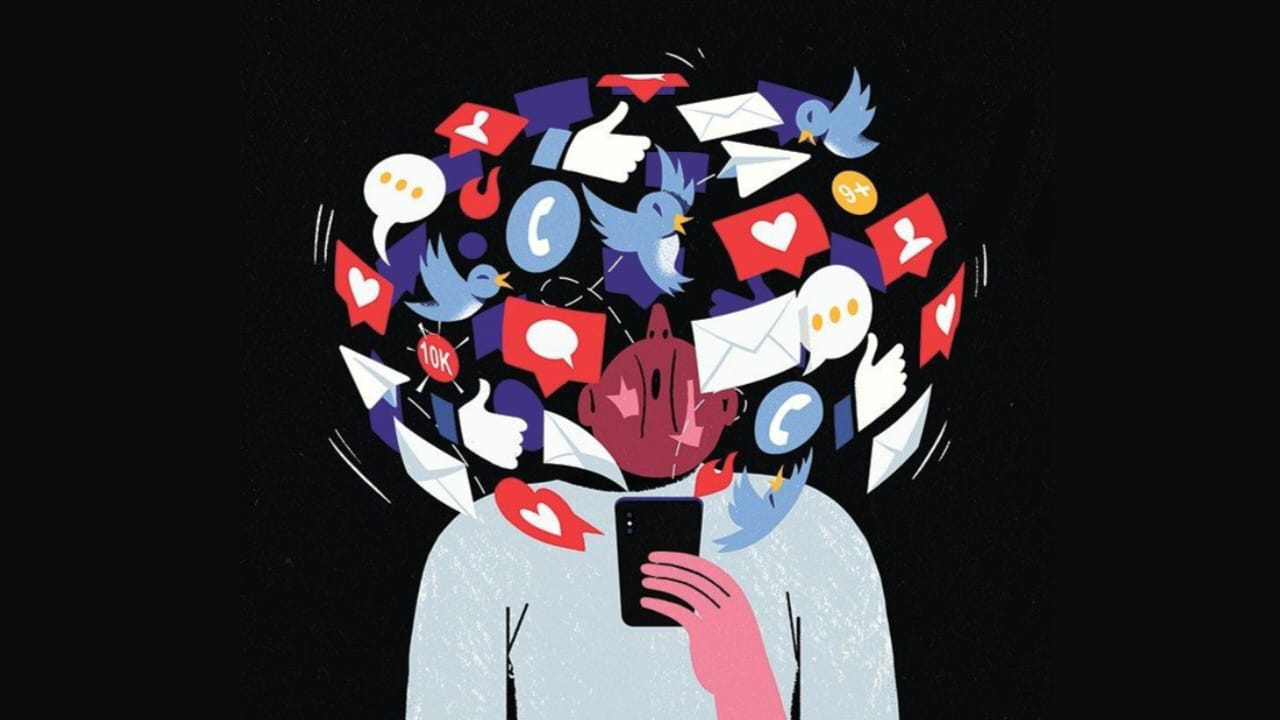
If you are Gen Z and online, you know how it feels when a trend becomes “everywhere” overnight. The audio is on every reel. The meme is in every group chat. The news story has a thousand hot takes before you even finish class. It feels like the whole planet is in the same room.
But some of Gen Z is not in the room at all.
Not because they are “out of touch.” Not because they do not care. Because the door is locked.
The International Telecommunication Union (ITU) estimates that about 2.2 billion people were still offline in 2025, and it revised its 2024 estimate to about 2.3 billion. Earlier 2024 reporting also put the number even higher, at 2.6 billion offline. Either way, it is a crowd so huge it breaks your sense of scale. And a lot of that crowd is young.
The Internet Feels Global, Until You Notice Who Is Missing
Your feed is not just entertainment; It is where opportunities show up first.
Homework resources, scholarship links, job listings, mental health info, community, identity, music, movements, money, even basic services.
So when someone is offline, they are not only missing memes. They are missing the modern default.
The chart by voronoi capitalist makes this real. It ranks countries by the number of people without internet access, and the numbers are enormous:
India is at the top with 440,123,000 people offline, even though “only” 30% of the country is offline. Pakistan follows with 139,387,000, then Nigeria with 130,044,000. China shows up with 118,883,000 offline, despite just 8.4% offline, simply because its population is huge. Then you see countries like Ethiopia, Uganda, and Tanzania where the offline rates are near or above 70%. In those places, being offline is not an exception. It is normal.
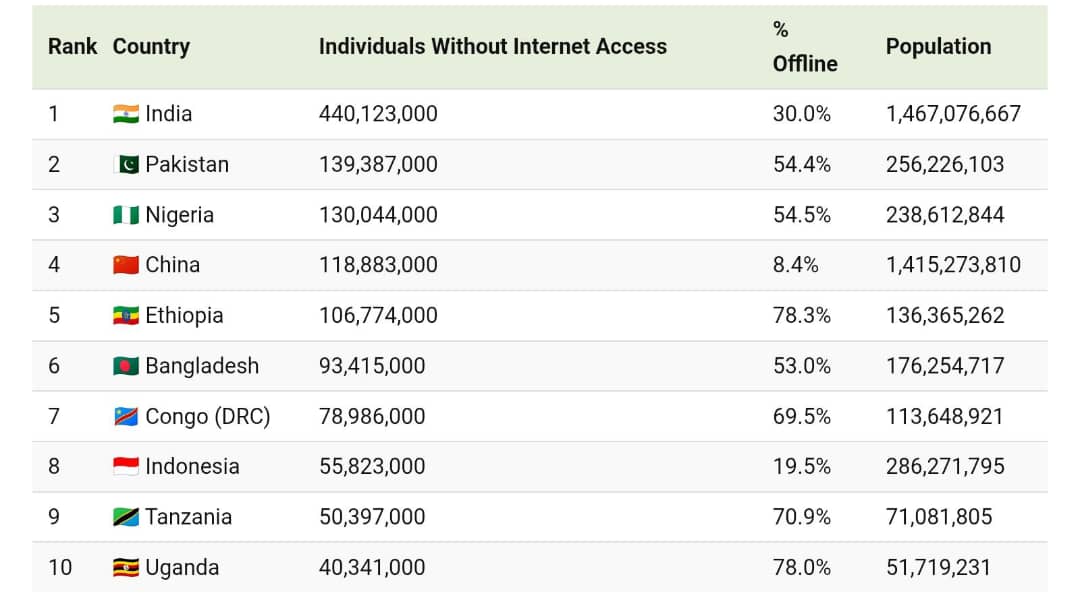
Add up the ten countries in that chart and you get more than 1.25 billion people offline.
That is the part that should mess with your head: “global trends” are often built from a slice of humanity, and then presented as if they represent everyone.
Big Numbers Do Not Always Mean The Deepest Problem
It is tempting to read the ranking like a scoreboard, but it is actually two different stories mixed together.
One story is scale. India and China have so many people that even a smaller offline percentage becomes a massive number of humans. That is how China can have a relatively low offline rate and still have over 100 million people offline.
The other story is depth. In countries like Ethiopia (78.3% offline), Tanzania (70.9%), Congo (DRC) (69.5%), and Uganda (78.0%), the offline majority is not a small group being “left behind.” It is most people.
That difference matters, because it changes what “being connected” even means socially. In some places, internet access is a normal utility. In others, it is a rare advantage that can change your entire future.
The Painful Truth: Some People Live Under A Signal and Still Cannot Use It
A lot of people imagine the digital divide as “no towers, no signal, end of story.”

But the modern gap is often about something uglier, and more everyday: you can be near coverage and still be priced out, device locked, or skill blocked.
Researchers call this a “usage gap,” meaning people technically live in areas covered by mobile internet, but still do not use it consistently. Reuters has described a world where mobile network coverage reaches the vast majority of people, while billions remain offline because of barriers like affordability and digital skills.
So What Actually Blocks The Door?
Cost is one of the biggest reasons. The ITU has reported that in low income economies, even “entry level” mobile broadband can take up a much larger share of income than it does in high income countries. If internet costs the kind of money that competes with food, transport, or school needs, you do not scroll for fun. You ration data. You choose silence over participation.
Device affordability is another gate. The GSMA has repeatedly highlighted device cost as a major barrier to mobile internet adoption in low and middle income countries. A signal is useless if the phone that can use it is out of reach, or if the only available device is old, shared, or constantly dying.
Then there is confidence. If you have never been taught how to use online tools safely, spot scams, protect privacy, or even navigate forms and settings, the internet can feel less like opportunity and more like risk. The GSMA also points to digital skills and literacy as key barriers alongside affordability.
And sometimes the internet simply does not feel like it was made for you. If the content is not in your language, if local services are missing, if online spaces feel hostile, or if misinformation is everywhere, the internet becomes something you avoid, not something you trust.
The Divide is Also About Who Gets Heard
Even when access improves, it is not evenly shared.
The ITU estimates that in 2024, 70% of men used the internet globally compared with 65% of women, a gap that amounts to 189 million more men than women online. The GSMA similarly reports that in low and middle income countries, women are still less likely than men to use mobile internet, leaving hundreds of millions of women unconnected.
For Gen Z, this is not abstract. It shapes who gets to learn digital skills early, who gets to build online income, who gets private access to health information, and who gets a voice in the public conversation.
If you are not connected, you are not counted. And if you are not counted, the world gets comfortable making decisions without you.
What “Offline” Costs a Young Person, Emotionally and Practically
Being offline is not one disadvantage. It multiplies disadvantages.
School gets harder because education increasingly assumes internet access, even when teachers do not mean to exclude anyone. UNICEF and the ITU have warned that huge numbers of children lack internet at home, which can lock in inequality when learning shifts online.
Work gets harder because job listings, applications, and skills training are now digital by default. Government services get harder because forms and information move online. Even simple things like banking, travel, and customer service are designed around being connected.
But the quiet cost is the one nobody talks about enough: belonging.
For a lot of Gen Z, the internet is where identity is tested, friendships form, communities gather, and confidence grows. Being offline can feel like watching life happen through a window.
Not because you are desperate to chase trends, but because trends have become a language people use to signal who they are. If you never see that language, you can be treated like you are invisible.
And here is the cruelest loop: the offline rarely show up in your feed to remind you they exist. So connected Gen Z can accidentally become unaware, not out of arrogance, but because the internet is built to show you who is already inside.
The Takeaway: We Are Not All Living In The Same Reality
Gen Z is often called the first truly online generation. The truth is more complicated.
Gen Z is also the generation where the gap is impossible to ignore, because so much of life has moved online while millions of young people are still blocked from it.
So the next time something is described as “what Gen Z thinks,” pause for a second.
Ask a simple question: Which Gen Z?
Because a world where culture is shaped in a room that billions cannot enter is not just unfair. It is incomplete. And until more people can connect safely, affordably, and meaningfully, the internet will keep telling a story that sounds global, but is missing huge parts of humanity.