How Nigeria’s First Telecom Innovators Built a Market—Then Lost It
Before GSM giants took over, Nigeria's early CDMA operators made phone access possible for millions. This is the story of how they helped build the telecom market and why they couldn't keep it.
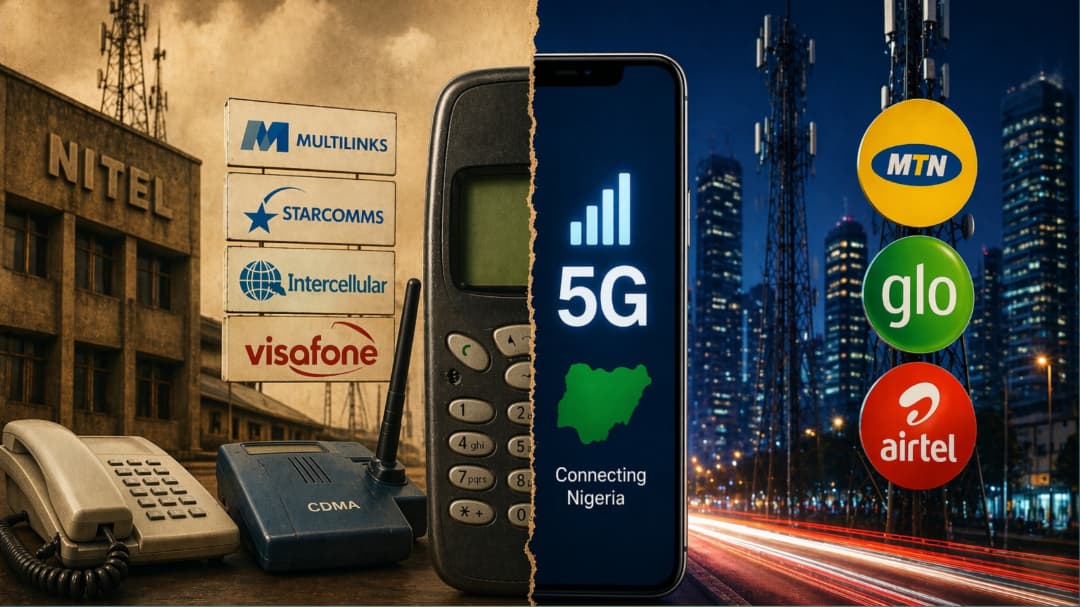
Before mobile phones became everyday essentials in Nigeria, owning a telephone line was a privilege reserved for a few.
For most Nigerians in the 1980s and 1990s, communication was slow, frustrating, and limited. Then, a group of companies changed everything.
Long before the rise of MTN Nigeria, Globacom, and Airtel Nigeria, Nigeria's telecom revolution had already begun, led by a set of operators using a technology known asCDMA.
They built the foundation of the country's modern telecom industry. But within a decade, they were gone.
Before the breakthrough
For years, Nigeria's telecom space was dominated by NITEL, the state-owned monopoly responsible for fixed telephone lines. The system struggled with poor infrastructure, limited coverage, and long waiting lists.
In many parts of the country, especially outside major cities, access to a working phone line was rare. Communication, in practical terms, was a daily challenge.
That began to change in the late 1990s, when theNigerian Communications Commission opened the sector to private operators in an effort to improve services and expand access.
The rise of CDMA operators

With new licenses came a wave of companies deploying Code Division Multiple Access networks. Operators such as Multilinks, Starcomms, Intercellular, and later Visafone, began offering fixed and limited mobile telephony services to Nigerians who had long been underserved.
For the first time, people had real options.
CDMA networks initially offered strong call quality, relatively stable connections, and more accessible pricing compared to the old system. In urban centres especially, this felt like a breakthrough.
By the early 2000s, these operators had built real momentum.
History
Rewind the Stories that Made Africa, Africa
A Journey Through Time, Narrated with Insight.
Starcomms grew to millions of subscribers and introduced early broadband services, while Visafone expanded rapidly within a few years of launch.
Nigeria's telecom market was no longer stagnant, it began to grow.
Why CDMA worked
At its core, CDMA was a capable technology.
It allowed multiple users to share the same frequency efficiently, which translated to good call quality and early data advantages at a time when alternatives were still developing.

It also enabled relatively quick rollout in key areas.
More importantly, CDMA operators succeeded where the old system had failed, they made communication more accessible.
They helped move Nigeria from a country where phones were scarce to one where connectivity was gradually becoming part of everyday life.
The turning point: GSM arrives
The real disruption came in 2001, when the Nigerian government issued licenses following a landmark auction by the Nigerian Communications Commission.
Companies like MTN Nigeria and Econet (later Airtel, after passing through several rebranding phases including Vmobile, Celtel, and Zain) entered the market with a model built for scale.
Unlike CDMA operators, which were initially restricted to regional operations, GSM companies were granted nationwide licenses. This allowed them to expand rapidly across the country, reaching millions of subscribers in a short time.
They also introduced a major advantage:SIM cards. With GSM, users could easily switch devices by moving their SIM cards from one phone to another. CDMA devices, by contrast, were typically tied to a specific network, making them less flexible and, over time, less appealing.
As GSM networks expanded and prices dropped, their popularity surged.
Why CDMA couldn't keep up
History
Rewind the Stories that Made Africa, Africa
A Journey Through Time, Narrated with Insight.

The decline of CDMA operators was not caused by a single factor, but by several overlapping challenges.
First were structural limitations. Early regional licensing restricted growth and capped revenue potential at a critical stage, while GSM competitors scaled nationally from the outset.
Second, some CDMA companies struggled with underinvestment and operational inefficiencies. In certain cases, poor management decisions slowed expansion and weakened competitiveness.
Finally, consumer preferences shifted. GSM's flexibility, wider coverage, and rapidly falling costs made it the more attractive option for a growing number of Nigerians.
By the time CDMA operators were granted broader licenses, the gap had already widened significantly.
The fall of the pioneers
One by one, the CDMA operators faded. Multilinks changed ownership multiple times before declining. Intercellular lost relevance.
Starcomms, once a market leader, saw its subscriber base shrink sharply.
Visafone, the strongest among them, was acquired by MTN Nigeria in 2016, which used its spectrum to strengthen its own 4G LTE network rather than continue CDMA operations.
By 2019, after theNCC withdrew tens of millions of CDMA numbers and the last remaining operator recorded zero subscribers, CDMA had officially disappeared from Nigeria's telecom market.
A legacy that still matters

Despite their decline, the impact of these early operators remains significant.
They broke a long-standing monopoly, they introduced competition, they gave millions of Nigerians their first real access to telecommunication services.
History
Rewind the Stories that Made Africa, Africa
A Journey Through Time, Narrated with Insight.
In many ways, they helped build the market that GSM companies would later dominate.