China's Robot Race Is a Glimpse Into the Next Industrial Revolution
China’s robot marathon highlights rapid advances in automation that could redefine work, industry, and global competition
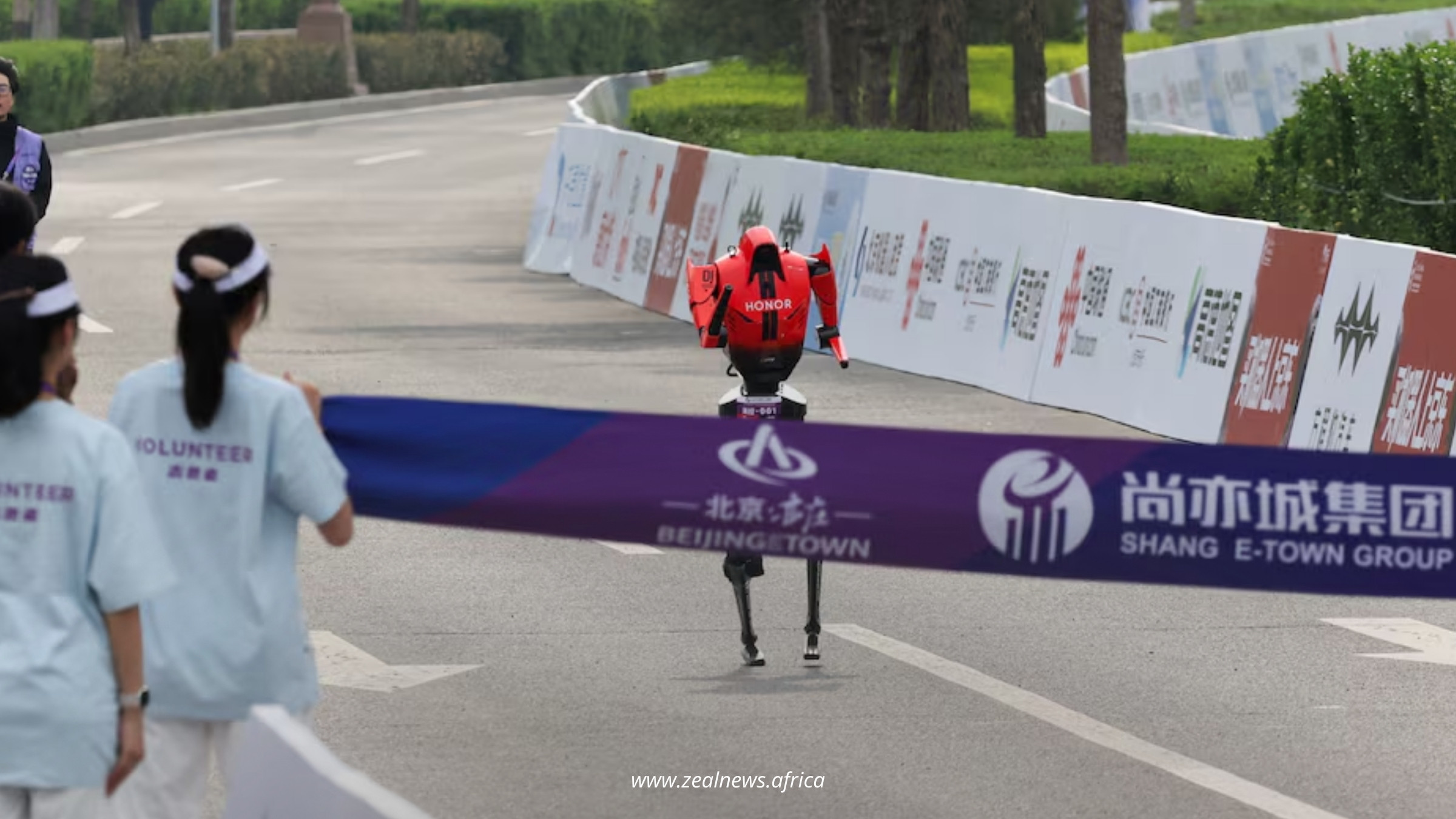
On April 19, 2026, the streets of Yizhuang in southern Beijing became the site of something that felt ripped straight from a science fiction movie.
Dozens of humanoid robots were racing alongside human athletes in a 21-kilometre half-marathon. The machines did not just finish. Several of them won, and one broke a human world record in the process.
If you thought the robot takeover was some distant fantasy, China just moved that timeline up considerably.
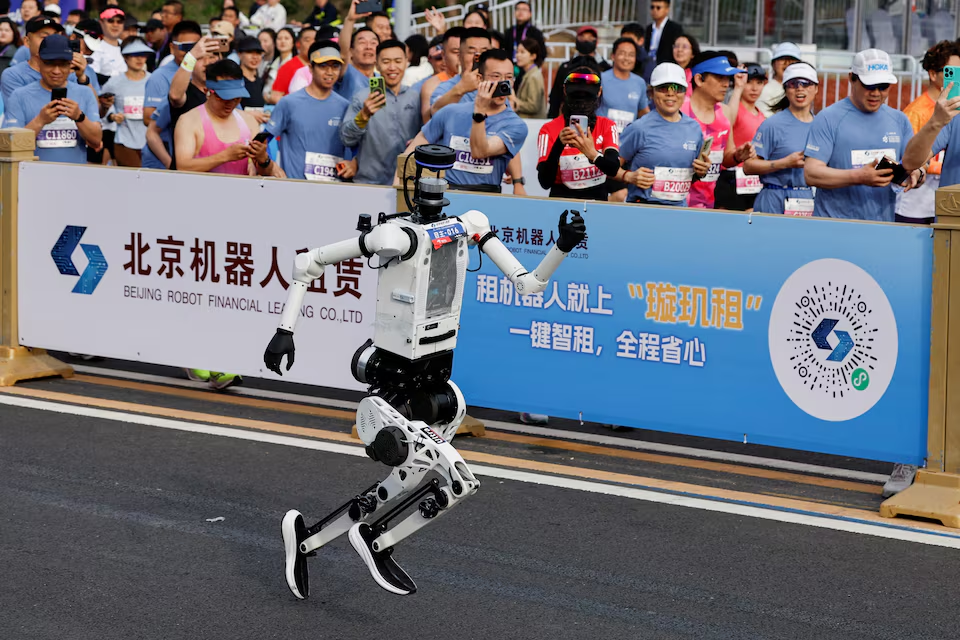
Tiangong Ultra 2026 humanoid robot takes part during the second Beijing E-Town Half Marathon and Humanoid Robot Half Marathon in Beijing, China April 19, 2026. Source: REUTERS/Tingshu Wang
From Stumbling to Sprinting
The race's inaugural edition in 2025 had lots of mishaps, and most robots were unable to finish.
The champion that year finished at 2 hours and 40 minutes, more than double the human winner's time. Twelve months later, the gap between human and machine had collapsed entirely.
The winning humanoid was equipped with an autonomous navigation system and ran for the Chinese smartphone maker, Honor. It completed the roughly 21-kilometre course in 50 minutes and 26 seconds, at an average speed of about 25 kilometres per hour.
That surpassed the current men's world record of 57 minutes and 20 seconds, held by Ugandan runner Jacob Kiplimo.
Think about what that means. A robot, built by a phone company that most people associate with Android handsets, just ran faster than the fastest human ever recorded over that distance.
The winning robot was fitted with legs 90 to 95 centimetres long to mimic elite human runners, and used liquid cooling technology borrowed from smartphone engineering.
Teams from Honor took all three podium spots, all self-navigated and posting world-record-beating times.
The Scale-Up Nobody Saw Coming
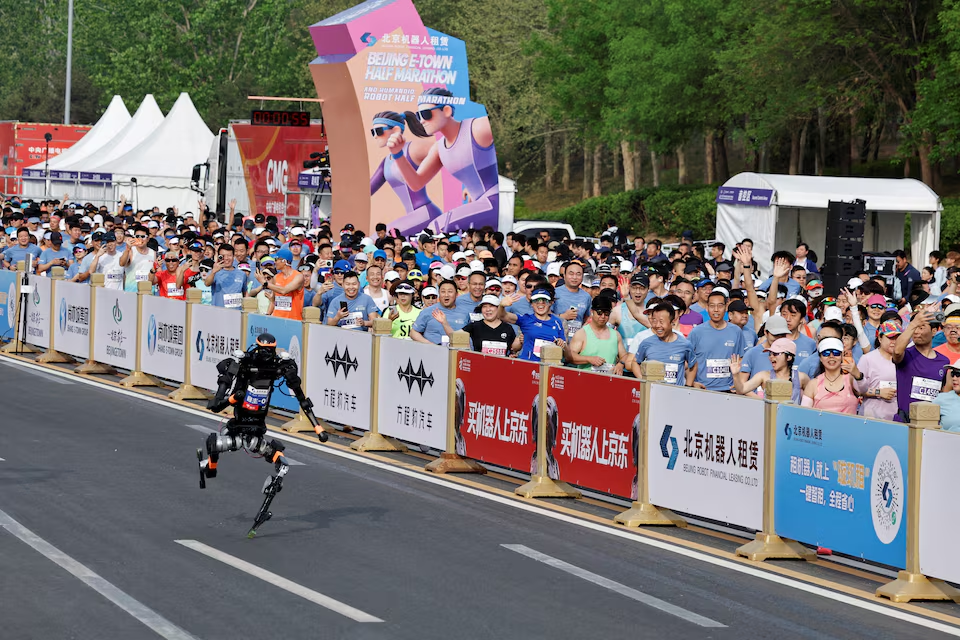
What makes this more than a flashy publicity stunt is the scale at which it happened. The number of participating teams increased from 20 to more than 100, with several robot frontrunners noticeably faster than professional athletes, beating the human race winners by more than 10 minutes.
Both autonomously navigated and remotely controlled robots competed on the same course, with results calculated using weighted coefficients that incentivised full autonomy.
Autonomous navigation teams accounted for about 40 percent of the total field. The organisers are actively engineering competition rules to push robots toward operating independently, without any human input at all.
That design choice matters. A robot that can run a half-marathon on its own is already solving a deeply complex problem: real-time environmental perception, dynamic balance, energy management, and navigation — all simultaneously, across 21 kilometres of open road.
This Is Bigger Than a Race
China is not doing this for entertainment. Beijing's latest five-year plan specifically vows to target the frontiers of science and technology, and speeding up the development of humanoid robots and their applications is written directly into the 2026-2030 national plan.
Rapid advances in multimodal AI are accelerating embodied AI, autonomous machines operating in the real world. This is a push Chinese officials say could help offset labour shortages and drive productivity gains.
With a population that is aging and a manufacturing sector that employs hundreds of millions, the economic urgency behind this technology is real.

Unitree Robotics Product. Source: TIME Magazine

China's humanoid robot output is projected to grow by 94 percent in 2026, with Unitree Robotics and AgiBot emerging as clear market leaders, together projected to account for nearly 80 percent of total shipments.
Omidia recently ranked these three Chinese companies, AGIBOT, Unitree Robotics, and UBTech Robotics, as the only first-tier vendors in its global assessment for shipment numbers for general-purpose embodied intelligent robots.
The Gap Between Spectacle and Factory Floor
While economically viable applications of humanoid robots mostly remain in a trial phase, Chinese robotics firms are still struggling to develop the AI software that would enable humanoids to match the efficiency of human factory workers.
Experts noted that the skills on display during the half-marathon, while impressive, do not directly translate to industrial capability.
Running in a straight line and even at record-breaking speed, is mechanically simpler than assembling a circuit board, folding a garment or navigating an unpredictable warehouse floor.
The marathon is a proof of physical endurance and navigation. The factory is a proof of dexterity and judgment. Those are different problems entirely.
However, this is what should command attention. A technology that went from barely crossing a finish line to outrunning world-record-holding humans in a single year is not moving slowly.
Conclusion
The global humanoid robot market, valued at roughly 4.89 billion dollars in 2025, is projected to reach 165 billion dollars by 2034.
The industries first in line for disruption which includes manufacturing, logistics and healthcare, are the same ones the younger generation are preparing to enter.
China just ran a robot past every human on a Beijing road. The next question is not whether this technology will change the world. It is whether the rest of the world is watching closely enough.
Meta Description:
Tags:
, , ,