Ayariga Slams Ghana's Economic Woes, Revives 24-Hour Economy Plan
Dr. Hassan Ayariga warns that Ghana is losing economic sovereignty to foreign investors and has not fulfilled Dr. Kwame Nkrumah's vision 69 years after independence. He critiques current governance, education, and political practices, advocating for his 24-hour economy policy and inclusive leadership to achieve true economic independence.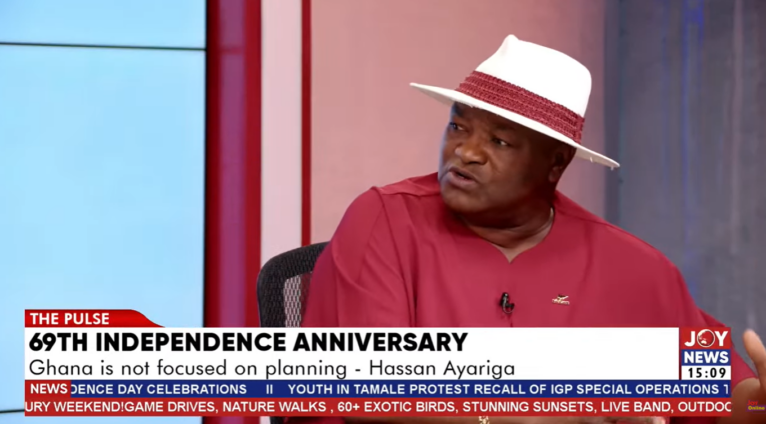
Dr. Hassan Ayariga, Founder and Leader of the All People’s Congress (APC), has voiced serious concerns regarding Ghana’s economic and political trajectory, asserting that the nation is gradually losing control of its economy to foreign investors. He characterizes this trend as a 'takeover' rather than genuine investment, despite acknowledging the inherent benefits of foreign capital. Speaking on The Pulse on March 6, Dr. Ayariga highlighted increasing foreign dominance across crucial sectors such as housing, banking, and major businesses, which he believes poses a severe threat to Ghana’s economic and political sovereignty.
Under a potential presidency, Dr. Ayariga proposed implementing strict restrictions on foreign ownership of property. "If I am president, I don’t want any foreigner to own property. You can invest your money, yes, but when you’re buying almost everything, land, businesses, companies, you’re losing control," he stated. He further warned of a concerning long-term strategy where foreigners are "building up structures to ensure they have children in Ghana who can run for ministerial or parliamentary elections, and even the presidency," which he views as a direct threat to the country's political future.
Ayariga emphasized that this escalating foreign control in banking, business, and housing undermines the capacity of indigenous Ghanaians to fully benefit from their own economy, leading to a loss of national sovereignty. He urged for vigilant oversight and careful regulation to ensure that foreign investment genuinely supports national development and does not displace local ownership and control, warning that without such measures, Ghana risks losing both its economy and its future.
Extending his critique to Ghana's post-independence journey, Dr. Ayariga argued that 69 years after gaining independence, the nation is yet to fully realize the vision of its first president, Dr. Kwame Nkrumah. He lamented that successive leaders have failed to build upon Nkrumah’s strong foundations, causing Ghana to drift from its intended path. "Sixty-nine years is a long time for a country like ours that inherited so much. We could not maintain the significance of those fundamentals that shaped us," he remarked, suggesting a decline in leadership quality since the Nkrumah era.
He further criticized Ghana's education system, contending that it has failed to adequately prepare the younger generation to become critical thinkers, innovators, and leaders, often leaving them unprepared for roles beyond the usual, including corruption. Dr. Ayariga questioned the readiness of the youth to inherit the nation's leadership, underscoring a broader failure in national development.
The "winner-takes-all" approach prevalent in Ghanaian politics also came under fire from Dr. Ayariga, who views it as a regressive mindset that divides the nation and weakens its collective strength. He stressed that national progress necessitates inclusive leadership and the participation of all citizens, irrespective of their political affiliations. "Until we change the mindset and create leadership that everyone is part of, we will continue to lose ground," he asserted, advocating for a system where progress is continuous and not abandoned with every change of power.
In addressing Ghana's economic challenges, Dr. Ayariga highlighted the much-discussed 24-hour economy policy, claiming its origin in his 2012 manifesto. He views this concept as a practical solution to Ghana’s low production levels, envisioning structural reforms where government institutions and industries operate continuously in shifts to maximize economic output. "Let’s say we’re going to use eight hours on manufacturing and eight hours on industry, you have this three-cycle system of a 24-hour economy," he explained.
While pleased that the concept has gained national traction, Dr. Ayariga expressed a desire for acknowledgment of his contribution. He urged the government to adopt a more inclusive leadership approach when implementing policies, particularly those originating from different political actors. "It’s good to adapt anybody’s manifesto, but leadership must be inclusive," he maintained, reiterating that strategic implementation of the 24-hour economy could significantly strengthen production, improve industrial output, and foster Ghana’s long-term economic growth. Ultimately, Dr. Ayariga's comments serve as a comprehensive call for reflection and urgent action, emphasizing that until Ghana achieves genuine economic independence, its political independence will remain incomplete.