AI Healthcare Tools That Could Change Jobs in Medicine
AI is reshaping healthcare jobs in real time—from diagnostics to drug discovery. Here’s how tools like Abridge and AI imaging are redefining roles for the next generation of medical professionals.
If you are currently in med school, nursing school, or even just thinking about a career in healthcare, AI should be living rent-free in your head.
The conversation about AI in medicine has gone from "that's interesting" to "this is happening right now," and the people who get ahead of it are the ones who are going to shape what healthcare looks like for the next generation.
But the thing nobody is saying clearly enough is that AI is not just coming for repetitive tasks. It is redesigning entire job descriptions. So let's break down what is actually going on.
The Paperwork Problem Is Getting Solved
Currently, doctors spend roughly two hours doing digital paperwork for every single hour they spend with actual patients. And this is where AI is becoming the premium assistant.
Tools like Abridge and Microsoft's Dragon Copilot sit in on patient-doctor conversations, listen in real-time, and generate clinical notes automatically.
Studies have shown that using these tools cuts documentation time by around three hours per week in routine practice settings and in lab environments, that reduction is even higher.
What does this mean for future healthcare workers? Administrative roles as we know them are going to look very different.
The person who used to manually type up visit notes might instead be overseeing AI-generated notes for accuracy.
The job doesn't disappear like it is feared it would, it just evolves. Think less about "data entry" and more "quality control and AI supervision."
Diagnostics Just Got an Upgrade
Radiology and pathology are already feeling the shift the hardest. AI tools can now analyze medical images ( MRIs, CT scans, X-rays) and catch things that human eyes sometimes miss.
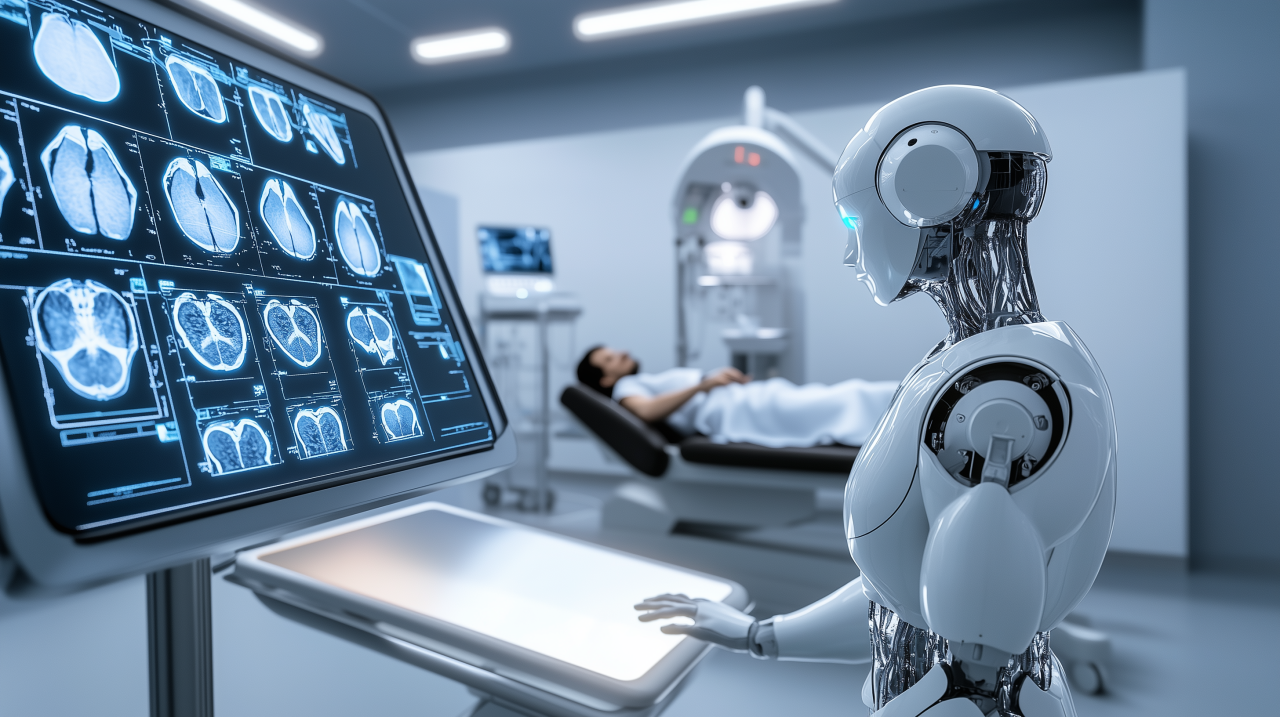
There is an AI tool that successfully detected 64% of epilepsy brain lesions that radiologists had previously overlooked. That is potentially life-changing for patients who would have gone undiagnosed.
For the present generations entering radiology or pathology, this might sound terrifying, like the robot is coming for your job. But the reality is more different.
Radiologists who understand and work alongside AI tools are becoming more valuable, not less relevant. You are not competing with the AI; you are the expert who knows when to trust it and when to push back on it.
The emerging role here is something like an AI Medical Imaging Specialist, someone who combines clinical knowledge with an understanding of how these algorithms work, where they fail, and how to interpret their outputs.
This wasn't a job five years ago. It is a growing field now.
Drug Discovery Is Moving at High Speed
Pharmaceutical research used to move at a very slow pace but now, AI-driven drug discovery is compressing timelines that used to take decades into years and in some cases, months.
Platforms are using machine learning to analyze massive datasets of biological information and identify drug candidates with a precision that human researchers simply can't match at scale.

This is opening up a whole category of roles called Clinical Data Scientists and AI-Driven Drug Discovery Researchers, positions that sit right at the intersection of biology, chemistry, and computer science.

If you are someone who always liked both science and tech, this is honestly one of the most exciting career paths you probably were not told about in secondary school.
The Ethics Problem Nobody Wants to Talk About
We all know AI systems are only as good as the data they are trained on, and healthcare data has historically been biased, usually underrepresenting certain communities, skewing results, and in some cases, producing tools that work better for some patients than others.
This is giving rise to an entirely new role, the AI Healthcare Ethicist. These professionals focus on identifying bias in algorithms, advocating for transparency in how AI makes decisions, and making sure patient data is used responsibly.
It is a role that requires both medical literacy and a strong sense of equity and frankly, it is one of the most important jobs the industry needs right now.
So, What Should You Actually Do?
If you are planning a future in healthcare, the message is clear: AI literacy is no longer optional.
You don't need to learn how to code (though it wouldn't be bad). But understanding what AI can and can't do, where it tends to get things wrong, and how to critically evaluate its outputs is the new baseline.
Medical schools are starting to integrate AI training into their curriculum, and certification programs are popping up specifically for healthcare professionals.
The gap right now between people who understand this technology and people who don't is your opportunity.
The future of medicine is not AI replacing doctors and nurses. It is AI making the good ones even better and creating entirely new roles for people curious enough to step into uncharted territory.
That sounds like a pretty solid deal.