Originality Is a Myth, But Credit Isn't: What the Beautiful Nubia Dispute Reveals About Credit Culture Crisis in Nigerian Music
The Beautiful Nubia dispute spotlights a deeper issue in Nigerian music: not originality, but the persistent failure to credit, acknowledge, and compensate creative influence.

There is this particular argument that runs through every music copyright dispute: all music borrows from music that came before it. It is said scales are shared and chord progressions are repeated. And no one can truly hold back rhythm from travelling across studios and shores.
It is a fair argument, and in most cases, it is also true. But somewhere between "music builds on music" and "I can use your melody without telling you," something important gets lost.
That something is credit and the Beautiful Nubia dispute has put it squarely back in the conversation.
The Accusation
On February 19, 2026, veteran folk singer, Segun Akinlolu, known professionally as Beautiful Nubia, took to social media with an accusation that quickly spread across the Nigerian internet.
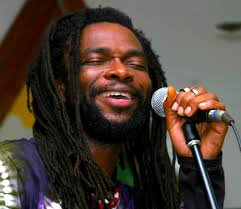
He alleged that gospel musician Yinka Ayefele's 2012 hit, My Faith in God (Igbagbo Ireti) and gospel artist BBO's 2026 single, Aminboth drew their core melodies from his 1997 classic, Seven Lifes, without permission, without acknowledgement and without compensation.
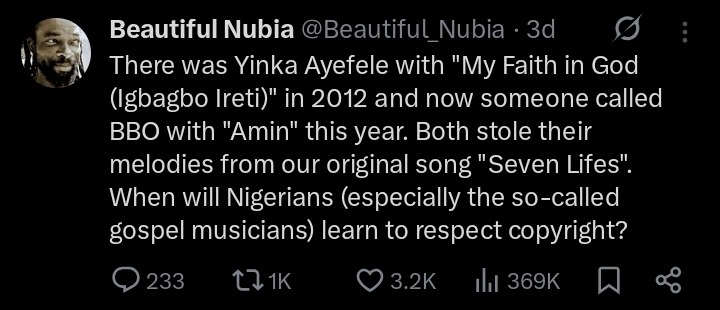

For anyone who has listened carefully to all three songs, the similarities are difficult to dismiss. Several social media users confirmed with one noting that the similarities were glaring in Amin and that it should have been cleared before release.

The reactions online split predictably between those who backed Beautiful Nubia completely and those who argued that musical similarity alone does not constitute theft.
Both camps have a point. But neither camp is asking the more important question.
The Complexity Nobody Wants to Sit With
The question is not whether originality exists in music. It largely does not and every artist actually absorbs influences.
Beautiful Nubia himself built his sound from a deep well of Yoruba folk tradition, acoustic storytelling, and African rhythmic heritage. He did not invent those elements either.
The George Harrison case in the 1970s, where a court found that his My Sweet Lord unconsciously copied a decades-old melody, established early that inspiration and infringement can coexist in the same song, sometimes without the artist even knowing it. Musical similarity is genuinely complex territory.
But complexity is not an excuse for silence, and that is precisely where Nigerian music has a problem.
What makes the Beautiful Nubia dispute significant is not the legal question of who copied what. No court has ruled on any of these allegations, and it is possible that BBO, whose supporters circulated an old video of him apparently composing Amin eight years before its 2026 release, arrived at the melody independently.
Independent creation happens in music all the time. What is harder to explain away is the pattern. That repeated absence of acknowledgement, the failure to pick up the phone, clear the sample, credit the source, or if at all, reach out.
Instead, what followed Beautiful Nubia's allegation was silence from both accused artists, an old music video from Ayefele, and an internet debate that quickly moved on to other things.
When "God Gave Me This Song" Becomes a Shield
This credit culture crisis in Nigerian music is not primarily about bad actors, but more about a creative ecosystem that has not learnt the habit of attribution.
In genres where "God gave me this song" functions as both testimony and legal defence, the question of who a melody belonged to before it arrived in a dream tends to get quietly buried.
Gospel music, in particular, has long sheltered behind spiritual framing in ways that make intellectual property conversations feel like a sin. To question whether a worship song was properly cleared is, in certain circles, to question the anointing.

That is a convenient arrangement but only for the person who borrowed the melody.

A Pattern Bigger Than One Dispute
This is not a new Nigerian problem, but one that has become harder to ignore. Sinach faced a lawsuit in 2024 from a producer claiming co-authorship of Way Maker.
Sir Victor Uwaifo publicly criticised artists for repackaging his classic Joromi without credit. 2Baba and Blackface spent years in a dispute over songwriting credits dating back to the early 2000s.
Each case points to the same gap that the industry lacks the right infrastructure for credit-giving.
The cost of that deficit falls heaviest on artists like Beautiful Nubia, those who built distinctive sounds through decades of work, whose melodic signatures are recognisable enough to borrow but whose names are not prominent enough to make borrowing feel important.
There is a particular cruelty in the fact that a song can carry someone's creative fingerprint across two decades, through at least two other artists' careers, and still never generate a royalty, a licensing conversation, or even a passing mention in the liner notes.

Credit Is a Choice
What the Beautiful Nubia dispute reveals is that the Nigerian music industry has not yet built the professional culture that converts awareness of copyright into actual practice.
Knowing that plagiarism is wrong is not the same as having a system that makes respecting intellectual property the path of least resistance.
Originality may be a myth. But credit is not a myth. It is a practice, a discipline and a choice.
And until Nigeria's music industry decides to treat it as such, the Beautiful Nubias of the industry will keep paying the price.