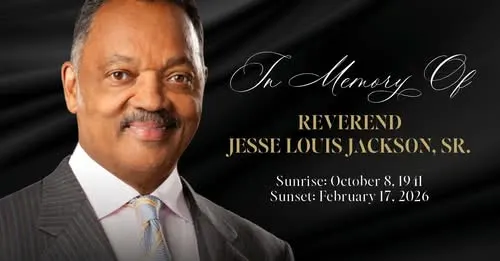
A Giant's Legacy: Civil Rights Icon & Grammy Winner Rev. Jesse Jackson Passes Away at 84

Published 1 hour ago6 minute read
Precious Eseaye
Precious Eseaye
A Giant's Legacy: Civil Rights Icon & Grammy Winner Rev. Jesse Jackson Passes Away at 84

The Reverend Jesse Jackson, a towering figure in American civil rights and politics, passed away on Tuesday, February 17, at the age of 84. Jackson, who was widely considered the foremost Black leader in the U.S. during the period between the assassination of Dr. Martin Luther King Jr. in 1968 and the rise of Senator Barack Obama in 2004, died at home, surrounded by his family. His daughter, Santita Jackson, confirmed his death to the Associated Press. For over a decade, Jackson had bravely battled progressive supranuclear palsy (PSP), a neurodegenerative condition. He was initially diagnosed with Parkinson’s disease in 2017, with the PSP diagnosis confirmed in April.

His family released a poignant statement online, honoring him as a “servant leader — not only to our family, but to the oppressed, the voiceless, and the overlooked around the world.” They added, “We shared him with the world, and in return, the world became part of our extended family. His unwavering belief in justice, equality, and love uplifted millions, and we ask you to honor his memory by continuing the fight for the values he lived by.”

Motown founder Berry Gordy also shared a heartfelt tribute, expressing deep sadness at the loss of his “dear friend.” Gordy hailed Jackson as not only a significant leader of the Civil Rights Movement but also as family, recalling Jackson’s steadfast support for him, Motown, and the community through various challenges and triumphs. Gordy notably mentioned Jackson’s pivotal role in bringing Dr. King to Hitsville in 1963, just days before Detroit’s historic Great March to Freedom, a moment that forged an enduring connection between music, movement, and mission. Gordy praised Jackson’s courage, faith, and unwavering commitment to justice, noting that even amidst his health struggles in recent years, Jackson fought with dignity, purpose, and grace. He concluded by calling Jesse Jackson “a force of history — a moral voice, a builder of bridges, and a champion for those whose voices were too often ignored,” asserting that his legacy would live on in the lives he touched and the progress he enabled.

Born on October 8, 1941, in Greenville, South Carolina, Jackson’s journey into activism began early. In the summer of 1963, at just 21 years old, he traveled to Washington, D.C., where he was profoundly impacted by Dr. King’s landmark “I Have a Dream” speech. Two years later, he joined a group of college friends on a significant trip to Alabama to participate in King’s Selma-to-Montgomery march, where he first met the civil rights icon. Early the following year, King entrusted Jackson, then only 24 and the youngest of King’s aides, to lead the Southern Christian Leadership Conference’s (SCLC) Operation Breadbasket in Chicago. In April 1968, Jackson was with King in Memphis, standing in solidarity with striking sanitation workers, just a day before King’s tragic assassination on the balcony of the Lorraine Motel.

Jackson’s media profile steadily grew, leading to his appearance on the cover of TIME in April 1970 for a special issue on Black America. However, tensions emerged between Jackson and the SCLC, culminating in his suspension by the SCLC board in late 1971 for “administrative impropriety” and “repeated violation of organization discipline.” Following this, Jackson resigned and founded his own organization, PUSH (People United to Serve Humanity, originally People United to Save Humanity). Similar to Operation Breadbasket, PUSH aimed to boost minority employment and ownership.

From the outset of his efforts to encourage and register Black Americans to vote, Jackson discovered his true calling: to empower African Americans and all who felt marginalized. His signature rally chant, “I am somebody,” resonated deeply with people. Through PUSH, Jackson mobilized get-out-the-vote initiatives that played a crucial role in electing Black mayors in cities like Gary, Indiana; Newark, New Jersey; and Cleveland, Ohio.

Jackson made history as the first Black presidential candidate to garner significant national support and spark credible discussions about his prospects. In the 1984 Democratic primaries, he secured approximately 3.5 million votes, roughly one in five ballots cast. Although former VP Walter Mondale won the nomination, choosing Geraldine Ferraro as his running mate over Jackson, Jackson’s influence was undeniable. Four years later, in 1988, he ran again, this time winning 7 million votes, second only to the eventual nominee, Massachusetts Governor Michael S. Dukakis. His hour-long speech at the 1988 Democratic National Convention brought many delegates to tears, yet he was again passed over for the VP nomination, which went to Texas Senator Lloyd Bentsen. The media increasingly recognized his appeal, with TIME’s May 1984 cover featuring “The Jackson Factor: Black Pride/White Concerns” and its April 1988 cover simply asking: “Jesse!?”

Jackson’s relationship with President Bill Clinton was complex. During the 1992 campaign, Clinton used Jackson as a foil in what became known as the “Sister Souljah moment.” At a political event, Clinton publicly criticized remarks made by rap singer and activist Sister Souljah, whom Jackson had invited, creating an image of himself as a leader willing to challenge his party’s core base. This moment, while benefiting Clinton, came at Jackson’s expense. Despite this, Jackson had hoped to be Clinton’s running mate, but Clinton chose Tennessee Senator Al Gore instead on July 9. Years later, in August 2000, President Clinton honored Jackson with the Presidential Medal of Freedom, the nation’s highest civilian honor.

In the 2000s, Jackson’s national prominence began to wane, partly due to the emergence of numerous Black leaders in various sectors, making the idea of a single Black spokesperson for the entire community seem outdated. However, he was present at Grant Park in Chicago when President-elect Obama accepted his victory, a moment that moved Jackson to tears, reflecting both the long-awaited achievement and perhaps the personal sadness that the doors weren’t as wide open during his own campaigns in 1984 and 1988. Jackson is survived by his wife, Jacqueline, and their six children: Jesse Jr., Yusef, Jonathan, Jacqueline, Santita, and Ashley.

Beyond his political and civil rights work, Jackson also received recognition for his spoken word contributions. A recording of a Jackson speech won a Grammy in 1989 for best spoken word or non-musical recording; the track, “Speech by Rev. Jesse Jackson [July 27th],” was featured on Aretha Franklin’s gospel album One Lord, One Faith, One Baptism. He had previously received his first Grammy nomination in 1980 for best soul gospel performance, contemporary, for Push for Excellence, and a second nomination in 1985 for best spoken word or non-musical recording for Our Time Has Come. In 1988, Jackson was honored with the President’s Award at the annual NAACP Image Awards.

Loading...
Loading...

You may also like...