The Cadaver Synod: When a Dead Pope Was Put on Trial
In one of history’s most grotesque courtroom dramas, a dead pope stood trial—literally. Uncover the chilling story of the Cadaver Synod and the politics that unearthed a corpse.
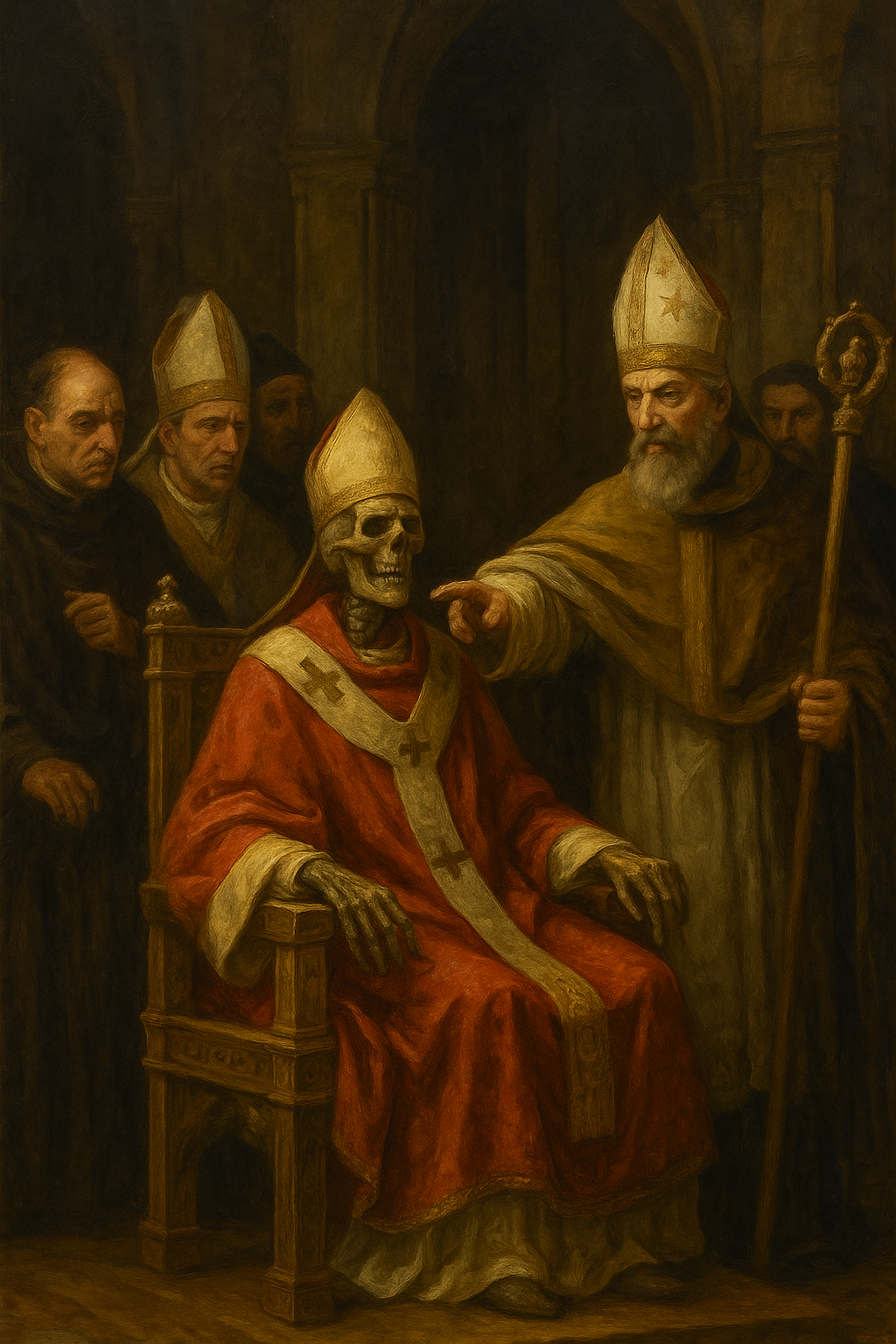
In the annals of history, few events stand out with the same combination of macabre spectacle and political intrigue as the Cadaver Synod (Synodus Horrenda), a posthumous ecclesiastical trial held in 897 AD in Rome.
During this event, the body of Pope Formosus, who had been dead for around nine months, was exhumed and put on trial by his successor, Pope Stephen VI (sometimes numbered Stephen VII).
This bizarre trial, conducted within the Basilica of St. John Lateran, was one of the most infamous episodes of what is known in church history as the “Saeculum obscurum,” or the “dark age” of the papacy. It reveals the intensity of political rivalry and the struggle for ecclesiastical legitimacy in the late 9th-century Christian world.
Background: A Time of Political Instability
The late 9th century was a period of chaos for both the papacy and the Holy Roman Empire. The Carolingian Empire, once consolidated under Charlemagne, had splintered. Italy, in particular, was rife with power struggles among regional kings, noble families, and church leaders.
The papacy, far from serving as a neutral spiritual authority, had become entangled in these political affairs. Pope Formosus, who reigned from 891 to 896, was deeply involved in these machinations.
Before becoming pope, Formosus had served as Bishop of Porto and undertaken diplomatic missions on behalf of previous pontiffs. He also cultivated relationships with Frankish nobility, including Arnulf of Carinthia, a contender for the imperial throne.
The Controversial Career of Formosus
Formosus’ papacy was shaped by both spiritual duties and fierce political choices. In 896, he crowned Arnulf as Holy Roman Emperor, defying the claims of Lambert of Spoleto, a rival emperor whose family wielded considerable power in central Italy.
Formosus' earlier career was equally contentious. In 872, he was excommunicated by Pope John VIII for abandoning his see and attempting to incite rebellion. Though the excommunication was later lifted, this episode remained a stain on his record and would later be used against him.
Stephen VI and the Spoletan Agenda
After Formosus’ death in April 896, the papal throne passed quickly from Boniface VI—who ruled only 15 days—to Stephen VI, a cleric loyal to the powerful Spoletan faction.
Stephen VI’s rise was backed by Lambert of Spoleto and his mother, Ageltrude, both of whom resented Formosus for favoring their imperial rival. Upon ascending the papacy, Stephen convened what became the most grotesque trial in Church history: the Cadaver Synod.
The Synod: A Corpse on Trial
History
Rewind the Stories that Made Africa, Africa
A Journey Through Time, Narrated with Insight.
In January 897, Stephen VI ordered the exhumation of Formosus’ corpse from its tomb in St. Peter’s Basilica. The putrefying body was dressed in papal robes and seated on a throne in the Lateran Basilica.
A deacon was appointed as a legal representative to speak on behalf of the corpse. The charges brought against Formosus were as follows:
Perjury – Allegedly violating oaths taken during his episcopal career.
Usurping the papacy – Having allegedly moved dioceses, in violation of canon law.
Performing sacraments illegally, especially due to the taint of prior excommunication.

This surreal trial featured formal questioning of the corpse, testimony from witnesses, and pronouncements of guilt by Pope Stephen himself.

Verdict and Desecration
Formosus was declared guilty on all charges. The consequences were dramatic and symbolic:
His papal vestments were torn off.
The three fingers of his right hand, used in blessings, were severed.
His body was dressed in lay clothing and buried in a pauper’s grave.
But the desecration didn’t end there. Later, his remains were again exhumed and thrown into the Tiber River. According to later accounts (including Liutprand of Cremona), the body washed ashore and was retrieved by monks for secret reburial.
Public Outrage and Reversal
The grotesque nature of the trial sparked widespread outrage in Rome. Riots erupted, and Pope Stephen VI quickly fell from grace. Later in 897, he was imprisoned and strangled to death by political enemies.
History
Rewind the Stories that Made Africa, Africa
A Journey Through Time, Narrated with Insight.
His successor, Pope Romanus, annulled the Cadaver Synod and reinstated Formosus’ legitimacy, but his own reign was brief. The next pope, Theodore II, also served briefly but convened a synod that formally restored Formosus' reputation and reburied his body at St. Peter’s.
The final nail in the Cadaver Synod’s coffin came under Pope John IX, who called two councils in 898. These councils officially condemned the Cadaver Synod, reaffirmed Formosus’ ordinations, and forbade trials of the dead.
Sergius III and the Reinstatement of the Synod
Strangely, the saga didn’t end there. In 904, Pope Sergius III—an early supporter of Stephen VI—came to power. He reversed the decisions of Romanus, Theodore II, and John IX, declaring the Cadaver Synod valid and Formosus’ papacy illegitimate.
Sergius’ actions did not find widespread support, and despite his pronouncements, Formosus' acts (including ordinations) were not undone in practice. His attempted reversal is seen by most historians as a political gesture rather than a canonical reform.
Why Was Formosus Put on Trial?
Historians agree that the Cadaver Synod had little to do with theology and everything to do with politics. The Spoletan dynasty, angered by Formosus' support for Arnulf of Carinthia, used Stephen VI as a puppet to delegitimize their rival.
Invalidating Formosus also threatened the legitimacy of the bishops and clergy he had appointed, effectively purging the Roman Church of his supporters. The trial was therefore a calculated move to consolidate Spoletan power.

Theological Implications
The Cadaver Synod created serious theological confusion, particularly about the validity of sacraments administered by a pope deemed illegitimate.
Catholic doctrine later reaffirmed the principle of ex opere operato—that the effectiveness of the sacraments does not depend on the moral character or canonical status of the clergy. This doctrine ensured the continuity of apostolic succession, even through turbulent times.
Historical Legacy
The Cadaver Synod is often cited as a low point in papal history. It exemplifies how corruption, political manipulation, and ecclesiastical instability plagued the Church during the early medieval period.
The event has inspired generations of scholars, artists, and theologians. It is frequently referenced in works on papal history and has been the subject of historical fiction and academic analysis alike.
History
Rewind the Stories that Made Africa, Africa
A Journey Through Time, Narrated with Insight.
Conclusion
The Cadaver Synod remains one of the most grotesque and surreal episodes in the history of Christianity. By putting a corpse on trial, the Church in the 9th century showed just how entangled it had become in secular power struggles and dynastic feuds.
Though subsequent popes tried to restore dignity and stability, the trial of Formosus left an indelible mark. It serves as a cautionary tale of how unchecked political ambition can drive institutions into absurdity and disgrace.