Remote Work Is Here to Stay — But Are African Countries Ready?
As remote work reshapes the world, is Africa ready? Explore the continent’s talent, tech gaps, and policies in the face of the global remote work revolution.
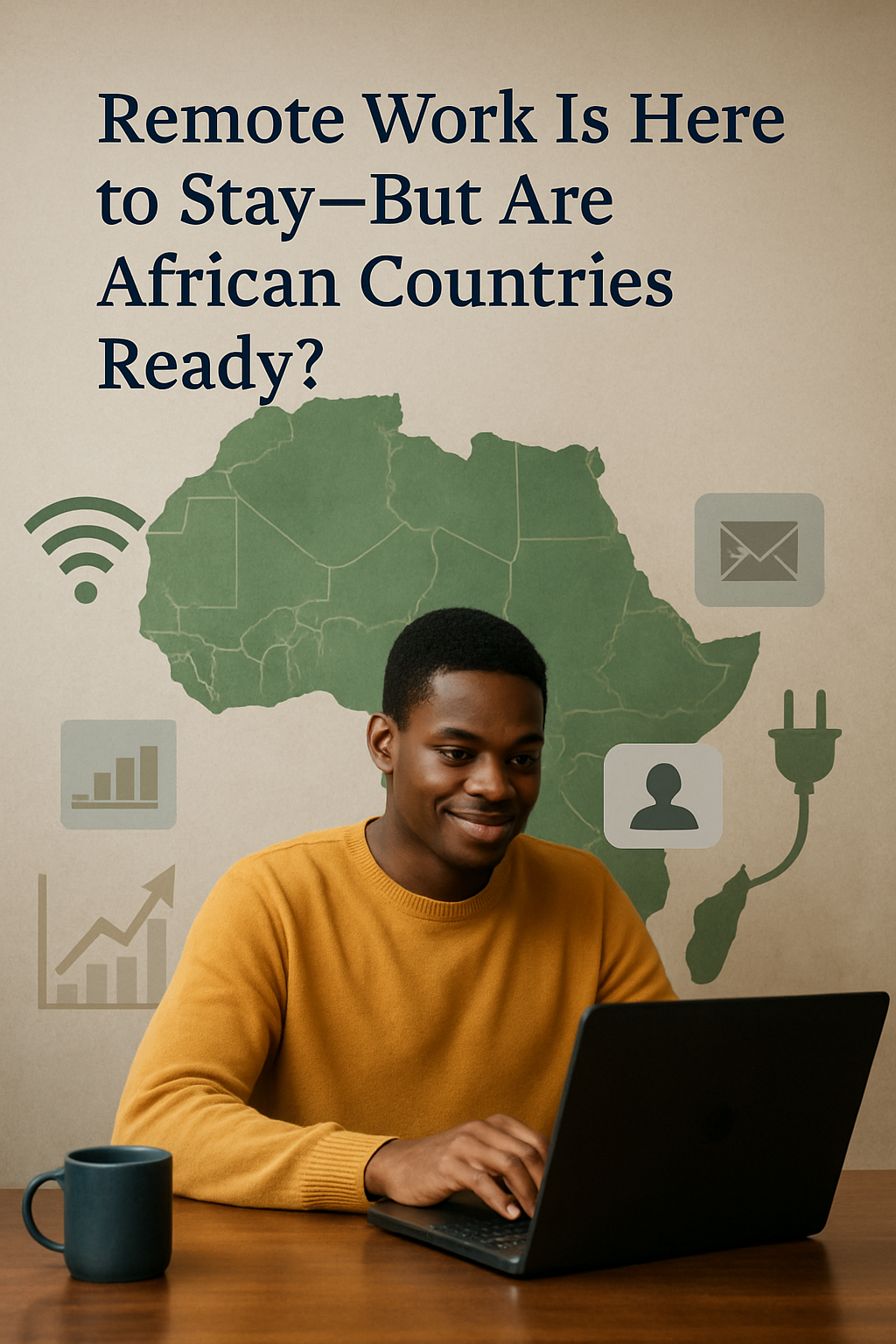
Let’s be honest: long before COVID, most of us had a sneaky suspicion that the 9-to-5 office grind was a bit of a scam. Waking up before sunrise just to sit in Lagos traffic for two hours, only to send emails to someone sitting two cubicles away? Unnecessary. Then came the pandemic, and boom — everyone was grounded.
And just like that, the great remote work experiment began.
What we discovered was shocking to exactly no one: people could actually work — and thrive — from home. Productivity didn’t crash. Deadlines were still met. The world didn’t implode. In fact, remote work grew by 159% in 2020 alone, according to Statista.
Today, remote work is no longer a privilege or a pandemic placeholder. It’s a pillar of modern employment.
But while cities like Lisbon, Bali, and Tallinn are busy building remote worker paradises, the big question is:
Are African countries ready to ride this wave — or risk being left behind?
The Remote Work Boom Isn’t a Trend. It’s the New Normal.
Let’s start with the facts. According to Gartner, 74% of companies plan to shift some employees to permanent remote work. Tech companies were early adopters, but now industries from customer support to education to finance are going hybrid or fully remote.
The global remote work economy is set to hit $1 trillion by 2030, according to Brookings Institution. Platforms like Upwork, Toptal, and RemoteOK are making it ridiculously easy for anyone with skills and Wi-Fi to earn globally, spend locally, and log in from anywhere.
And yet, while the global workforce is sprinting toward a location-flexible future, Africa is… limping, at best.
Talent? Africa Has It in Abundance.
Let’s get this straight — Africa has the people. We’ve got the talent. No shortage of it.
Across the continent, platforms like Andela, TalentQL, and Gebeya are connecting African software engineers to companies around the world. In Nigeria, over 56% of the labor force is under 35, according to Nigerian Bureau of Statistics, and they’re learning fast — thanks to tech-focused training schools like AltSchool Africa, Decagon, and UTIVA.
The World Bank projects Africa’s working-age population will double to over 1 billion by 2050. That’s not a typo. One. Billion.
Social Insight
Navigate the Rhythms of African Communities
Bold Conversations. Real Impact. True Narratives.
So, what’s the holdup?
The Infrastructure Cliff
We have to talk about the Wi-Fi elephant in the room. Internet access — or the lack of it.
According to DataReportal, only 43.1% of Africans had internet access as of 2023. That’s compared to a global average of 66.2%. In Ethiopia and Chad, the numbers drop below 20%.
Even in Nigeria, where the tech scene is buzzing, the Speedtest Global Index ranks us 103rd in the world for internet speed. Not exactly remote-work-ready.

And affordability? Let’s just say your data is eating more of your salary than jollof eats tomatoes. The Alliance for Affordable Internet reports that in some African countries, 1GB of data costs more than 3% of monthly income — triple the UN’s affordability target.
Then There’s Electricity — Or the Lack of It
The Internet is one part of the equation. The other is power.
You can’t Zoom from a laptop that’s dead. You can’t submit a report if PHCN strikes again.
The International Energy Agency (IEA) says over 600 million people in sub-Saharan Africa still lack access to electricity. That’s 43% of the population. And even those who do have access aren’t safe — frequent blackouts disrupt productivity.
Nigeria alone loses $29 billion a year due to unreliable power, according to the World Bank.
Remote work needs constant juice. Not candles.
Policy and Payment — The Other Big Gaps
While countries like Portugal, Estonia, and Barbados are rolling out “digital nomad visas” to attract remote professionals, only a few African nations — like Cape Verde and Mauritius — have even considered similar schemes.
More importantly, what about local freelancers?
Social Insight
Navigate the Rhythms of African Communities
Bold Conversations. Real Impact. True Narratives.
Currently, there’s no clear policy across most African countries to regulate:
Remote worker protections
Taxation for freelancers
Social security for gig workers
Online dispute resolution
That leaves millions of African remote workers legally invisible. No rights. No recourse.
Oh, and let’s not forget money. You want to get paid? Good luck.
According to the World Bank Global Findex, over 45% of adults in sub-Saharan Africa remain unbanked. On top of that, popular platforms like PayPal and Stripe either don’t work or have limited functionality in some African countries.
No PayPal = No Pay Day.
So… Can Africa Catch Up?
Yes — but it’ll take a serious reboot.
Here’s what needs to happen:
Affordable, fast internet access must be declared a right, not a luxury.
Power infrastructure needs real investment, not just photo ops and ribbon-cuttings.
Remote work policies must be developed to protect, not punish, online freelancers.
Payment systems need to open up — PayPal, are you listening?
Schools and training programs must prioritise digital literacy from day one.
Thankfully, efforts like the AU Digital Transformation Strategy, Smart Africa, and ITU-GIGA are already laying the foundation.
But implementation remains the keyword. Africa can’t afford to treat remote work as a techie side quest. It’s a national priority.
The World Has Logged In. Will Africa Join?
The remote revolution is not a flash in the pan. It’s here. It’s growing. And it’s already reshaping global labour markets. Africa, with its brilliant, youthful population, has everything to gain — or everything to lose.
The tools are there. The talent is there. The time is now.
So, the question isn’t “Will remote work come to Africa?”
It’s “Will Africa be ready when it fully comes?”