If Someone Is Born Deaf, What Language Do They Think In?
Do people born deaf think in words?, what happens inside their mind? Learn the psychology behind how thought works without sound.
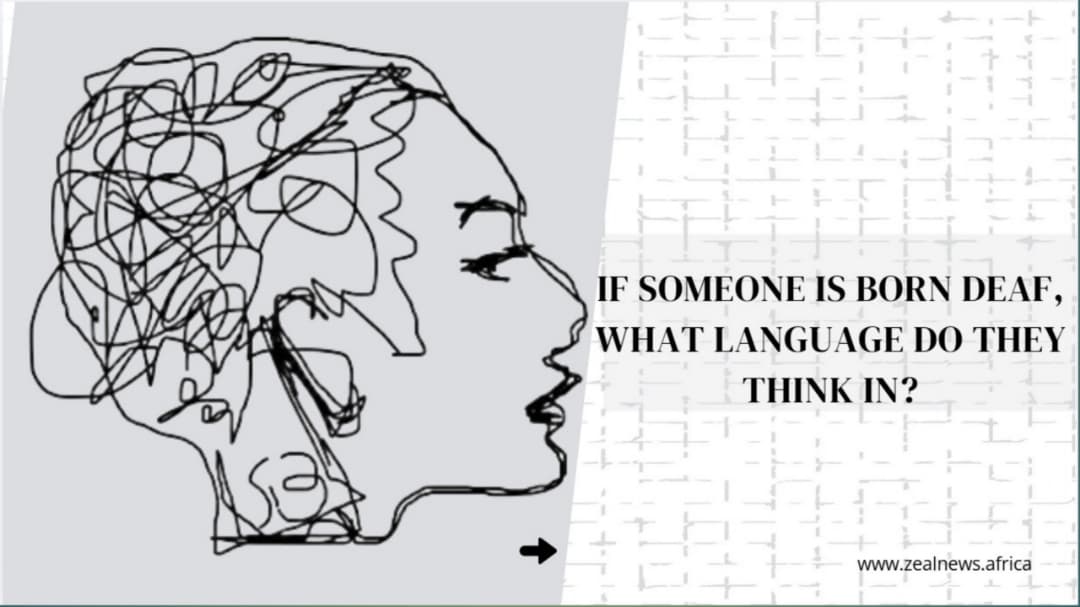
What is it like to think without sound?
Most of us experience the world through spoken language. We “talk to ourselves” in our heads, rehearse conversations, or read silently and hear the words in our mind.
But what happens if someone is born deaf and never hears a single word? What language do they think in?
The answer is more fascinating than you might expect.
It shows just how adaptable the human mind is and challenges our assumptions about language and thought.
Thinking Beyond Words
Language is more than spoken words.
It is a system of symbols and rules that helps us organize ideas and communicate.
spoken words are usually the foundation of language. But for someone born deaf, sound is not part of their experience.
Does that mean they cannot think in language? Not at all.
Thought does not depend on sound.
Thoughts can be visual, spatial, or even emotional.
A deaf child might imagine a tree not by naming it silently, but by picturing its shape, its movement in the wind, or the way it feels to touch.
The human brain is flexible. It builds thought using whatever tools are available.
Social Insight
Navigate the Rhythms of African Communities
Bold Conversations. Real Impact. True Narratives.
Sign Language: A Full Language in Its Own Right

Source: Google
Many people born deaf grow up learning a sign language likeAmerican Sign Language (ASL) orBritish Sign Language (BSL)from early childhood.
Sign languages are complete languages with their own grammar and structure.

They are not simplified versions of spoken language, they are fully developed systems of communication.
For fluent signers, thinking often happens in signs.
Instead of hearing an inner voice, they may visualize their hands forming signs in their mind.
Facial expressions and spatial positioning are important parts of sign language and can also appear in their thoughts.
Brain research supports this as the same areas of the brain that process spoken language in hearing people are used to process sign language in deaf people.
The National Center for Biotechnology Information explains how the brain’s left hemisphere, typically associated with language, adapts to visual language input.
This demonstrates something powerful: language is not about sound. It is about structure and meaning.
Visual and Written Thinking
Not every deaf person grows up with sign language from birth, some rely heavily on written language.
They may think by imagining words on a page or silently “reading” sentences in their mind.
Social Insight
Navigate the Rhythms of African Communities
Bold Conversations. Real Impact. True Narratives.
Many deaf individuals also rely strongly on visual thinking.
Their thoughts may appear as images, spatial layouts, or mental scenes rather than sentences.
For example, someone planning their day might picture the sequence of events visually instead of listing them in words.
The left hemisphere of the brain, typically responsible for language processing, becomes specialized in handling sign language.
This demonstrates the brain’s incredible flexibility.
Deaf individuals often develop enhanced visual attention and spatial reasoning skills.
This does not mean they think “better,” but it shows that cognition adapts to experience. When sound is absent, the brain strengthens other pathways.
Language is a tool to structure thought, but thought itself can exist without it.
What This Reveals About the Human Mind

Many hearing people assume that thinking requires an inner voice. But the experience of people born deaf shows that this simply isn’t true.
Thought can take many forms:
Visual imagery
Internal signing
Written words
Abstract concepts
Emotions without language
Philosophers have long debated whether language shapes thought or whether thought exists independently of language. The reality seen in deaf cognition suggests that while language helps structure and express ideas, it is not limited to speech.
Someone born deaf may “talk” to themselves in signs, visualize complex ideas as moving images, or think in ways that do not resemble spoken sentences at all. Their inner world is just as rich, reflective, and complex.
The next time you notice your own inner voice, consider this: someone else may be signing their thoughts, seeing them unfold like a silent movie, or feeling them in ways that never require sound.
The human mind does not depend on hearing to think. It depends on meaning and meaning can exist in many forms.
The key lesson is that thinking does not depend on hearing or speaking. Our minds are flexible, creative, and capable of forming rich, meaningful ideas in many different forms.
Understanding this broadens our view of human cognition and reminds us that language is just one of many ways our brains make sense of the world.