Copenhagen Ranks #1 on Visual Capitalist’s 2025 Most Liveable Cities List
Copenhagen tops the 2025 Global Liveability Index, followed by Vienna and Zurich. This in depth yet engaging article explores what makes a city truly liveable, and what rising African cities can learn from global models.
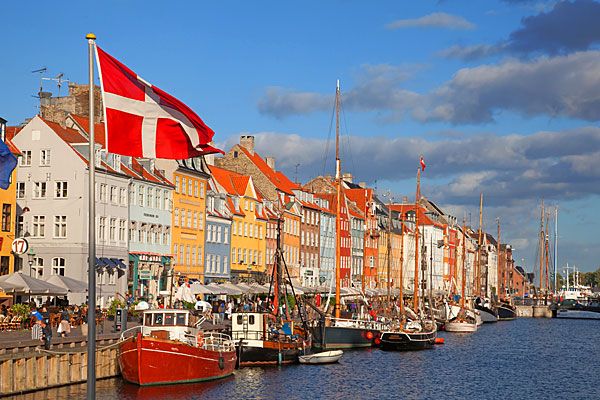
Welcome to 2025, Where Living Well Is the New Global Currency
Let’s face it. Most cities today are barely keeping up. Between chaotic traffic, rent that rivals your salary, healthcare systems hanging by a thread, and climate stress around every corner, urban living can feel like a daily endurance test.
So when a city not only survives but actually thrives, the world takes notice.
That’s why the latest Global Liveability Index 2025 from the Economist Intelligence Unit (EIU), visualized by Visual Capitalist, is more than just a neat ranking. It’s a global mirror showing us what cities are doing right, what others are missing, and how the pursuit of liveability has become a 21st-century obsession.
Copenhagen, Denmark, has just taken the crown as the most liveable city on Earth. But the real story lies in why.
The Top 10 Most Liveable Cities in 2025: Where Life Feels Human Again
According to the EIU’s scoring system, 173 cities were graded on five major categories: Stability, Healthcare, Culture and Environment, Education, and Infrastructure. Each city is assessed across more than 30 data points that capture how it feels to live there, from commute times and school access to clean air and street safety.
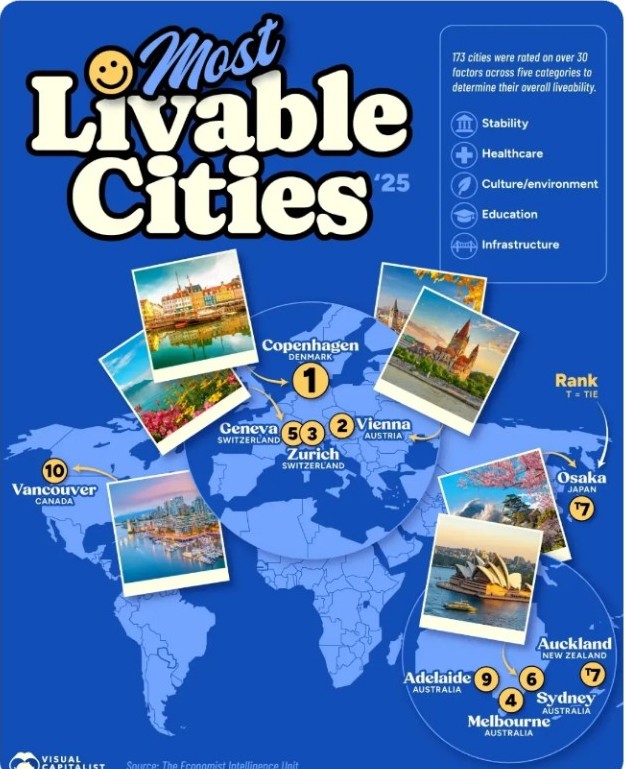
Photo Credit: Visual Capitalist
Here’s who made the Top 10:
Copenhagen, Denmark
Vienna, Austria
Zurich, Switzerland
Sydney, Australia
Geneva, Switzerland
Melbourne, Australia
Auckland, New Zealand
Osaka, Japan
Adelaide, Australia
Vancouver, Canada

Spot the pattern? There’s a strong showing from Europe and Australasia, regions where cities often combine high-tech governance with a deep respect for public well-being. These places have cracked the code by designing for people, not just profits.
Copenhagen: A City That Actually Likes Its Citizens
You know a city’s doing something right when its residents literally swim in the harbour without fear of falling ill.
That’s Copenhagen. The Danish capital is more than just scenic canals and minimalist design. It’s a living, breathing case study in urban harmony.
Here’s how it earned the number one spot:
Bikes outnumber cars, and bike lanes are treated with the same respect as highways
The city is on track to become carbon neutral by the end of 2025, and it’s not just a PR stunt
Universal healthcare and high-quality education are both accessible and efficient
It prioritizes clean air, green rooftops, affordable childcare, and public spaces that invite community
Copenhagen doesn’t aim to be the flashiest — just the most thoughtful. It’s a city that sees people as the point, not just an afterthought.
Vienna and Zurich: Where Efficiency Meets Equity
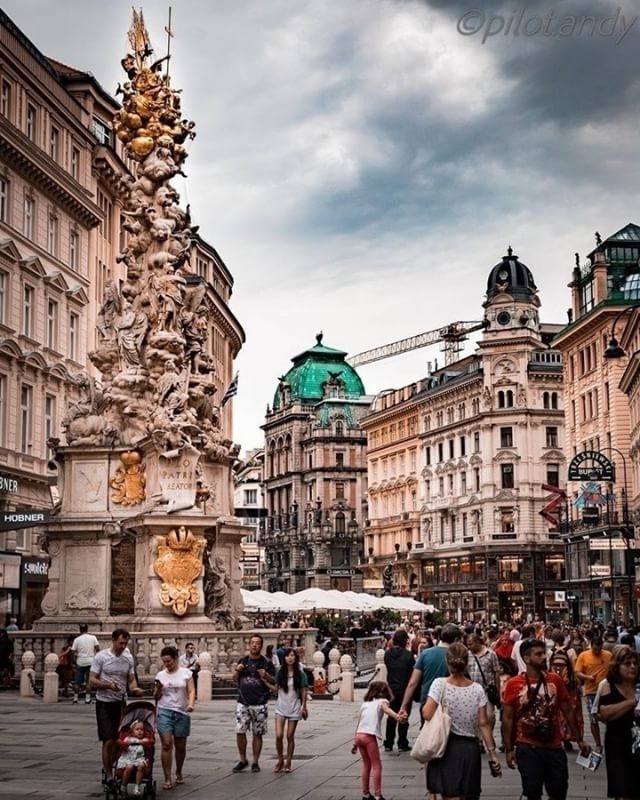
Photo Credit: Pinterest
Vienna, Austria’s elegant capital, has long held a VIP pass to the global liveability list. What’s its magic?
Over 60 percent of the population lives in subsidized housing, and it’s beautiful
Public transport is reliable, clean, and cheap
It’s a city that invests in opera, libraries, museums, and mental health programs with equal enthusiasm
Then there’s Zurich, Switzerland’s quiet powerhouse. Often mistaken for boring, Zurich is flawlessly functional. It excels in:
Healthcare quality and life expectancy
Public safety and crime prevention
A near-mythical ability to make trains run on time
These cities are proof that a place can be both economically powerful and deeply human-centered.
Australia’s Triple Play: Sydney, Melbourne, and Adelaide Step Up
Australia clearly didn’t come to play. It placed three cities in the top 10.
Sydney ranks number four and pairs postcard beauty with growing social awareness. It’s investing in green infrastructure, inclusive transit, and coastal protection
Melbourne is a creative playground — the street art capital, bursting with cafés, festivals, and indie bookstores
Adelaide may fly under the radar, but it’s a hidden gem with short commutes, wine country weekends, low crime, and family-friendly zoning
The common thread? Smart urban planning, climate preparedness, and cultural investment.
Osaka and Auckland: The Asia Pacific Success Stories
In a region dominated by megacities, Osaka and Auckland have managed something rare — big city services with small-town calm.
Auckland, New Zealand’s most diverse city, balances lush parks with multicultural neighbourhoods and a strong healthcare infrastructure. It’s been praised for its post-pandemic adaptability and green housing policies
Osaka brings Japan’s signature politeness, efficiency, and precision to urban life, minus the overwhelming pace of Tokyo. Think quiet trains, clean streets, and community-minded planning
Both cities prove you don’t need to sprawl endlessly to succeed. You just need to plan with purpose.
Vancouver: Where Nature and City Actually Get Along
Vancouver, perched between snow-capped peaks and the Pacific Ocean, is North America’s only top 10 entry — and it earns it.
The Canadian city offers:
Universal healthcare and progressive urban design
A deep commitment to green building and zero-emission housing
Public spaces that reflect its multicultural population and inclusive policies
Vancouver struggles with housing affordability, yes, but its efforts to address inequality, climate resilience, and community engagement keep it in the global elite.
READ: Lagos Holds the 6th Spot on Visual Capitalist’s 2025 Least Liveable Cities List
Why Aren’t African or Latin American Cities Here?
This part stings — but it’s necessary.
No African, Latin American, or Middle Eastern cities cracked the top ten. But let’s be clear. This isn’t about lack of culture, creativity, or ambition.
It’s about systemic barriers:
Weak or inconsistent infrastructure
Underfunded public healthcare and education
High crime or political instability
Rapid urban growth with limited planning
But here’s what’s encouraging. Cities like Kigali, Nairobi, Accra, and Dakar are not sitting idle. They’re innovating in tech, green energy, mobility, and governance — just without the legacy capital or global attention.
What they need now isn’t pity. It’s investment, policy vision, and the political will to prioritize people over elite interests.
What Does It Mean to Be Liveable in 2025?
Forget luxury condos and mega malls. In 2025, a truly liveable city is one where:
The air is clean, and public transport doesn’t feel like a punishment
Children go to school and come home safe
You can fall ill without falling into debt
Art is accessible. Nature is nearby. People feel seen, heard, and protected
Liveability isn’t about looking good on a postcard. It’s about what your city feels like when you walk out the door.
Conclusion: Liveability Is Not a Privilege. It’s a Plan
The cities that made this year’s top 10 didn’t get there by accident. They chose this path through policy, public will, and decades of consistent investment.
For cities across Africa, Asia, Latin America, and beyond, the message is loud and clear. You don’t need to be rich to be liveable. You just need to prioritize people.
As African cities rise, demographically, digitally, and culturally, there’s a golden opportunity to redefine urban living on our own terms.
Because the future of liveability doesn’t belong to the North. It belongs to every city that dares to believe life can be better, and builds like it.