AI Stock Race Shocker: Palantir Crushes Nvidia with Mind-Blowing 876% Growth
A rigorous analysis reveals that the biggest winners of the AI boom are not solely chipmakers like Nvidia, but increasingly companies solving critical physical infrastructure challenges such as cooling and power management, alongside key enterprise AI software providers. Firms like Vertiv Holdings and Palantir Technologies have significantly outperformed traditional AI leaders, highlighting a shift in investment focus towards supply chain resilience and fundamental constraints. Traditional data centers and legacy tech players, however, have seen underperformance.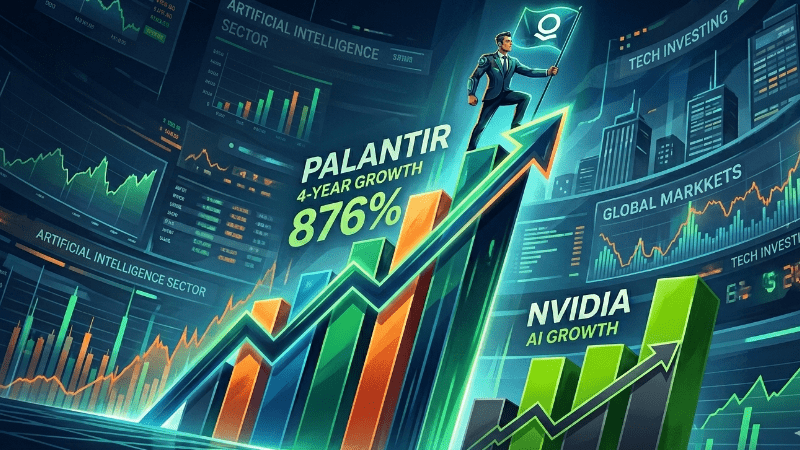
While Nvidia is widely perceived as the undisputed frontrunner of the artificial intelligence boom, a comprehensive new analysis of market data from 2021 to the end of 2025 reveals a significant and counter-intuitive shift in the AI investment landscape.
This rigorous study, compiled by BestBrokers and encompassing AI revenue and supply chain segments across 20 publicly listed companies, indicates that the most explosive growth in the AI ecosystem is increasingly concentrated in companies solving the physical infrastructure challenges created by demanding AI workloads, as well as those providing critical enterprise software.
The data illustrates a fascinating reality where the highest yields are currently stemming from the infrastructure and enterprise software layers, fundamentally upending traditional expectations.
While Nvidia achieved a formidable 534% gain over the four-year period, several companies quietly outperformed it.
Vertiv Holdings, a provider of high-end cooling and power systems crucial for AI data centers, saw its stock climb an impressive 549% over the same timeframe, rising from $24.97 to $162.01.
This surge underscores a fundamental truth: when every layer of the compute stack faces constraints, pricing power shifts to those controlling the tightest chokepoints.
In the current AI cycle, a primary limit on expansion is not solely GPU manufacturing, but also the immense thermal challenges of operating these processors at scale.
Beyond cooling, the broader hardware constraints have fostered an entirely new tier of infrastructure providers.
Networking giant Broadcom posted a substantial 420% increase, while high-bandwidth memory supplier SK Hynix rose by 397%.
The escalating demand for pure compute power is further exemplified by CoreWeave, an Nvidia-backed GPU cloud operator.

Following its IPO, CoreWeave’s share price rocketed 93% between March and December 2025 alone, with its revenue surging from a modest $15 million in 2022 to an astonishing $5 billion in 2025, driven by hyperscalers and AI laboratories increasingly outsourcing compute capacity through GPU-as-a-service models.
However, the software layer has also seen a dramatic re-rating, with one company surpassing even the physical infrastructure gains.

Palantir Technologies, a US AI and analytics firm, delivered the largest stock gain in the entire dataset, a staggering 876% in just four years, with shares rising from $18.21 to $177.75.
This is not mere algorithmic hype but a fundamental repricing of its business model. Once viewed as a niche government contractor, the market now recognizes Palantir’s utility as mission-critical enterprise AI infrastructure, enabling organizations to securely operationalize their proprietary data in the private sector.
Latest Tech News
Decode Africa's Digital Transformation
From Startups to Fintech Hubs - We Cover It All.
Perhaps the most sobering revelation is the stark underperformance of legacy technology players and traditional data center operators.
AI is proving to be a ruthlessly selective force, not a rising tide.
Traditional Data Center Real Estate Investment Trusts (REITs) like Equinix and Digital Realty actually experienced declines of 9% and 13% respectively over the four-year period.
Similarly, legacy chipmaker Intel saw its stock plunge by 28%.
The market is clearly differentiating between companies directly enabling high-density AI workloads and those merely serving the broader, older data center market, as standard facilities lack the requisite power density and liquid cooling capabilities for next-generation AI clusters.

As Paul Hoffman, an analyst at BestBrokers, summarizes:
“The stock performance data tells a more nuanced story than the AI hype cycle would suggest. The biggest winners weren’t the household names building AI models or selling cloud services; they were the companies solving the unglamorous physical problems that AI creates: keeping data centres cool, moving data fast enough, and supplying the memory that large language models run on.”
He concludes that the market has looked past the software layer to price in infrastructure constraints that were largely ignored before the widespread accessibility of AI tools.
The next phase of the AI economy will be defined not just by foundational models, but by supply chain resilience, with investors heavily pricing in the power, memory, and cooling constraints—indicating that the real money is now firmly in the liquid cooling pipes.