AI Didn’t Steal Your Job, But This Mindset Might
Think AI stole your job? Think again. The real threat is a fixed mindset, fear of change, and resistance to upskilling. Discover how your attitude, not algorithms, might be holding you back in the AI age.
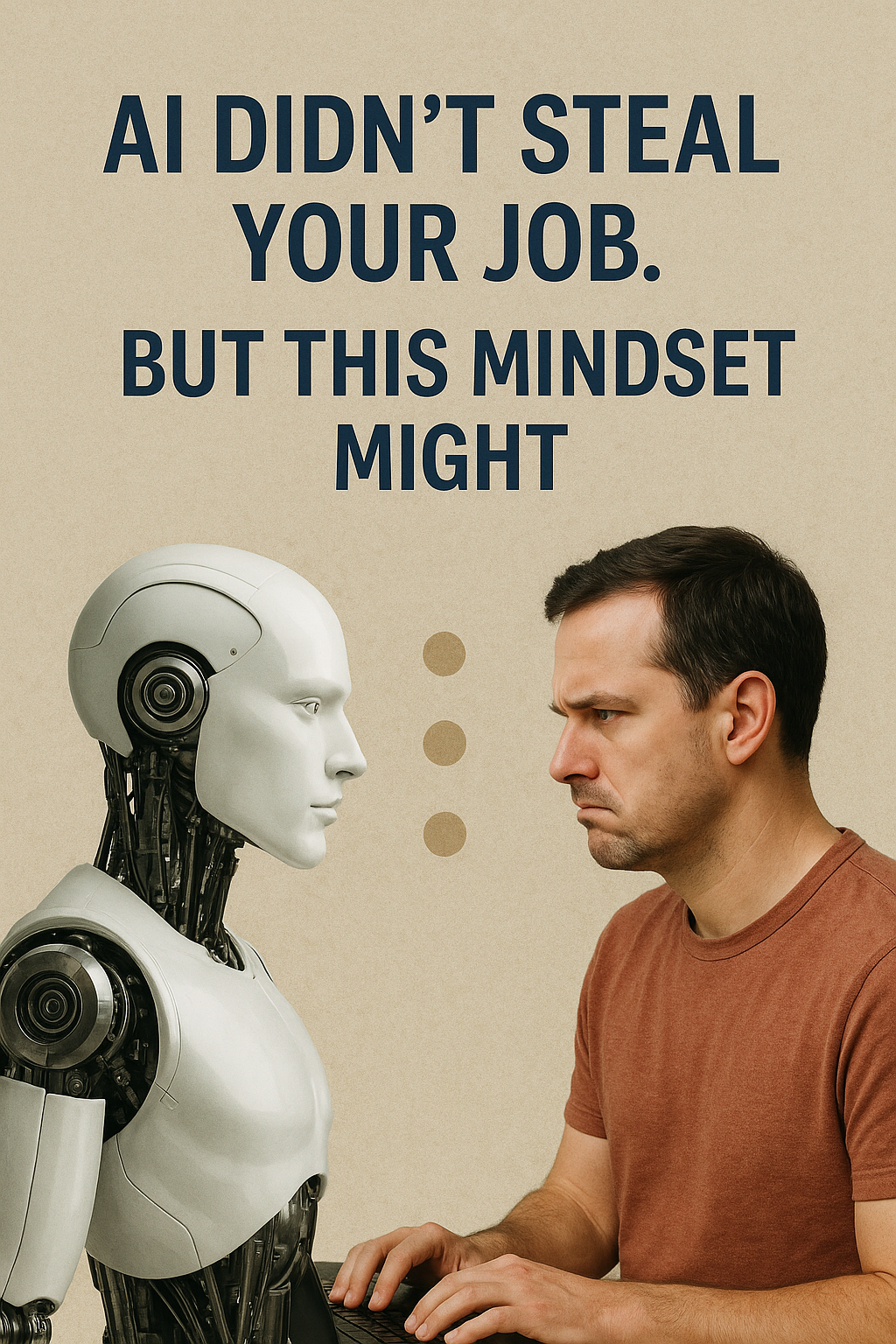
In the era of AI, everyone’s looking over their shoulder. From software engineers to content creators, the fear is universal: “Is a machine coming for my job?” But what if we’ve been asking the wrong question? What if the real threat isn't artificial intelligence but something far more insidious; our own mindset?
The truth is, AI didn’t steal your job. But a fixed mindset, fear of change, resistance to upskilling, and nostalgia for “how things used to be”—those might just be the culprits.
Let’s talk about it.
The Real Automation Threat Isn’t AI—It’s Apathy
Yes, automation is changing how we work. Machines now write code, create art, and even pass medical exams. But we often overlook the fact that technology has always disrupted work. The printing press disrupted scribes. Spreadsheets disrupted accountants. Google disrupted libraries.
Yet, what sets today’s moment apart is the rate of change and how we react to it.
When faced with disruption, people typically go one of two ways:
Adopt and adapt
Resist and retreat
Unfortunately, many choose the latter.
The problem isn’t that AI is capable. It’s that we don’t respond capably. We become passive observers of our obsolescence.
A Fixed Mindset is the Silent Job Killer
Psychologist Carol Dweck coined the terms “fixed mindset” and “growth mindset.” A fixed mindset assumes that intelligence, talent, and skills are static. A growth mindset, however, thrives on challenge and sees failure as a springboard for growth.
In the age of AI, a fixed mindset sounds like this:
“I’m not technical.”
“This is too advanced for me.”
“I’ve done this job the same way for 20 years.”
“I’m too old to start learning about AI.”
Let’s be clear: it’s not AI that’s holding you back. It’s this mental rigidity.
Because in this fast-paced digital economy, learning is the new currency. And those who stop learning voluntarily are already obsolete—AI or not.
We love to say, “AI will never replace human creativity, empathy, or judgment.” True, for now. But those things only count if you're actively using them.
Let’s say you’re a teacher relying on the same outdated materials. A doctor unwilling to learn telemedicine. A journalist who refuses to engage with AI-assisted research tools. A designer ignoring generative art tools.

You may have uniquely human skills, but if you're not applying them in new, relevant, and future-proof ways, you become easier to replace.
The sobering truth? You’re not competing with AI. You’re competing with humans who use AI better than you.
From Scarcity to Abundance: The Mindset Shift You Need
There are two worldviews in this age:
Scarcity Mindset: "There aren’t enough jobs. AI is taking everything. I better protect my turf."
Abundance Mindset: "New tools create new problems. New problems create new opportunities. I want to be ready."
Take creators, for instance. AI now helps with editing, scheduling, scripting, and even voiceovers. That doesn’t mean human content is obsolete—it means creators who embrace these tools can do more with less.
The same goes for lawyers using AI to summarize briefs or doctors using machine learning to detect early-stage cancer. AI doesn't make them less useful—it makes them superhuman.
The choice is yours: adapt or stagnate.
The Great Divide: Tool Users vs. Tool Builders
In every technological wave, there emerges a divide:
Those who fear the tools
Those who learn to use them
And those who build them
Most of us don’t need to become AI engineers. But we do need to know how to talk to AI, understand its capabilities, and integrate it into our work. That starts with curiosity.
A tool is only as dangerous or powerful as the hands that wield it. AI is not your competitor—it’s your collaborator if you let it be.
The question is: are you picking up the toolbox or hiding from it?
Real-World Examples of Mindset Making the Difference
1. Customer Support Professionals
Those who feared AI chatbots saw job cuts. But those who learned to supervise, train, or analyze chatbot data became AI Customer Experience Specialists—a job that didn’t exist 5 years ago.
2. Writers and Journalists
Some fought AI tools like ChatGPT and Grammarly, calling them cheats. Others used them to speed up drafts, fact-check, or break through writer’s block. Many now publish more content, more efficiently, while focusing on deeper human stories.
3. Small Business Owners
Those who embraced AI tools for marketing automation, inventory forecasting, and customer behaviour analytics reported higher productivity and profits. Those who resisted? Still buried under spreadsheets and guesswork.
The lesson: AI rewards the proactive, not the paranoid.
The Most Dangerous Phrase in the Workplace
“This is how we’ve always done it.”
That sentence has killed more careers, companies, and industries than AI ever will.
Kodak said it when digital photography emerged. Blockbuster said it when Netflix appeared. Taxi unions said it when Uber arrived. Teachers, healthcare providers, marketers, factory workers—all have the same choice when disruption arrives: adapt or die.
Change is hard. But irrelevance is harder.
Upskill or Obsolete: The Lifelong Learning Imperative
You don’t need to become a coder to survive AI. But you do need to become a lifelong learner.
Here’s a new mantra for this era:
Learn fast. Adapt faster. Repeat.
What can you do today?
Take a free AI course (Coursera, edX, LinkedIn Learning)
Learn prompt engineering and use AI for small tasks
Stay updated on tools relevant to your industry
Cultivate soft skills: creativity, storytelling, critical thinking
Build a habit of curiosity, not complacency
Embracing the Human Advantage
AI can crunch data, but not. It can simulate empathy, but it doesn’t care. It can generate music, but it doesn’t dance. It can write poetry, but it doesn’t cry.
In a world where machines can do almost everything, what remains sacred is what makes us human:
Emotional intelligence
Ethics and morality
Cultural nuance
Imagination
Intuition
But these don’t flourish in outdated environments. They require evolution, not preservation.
So yes, lean into your humanity. But don’t weaponize it against progress. Use it to shape the future, not resist it.
If AI didn't steal your job, what did?
Was it your reluctance to learn?
Your nostalgia for outdated systems?
Your fear of being a beginner again?
Your overconfidence in being “irreplaceable”?
Technology doesn’t destroy jobs. It transforms them. And it rewards those who transform with it.
So the next time you’re tempted to curse a bot, pause and ask yourself a better question:
“Am I growing with the future or anchoring myself to the past?”
Because the machines aren’t coming for your job.
But your mindset?
That’s already on the move.