11-Year-Old Boy Expelled After Disarming Classmate’s Loaded Gun in Michigan School
An 11-year-old Michigan boy was expelled after disarming a classmate’s loaded gun and preventing a potential tragedy. His case raises questions about zero-tolerance policies, school safety, and fairness.

An ordinary school day at Dwight Rich School of the Arts in Lansing, Michigan, could have ended in tragedy. Instead, it ended in controversy.
An 11-year-old student, Sakir Everett, noticed that a classmate had brought a loaded firearm to school. Acting quickly, he disarmed the child, removed the bullets, and dismantled the weapon so it could not be fired. His quick thinking likely prevented panic, injury, or worse.
But what might have been hailed as an act of heroism has left Sakir without a school.
From Bravery to Expulsion
Following the incident, school officials launched a full investigation, reviewing security footage and interviewing witnesses. Their conclusion was that Sakir had violated the district’s zero-tolerance policy on weapons, which prohibits students from handling or possessing firearms on school property under any circumstances.

Photo Credit: GoFundMe| Savitra Mcclurkin and Sakir Everett
The district’s stance was clear: even though he acted with good intentions, he did not notify staff immediately, and by handling the weapon himself, he put himself and others at risk. Under Michigan law and district guidelines, administrators said they had little choice but to expel him.
For Sakir and his family, the outcome has been devastating. His mother, Savitra McClurkin, described him as a bright student; an A/B grader and athlete with no history of misconduct. Now, instead of moving forward in his education, he’s been shut out of several schools in the district and is relying on an online program that isn’t accredited.
A Divided Public
The decision has sparked widespread public debate. On one hand, many people argue that Sakir should be celebrated for his courage. In their eyes, he did what adults expect of children in moments of danger; he took action. Without his quick response, the situation could have spiralled into a school shooting. To expel him, they argue, is to punish bravery.
On the other hand, school officials and some parents insist that the decision was necessary. Rules around weapons in schools exist for a reason: to minimize risk.
By handling the gun himself instead of immediately reporting it, Sakir may have endangered himself and others. To them, the rule of law cannot bend, even in extraordinary circumstances. If exceptions are made, they argue, policies lose their force.
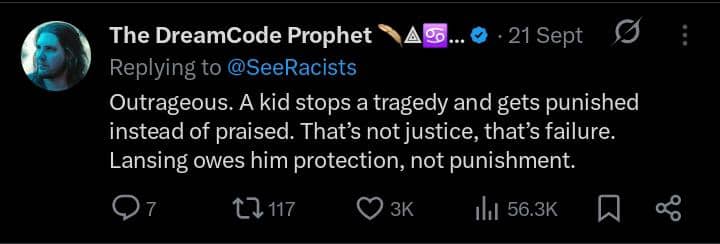
Photo Credit: X, formerly twitter
This tension, between intent and rule, bravery and risk, lies at the heart of the controversy.
Was Expulsion the Right Call?
Whether expulsion was the right decision depends on how we weigh the facts.
Yes, he saved lives. Sakir’s actions disarmed a potentially deadly situation. If we take the scenario to its logical extreme, his intervention may have spared classmates from serious harm. In that sense, his act was heroic.
Yes, he broke the rules. Zero-tolerance policies leave little room for nuance. Handling a weapon on school grounds, regardless of intent, violates those policies. From a legal standpoint, administrators followed the book.
But life is not lived on paper. Rules are meant to serve people, not the other way around. When policies designed to protect children end up harming them, as many believe has happened here, then it is worth asking whether the system is too rigid.

Sakir’s case raises a haunting question: what message do we send to children when we punish them for preventing harm? Will future students hesitate to act in emergencies for fear of being expelled? And if so, is the policy truly protecting schools, or simply protecting the rules themselves?

Photo Credit: Google Maps | Dwight Rich School of the Arts in Lansing, Mich.
A Story Bigger Than One Boy
The expulsion of an 11-year-old for disarming a gun goes beyond a single case. It speaks to broader issues in how schools handle discipline, safety, and compassion. Zero-tolerance policies were designed to keep classrooms safe after decades of rising gun violence, but they often strip administrators of the ability to consider context.
In Sakir’s case, context matters: a child acted to protect his peers. He is now paying the price not for bad intent, but for a system unable to accommodate exceptions.
For some, the district’s decision is a cautionary tale about the dangers of rigid rules. For others, it is a reminder of why those rules exist. What is clear is that this story has touched a nerve, sparking national conversations about school safety, fairness, and the line between policy and humanity.
Conclusion
Sakir Everett may not have seen himself as a hero, but his actions that day very likely prevented a tragedy. Yet instead of being commended, he finds himself isolated, his education disrupted, and his reputation marked by an expulsion.
Was the school right to expel him? Legally, perhaps. But morally? Many would say no. Rules matter, but so does intent. And when an 11-year-old boy chooses courage over fear, perhaps what he deserves most is not punishment, but understanding.
Because if saving lives isn’t enough to protect a child from expulsion, then maybe the rules need to change.