Top 10 Global Economic Powerhouses — What Drives Their Power?
The world’s biggest economies continue to dominate global influence—what sectors and strengths underpin their leadership in the global economic landscape?.
For all the talk of a shifting global order, the same countries still sit firmly at the top of the economic ladder.
The names rarely change, and neither does their influence. What does change, however, is how they maintain that position.
Economic size alone doesn’t explain it. Behind every trillion-dollar economy is a mix of industry, policy, and long-built advantage that keeps it ahead of the rest.
According to projections from the International Monetary Fund, global GDP is larger and more spread out than ever, but a handful of nations still dominate.
The World’s Top 10 Economic Powerhouses
1. United States — $31.82 trillion
The United States leads the global economy by a wide margin. Its dominance in technology, finance, and consumer markets, supported by companies like Apple and Microsoft, keeps it at the centre of global commerce.
2. China — $20.65 trillion
China’s economic story is defined by scale. It serves as the world’s manufacturing hub and a growing force in services and tech. Megacities such as Shanghai and Shenzhen anchor enormous industrial and innovation clusters that feed global supply chains every day.
3. Germany — $5.33 trillion
Germany’s strength lies in precision and quality. Its export-driven model, particularly in engineering and automobiles, has made it the industrial anchor of Europe.
4. India — $4.51 trillion
India has overtaken Japan to become the fourth-largest economy. Its growth is driven by a large, young population and an expanding services sector, particularly in digital and information technology.
5. Japan — $4.46 trillion
Despite demographic challenges and slower growth, Japan remains a global power in advanced manufacturing and electronics. Brands with decades of global recognition continue to anchor its economic presence in key industries.
6. United Kingdom — $4.23 trillion
The United Kingdom combines a rich history of international finance with modern services and technology sectors. London remains a major financial hub, drawing investment from across the world and keeping the U.K. economically influential.
7. France — $3.56 trillion
France blends industrial output with cultural and luxury exports. Its aerospace and luxury goods sectors are globally recognised, and tourism, even after global disruptions, remains a strong economic contributor.
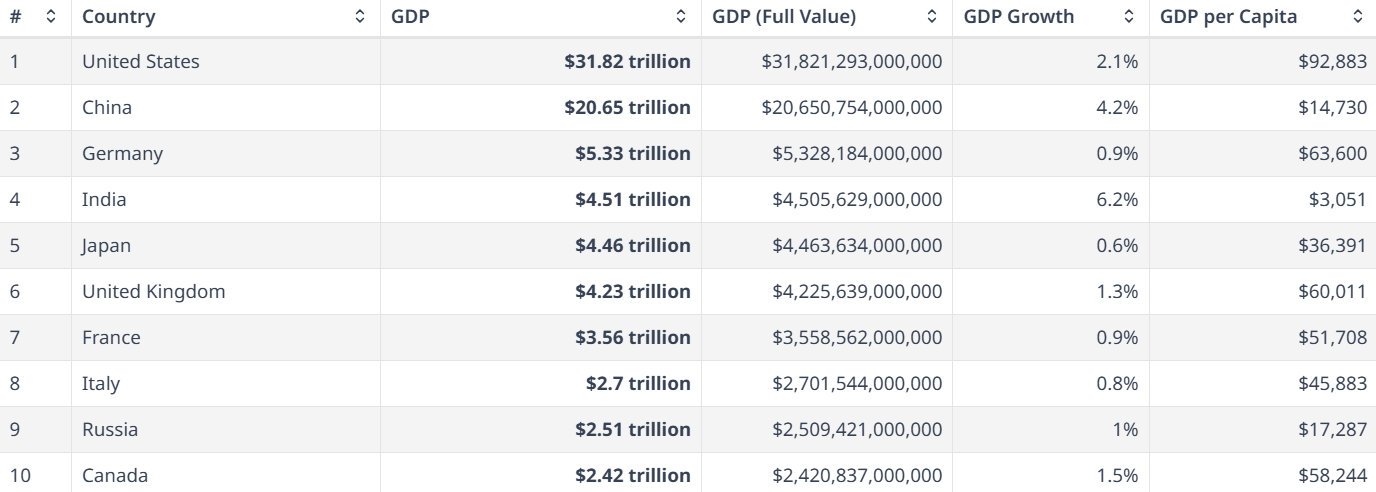
8. Italy — $2.70 trillion
Italy’s economy is driven by manufacturing, luxury fashion, and the food industries. Its export capacity and regional specialisations contribute to its place among the world’s top economies.
9. Russia — $2.51 trillion
Russia’s large economy remains heavily linked to energy exports, especially oil and gas. While geopolitical tensions and sanctions pose ongoing challenges, the scale of its natural resources continues to sustain economic output.
10. Canada — $2.42 trillion
Canada’s economy is supported by rich natural resources and a strong services sector. Close trade ties with larger markets, particularly the United States, bolster its growth and global integration.
What Drives Their Power

Looking at this list, size alone doesn’t tell the whole story.
What unites these economies, whether developed or emerging, is a mix of diversification, strategic sectors, and global integration.
Innovation and technology are perhaps the most visible drivers. The United States and China, for example, are not just leading in GDP size; they are shaping future industries with artificial intelligence, advanced manufacturing, and digital services.
Industrial strength remains a defining advantage for Germany and Japan, where high‑value manufacturing underpins global export competitiveness.
Services and finance are core to economies like the United Kingdom and France, where strong banking, insurance, and professional sectors draw international business and capital.
Demographics and growth potential are especially important for India, where a young workforce and booming tech services offer a long runway of expansion.
Across these nations, strong institutions including legal frameworks, education systems, and infrastructure, also help sustain growth and absorb economic shocks more effectively than many other countries.