The Roar Beneath the Fabric: The Transcultural Story of Isi Agu
How Many Cultures Does Isi Agu Borrow From? When did it arrive in Nigeria? How Much Does Nigeria spend on textile imports, and does Agu really mean Lion, in Igbo?
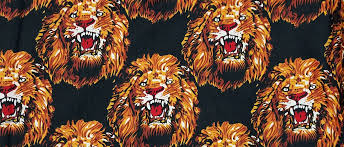
Origins and Manufacturing: From Imported Velvet to Lion’s Head
To most, the Isi Agu may appear as just another patterned fabric—its vivid hues, bold lion heads, and ornate tailoring make it a visual staple in Igbo ceremonies. But behind its flamboyance lies a transcultural journey. Isi Agu, meaning “lion’s head” in Igbo, did not originate from within Igboland’s traditional textile practices. Instead, it is a product of global trade routes, colonial entanglements, and the creative power of cultural adaptation.
The fabric rose to prominence in the late 19th and early 20th centuries, a time of profound transformation in what is today southeastern Nigeria. Originally woven from cotton or silk threads, Isi Agu’s signature lion-head design was not native to the region. Rather, its roots trace back to the Niger Delta, a region with a long history of trade, where the Kalabari people became known for their extravagant use of gold-embroidered velvet fabrics imported from India.
These luxurious Indian velvets, often arriving via European trading companies, were symbols of affluence, worn during high-status events and reserved for the elite. While the Igbo people did not initially produce these fabrics themselves, they were not mere passive recipients. In time, they localized the design, adapting it to align with Igbo cosmology and social hierarchies.

Image Above: Kalabri Velvet. Credit: Sugars Weddings and Parties.
The lion, a powerful and noble beast, was an ideal motif for expressing prestige, courage, and leadership. Though early versions were hand-crafted, modern Isi Agu garments are machine-made, primarily in China or India.
Import and Adaptation: The British, the Indians, and the Igbo

Image Credit: Darcy’s
The path of Isi Agu into the heart of Igbo cultural life is a classic story of hybridization. Its journey was made possible by European colonial trade routes in the 19th century, through which Indian textiles were brought into West Africa in bulk. For British colonial traders, the fabrics were part of a larger economic network—an enterprise in which goods flowed from Asia to Europe to Africa, and back again. But for the Igbo, the fabrics represented something more, a blank canvas onto which cultural identity could be projected.
The adoption of Isi Agu didn’t occur in isolation. As British colonial rule spread across Nigeria in the early 20th century, so did British aesthetics. The style of Isi Agu garments, typically a long-sleeved tunic, sometimes paired with agbada-style robes—echoes the silhouette of Victorian English dress shirts. These styles merged with existing West African tailoring traditions to produce something rather unrecognizable. The result was a garment that looked both regal and modern, both foreign and local.
Social and Cultural Significance: The Lion as a Symbol of the Self

Image Credit: ElyDuo Fabrics and Designs
Though its materials and motifs may have arrived from distant lands, Isi Agu has become deeply embedded in Igbo cultural consciousness. In its early days, the fabric was worn exclusively by titled men, known as Ndi Ichie, or members of the traditional council. These were individuals who had earned distinction in their communities—through wealth, wisdom, or service.
Accessories became powerful signifiers. The iconic red cap, often worn with Isi Agu, denotes seniority, status, and sometimes, political office. Eagle feathers, which may accompany the ensemble, are reserved for titled men and serve as emblems of honor and valor.
The symbolism of the lion plays a central role here. In many African cultures, lions are associated with authority, strength, and the ability to protect. However, rather surprisingly, The Igbo word “Agu” is often misunderstood to mean “lion,”but this is not linguistically accurate. In Igbo, “Agu” actually means “leopard.”
The idea that "Agu" means lion in Igbo is not just linguistically inaccurate, it's also ecologically and culturally disconnected from the realities of southeastern Nigeria; where the leopard, not the lion, held symbolic and environmental prominence. The leopard (Panthera pardus) is native to the forests and savannah-forest mosaics of sub-Saharan Africa, including the southeastern region of Nigeria, where the Igbo people are predominantly found.
In contrast, lions (Panthera leo) prefer open savannahs and grasslands, which are more typical of northern Nigeria and the Sahelian regions of West Africa. So when someone says “Agu N’eche Mba” (“The leopard that guards the nation”), they are referencing both the metaphorical lion, and the literal predator that was part of daily life.

New Times, New Practices
However, as Nigeria modernized and democratized over the 20th century, so too did access to Isi Agu. What was once the preserve of aristocracy became increasingly available to the broader Igbo populace. The shift was subtle but significant. Today, Isi Agu is a common sight at weddings, funerals, and civic events. It has become a visual shorthand for “Igbo-ness”, a cultural marker that provides identity in a rapidly globalizing world.
All That Glitters Is Not Gold
In the era of diaspora and digital visibility, Isi Agu has taken on new life in London, Atlanta, or Johannesburg. But this global visibility also prompts new questions. Where is Isi Agu really made? Who profits from its production?
Today, most Isi Agu fabrics are mass-produced in China or India, using synthetic threads and printed rather than embroidered designs. This global outsourcing has troubling implications—not only for local economies but also for sustainable fashion.
In 2023, Nigeria spent over $4 billion on textile imports, a staggering figure that reflects a deep dependency on foreign suppliers for fabrics, including traditional prints like Isi Agu.
It is an irony that a garment so central to Nigerian cultural identity is so often manufactured abroad. Despite its role as a cultural emblem, Isi Agu has yet to inspire a robust local textile industry capable of meeting domestic demand. The absence of a homegrown production infrastructure not only limits economic opportunity but undermines the very essence of self-determination.
Conclusion
Isi Agu is a story of how cultures absorb, transform, and reimagine; from Indian velvet looms to British colonial tailors, from Igbo titleholders in the 1920s to diaspora wedding parties in 2025.
But with that identity comes responsibility. If Isi Agu is to remain a living tradition and not a fossil of global manufacturing, Nigeria must rethink its dependence on imported textiles. We must learn to weave what we wear.