THE DOLLAR EXCUSE: NIGERIANS’ FAVOURITE SCAPEGOAT
Blaming the dollar has become Nigeria’s national excuse for skyrocketing prices—even for local goods. But beneath the hype lies a deeper story of inflation, transport costs, and broken systems. Here's the truth behind the price madness.
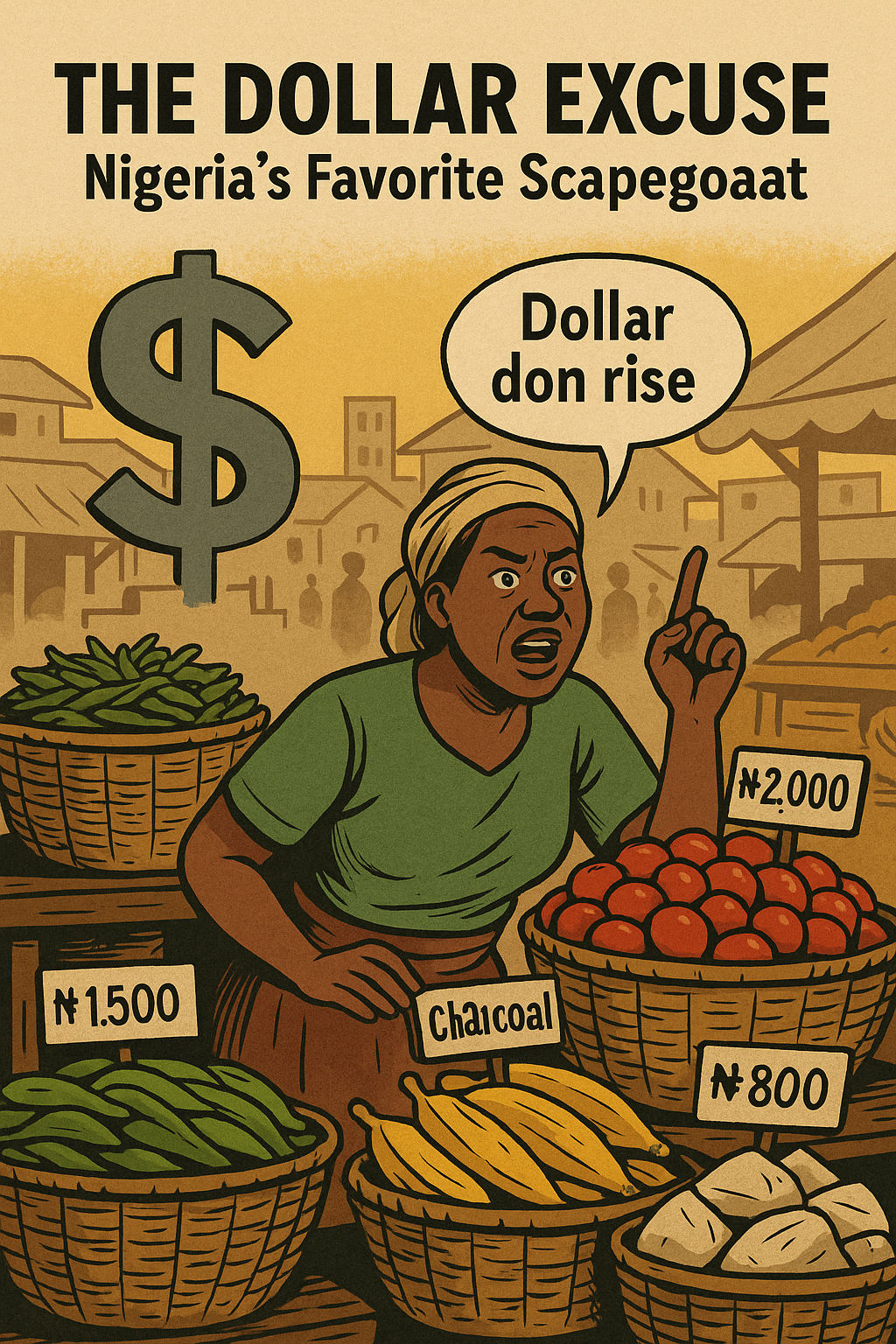
From the tomatoes in your stew to the ogi your grandma takes every morning while watching her favourite African drama, the dollar has somehow become the god of price determination. Ask any market woman why their goods are expensive, and the response is:
“Dollar don rise.”
It doesn’t matter whether the item was planted, harvested, and processed right here in Nigeria; even if you want to buy local charcoal, someone will still find a way to blame the dollar. Even the woman who roasts corn by the junction still blames the dollar when you ask her why her plantains are now costly.
We’ve turned the dollar into a mythical villain, the ghost responsible for everything from the price of onions to the cost of school uniforms. But what’s more frustrating is that this excuse has become a reflex, not a reflection of reality.
A National Obsession with the Greenback
The truth is, many Nigerians now monitor the dollar more closely than the weather. Every small price change triggers speculation:
“Dollar don reach ₦1,500!”
“E go soon reach ₦2,000!”
“That’s why pepper don cost!”
The irony? Half of the time, the people making these claims aren’t trading in dollars, don’t import anything, and don’t even have a domiciliary account. Still, the dollar serves as the all-purpose scapegoat that ends every conversation about prices.
And sadly, many buyers, worn out by years of hardship and policy instability, don’t bother to question it.
The Real Reasons Prices Keep Skyrocketing
Let’s put the dollar aside for a moment and talk about a few other reasons why things are expensive. Because—newsflash—the dollar isn’t the only villain in every story.
1. Inflation: The Silent Thief
Nigeria’s inflation rate is doing press-ups. Prices are rising across the board, and not just because of the dollar. The naira itself has been losing value, which means even locally produced goods are getting more expensive.
Social Insight
Navigate the Rhythms of African Communities
Bold Conversations. Real Impact. True Narratives.
According to the National Bureau of Statistics (NBS), Nigeria’s inflation crossed 30% in 2024. Food inflation alone has been galloping, driven by insecurity, logistics problems, and weak purchasing power.
A farmer who used to buy seeds and fertilizer for ₦50,000 now spends ₦120,000. That cost increase travels to your dinner plate.
2. Fuel Prices and Transportation: The Long Road to Your Market
The cost of moving goods from farms to markets has doubled, thanks to fuel subsidy removal and rising PMS prices. Since mid-2023, petrol has gone from ₦185 to over ₦600 per litre in some areas.
If a truck driver spends twice as much to bring yam from Benue to Lagos, trust me, that yam will arrive with an attitude—and a new price tag.

Some traders are not even moving large volumes anymore. Transport costs are eating into profits, so they bring smaller loads and increase prices to compensate. It’s basic survival, not forex.
3. Middlemen Wahala: Too Many Hands in the Pot
Before that tomato reaches your pot, it has passed through at least five different hands, each person adding their profit. By the time it lands in your market, it’s wearing a designer price tag.
This broken value chain is common in Nigeria’s agricultural system. Without storage, processing, and transport infrastructure, traders depend on intermediaries, and every hand adds its price hike.
4. Hoarding and Greed: Opportunism in Motion
Let’s be real. Some traders just increase prices because they can. They see others doing it and join the bandwagon. It’s not economics—it’s peer pressure.
From fuel hoarding to food warehousing, hoarding is a well-documented tactic in Nigerian markets. It creates artificial scarcity and drives prices up unnecessarily. While, its understanding that the market struggles with fluctuating prices, its quite unfair that some traders deliberately increase the price of their commodities.
Why This Habit is Dangerous
Blaming the dollar for everything is not just misleading; it’s harmful.
1. It Spreads Misinformation
Social Insight
Navigate the Rhythms of African Communities
Bold Conversations. Real Impact. True Narratives.
The dollar is an easy target, but every time we use it to explain every price increase, we confuse people. Traders themselves are misinformed. It makes it harder to understand the real reason for inflation.
2. It Kills Accountability
When we accept "Dollar don rise" as the final answer, we ignore deeper issues—poor infrastructure, high fuel prices, inefficient farming systems, lack of electricity, and bad governance.
For instance, Nigeria still imports over 90% of its refined fuel, a major reason fuel prices are unstable. These are the things we should be interrogating.
3. It Triggers Panic-Buying
The moment people hear "Dollar don rise," they rush to buy in bulk—cement, rice, even baby food, causing artificial scarcity. The fear of future hikes leads to hoarding, and hoarding leads to... you guessed it: more price hikes.
Breaking the Cycle
So, what can we do?
1. Ask Questions
The next time a trader tells you "Dollar don rise," ask them how exactly the dollar affects their local produce. Was the cassava grown in America? Did the egusi cross the Atlantic?
Watch them think twice.
2. Demand Accountability
Government policies play a role in inflation, but we can’t keep letting traders get away with random price hikes just because it’s trendy. Even market unions sometimes fix prices arbitrarily and enforce them. We need truthful pricing and transparency.
3. Support Local Production
The more we rely on local goods and agribusiness, the less power the dollar has over our economy. And supporting local farmers doesn’t just reduce prices—it creates jobs and builds resilience.
Social Insight
Navigate the Rhythms of African Communities
Bold Conversations. Real Impact. True Narratives.
4. Spread Awareness
If you’re reading this, congratulations, you now know better. Tell a friend to tell a friend. Let’s put an end to this market fairy tale. Not every price increase is a forex prophecy.
Final Thoughts
Look, I’m not saying the dollar has zero impact on our economy. Of course, it does. But not everything should be blamed on it. If tomorrow, the dollar falls, will prices drop too?
Exactly.
Until then, the next time someone tells you that yams have become expensive because of the dollar, ask them which border the tuber crossed. If they can’t answer, just smile and walk away.
They’ll get the message.
In short: The dollar is a factor, but not the whole story. Understanding the real reasons behind rising prices helps us make better decisions and demand real solutions.