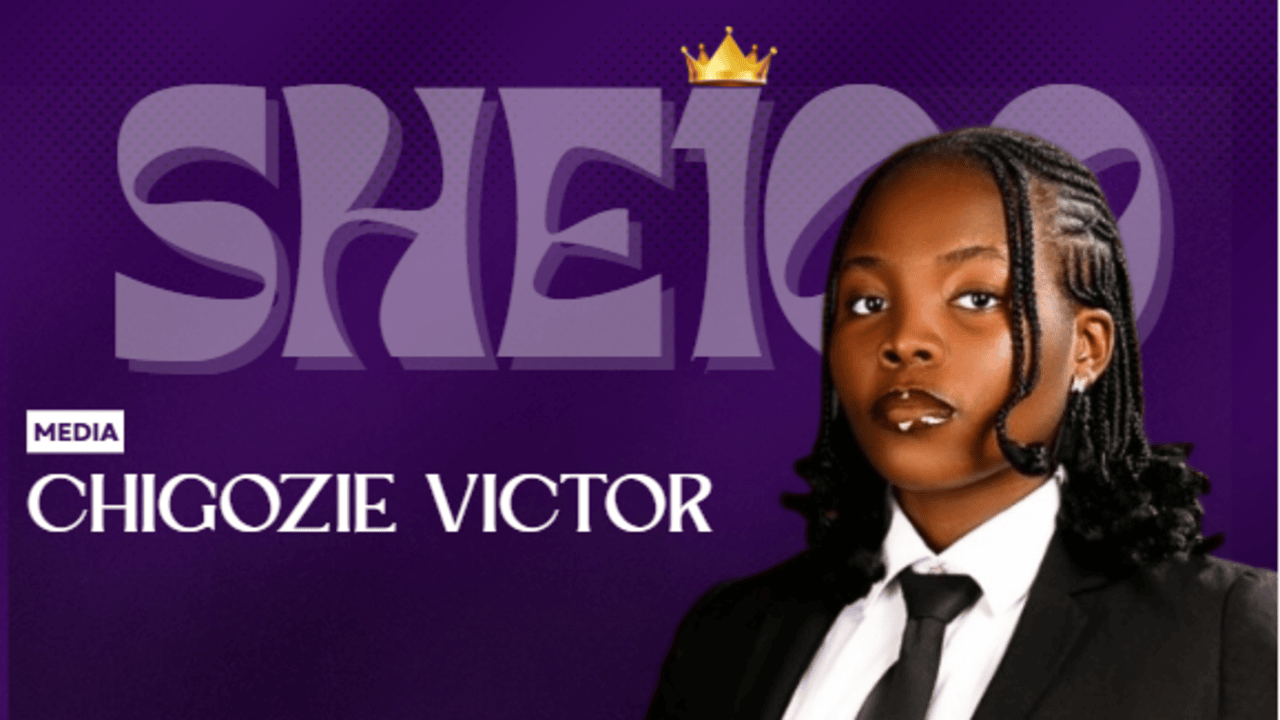
SHE100: The Journalist Making Sure Nigeria Gets Its Story Right — Chigozie Victor
As Senior Editor of Zikoko Citizen, Chigozie Victor covers the systems shaping young Nigerian lives across different topics with clarity, courage, and the stubborn refusal to look away. This is the story of the journalist making sure young Nigerians cannot be ignored.
There is a line on Chigozie Victor's author page at Zikoko that reads like a declaration of war: "I'm stronger than Nigeria." It is four words.
It is also, for anyone who has read her work, an entirely accurate self-assessment. Because to write the stories she writes, about police brutality and policy failures, about gender-based violence and institutional rot, about a government that signs tax reform laws while its citizens go hungry and to write them with the clarity, the precision, and the sustained conviction she brings to every piece, you have to be.
You have to be stronger than the noise, stronger than the discouragement, stronger than the country's bottomless appetite for forgetting.
Chigozie Victor is the Senior Editor of Zikoko Citizen — the civic journalism arm of one of Nigeria's most influential digital media platforms.
She is also, in the most precise sense of the term, a journalist for her generation: one who covers the systems that shape young Nigerian lives not as abstract policy questions but as urgent, lived realities that demand to be named, examined, and held to account.
From Awka to the Frontlines of Nigerian Accountability Journalism
Chigozie Victor studied English and Literature at Nnamdi Azikiwe University in Awka, a discipline that gave her not just the tools of language but the instinct for story, for structure, for the difference between what is said and what is meant.
She graduated with a foundation in the humanities and a clear direction: she was going to be a journalist.
Not the kind that reads from teleprompters or chases celebrities, but the kind that goes where it is uncomfortable and stays until the story is fully told.
Her early career was built across some of Nigeria's most credible accountability journalism platforms.
She has contributed her stories to HumAngle — the Maiduguri-based outlet known for its rigorous coverage of the Lake Chad Basin conflict and humanitarian crisis.
She has written for TheCable, one of Nigeria's most respected online newspapers. She reported for the International Centre for Investigative Reporting—the ICIR—whose work on governance and public finance has set the standard for accountability journalism in Nigeria.
Across all three platforms, her focus has been consistent: security, governance, SGBV, and the policy failures that turned structural neglect into human suffering.
The Journalism That Does Not Look Away

At Zikoko Citizen, Chigozie Victor covers the stories that sit at the intersection of power and ordinary life.
She has written about godfatherism returning to Edo elections and why young Nigerians should care. She has covered the federal government's intervention in the Maiduguri flood disaster.
She has tracked the deployment of the Cybercrime Act against journalists and citizens, documenting in clinical detail how section 24 has been used to punish Nigerians who dared to criticise a sitting president online.
She assessed the state of Nigeria's democracy two years into the Tinubu administration, unflinching, evidence-based, and sharp enough to make comfortable people deeply uncomfortable.
Her year-end accountability piece — the Worst Nigerian Politicians of 2025 — was a masterclass in the kind of journalism that holds power to account without retreating into false balance.
She named names, cited records, and made the case, clearly and without theatre, for why the country's political officeholders had failed the people they were elected to serve.
It was read widely, shared widely, and did what the best accountability journalism always does: made it harder for bad behaviour to pretend it had not been seen.

She has also moderated panels at Zikoko Citizen's flagship events, including the 2025 Citizen Townhall, where she hosted the panel on The Role of the Media in Amplifying Youth Voices, sitting alongside journalists from AFP and Reuters.
The panel produced resolutions that went beyond the room: that positive representation of young Nigerians in the media was non-negotiable, that the media had an obligation to clamp down on misinformation discouraging youth political participation, and that good and bad stories about young Nigerians deserved equal telling.
Young Nigerians Will Be Heard — She Is Making Sure of It
In 2026, Chigozie Victor led the Citizen Townhall themed Who Shapes the Nigerian Life?, an event co-organised with Luminate and the Open Society Foundation, designed to move civic conversation beyond the noise of electoral cycles and toward the systems, institutions, and pressure points that determine how young Nigerians actually live.
The event brought together policymakers, development sector leaders, journalists, and young Nigerians, centering the voices that are most affected by the decisions being made on their behalf and least often consulted about them.
The Nigerian media has always had journalists who reported the facts. What it has needed, in every generation, is journalists who understand what the facts mean to the people living inside them and who write with enough clarity and enough courage to make sure those people feel seen.
Chigozie Victor is one of those journalists. She is still early in a career that is already distinguished. The stories she has yet to tell are the ones Nigeria needs most.
She said it herself. She is stronger than Nigeria. The country, for once, should be glad that she is.