Returning Home Stories: Nigerians Who Returned Home to Build Business
Discover inspiring stories of Nigerian returnees turning challenges into opportunities by building thriving businesses in tech, fashion, health, and more.
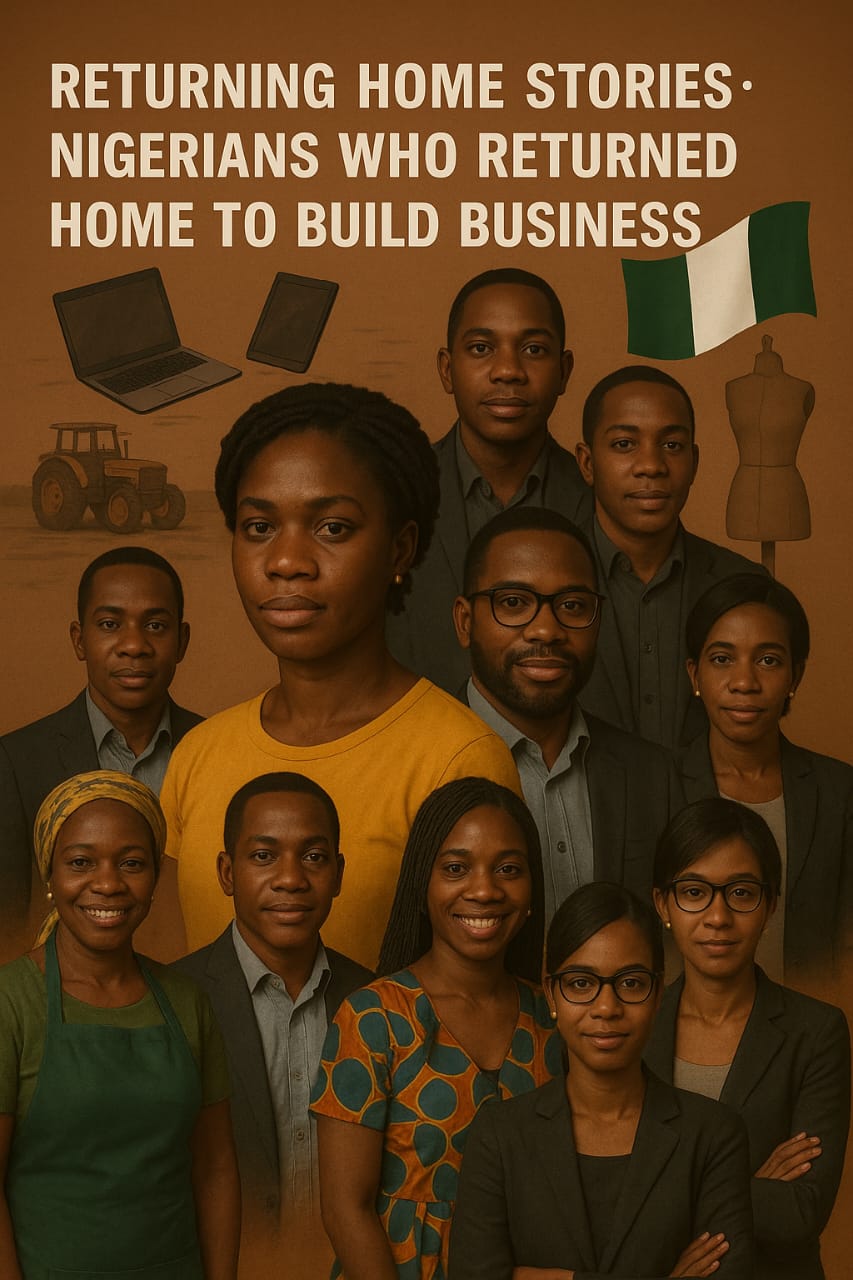
While the popular “japa” narrative focuses on Nigerians leaving for opportunities abroad, an equally powerful movement is happening in reverse. Across tech hubs, farmlands, fashion runways, and boardrooms, Nigerians from the diaspora are returning home to build visionary businesses.
These returnees come equipped with global education, professional experience, and often the clarity that Nigeria’s challenges are opportunities in disguise. Whether they're building air ambulances or fashion houses, these entrepreneurs prove that returning home is not failure—it’s a strategy.
1. Iyinoluwa Aboyeji – Powering Africa’s Next Tech Unicorns

Iyinoluwa Aboyeji is best known for co-founding two of Africa’s biggest startups: Andelaand Flutterwave. Andela tackles Africa’s tech talent gap by training software developers and connecting them with global companies. Flutterwave simplifies digital payments across Africa, making it easier for businesses to transact seamlessly. After years abroad building these tech giants, Iyinoluwa returned to Lagos to focus on nurturing the next generation of African innovators.
He now leads Future Africa, a fund that backs visionary founders solving complex problems across healthtech, agritech, edtech, and fintech. By investing in scalable solutions tailored to African realities, Iyinoluwa is helping create a pipeline of homegrown unicorns that reflect the continent’s unique opportunities and challenges.
2. Tara Fela-Durotoye – Building Nigeria’s Beauty Empire

Tara Fela-Durotoye studied law in the UK but returned to Nigeria with a vision to redefine African beauty. She founded House of Tara, one of the continent’s pioneering makeup and cosmetics brands. What started as a cosmetics company quickly evolved into a platform training thousands of young women in professional makeup artistry, creating employment and entrepreneurial opportunities.
Her work has not only shaped beauty standards but has also contributed to economic empowerment by professionalizing the informal sector. Tara’s commitment to empowering women and celebrating African aesthetics has positioned House of Tara as a household name, inspiring a new generation of beautypreneurs across West Africa.
3. Bilikiss Adebiyi-Abiola – Turning Trash Into Jobs

After graduating from MIT Sloan, Bilikiss Adebiyi-Abiola left behind a promising tech career in the U.S. to address the waste management crisis in Lagos. She launched Wecyclers, a social enterprise that incentivizes low-income households to sort and recycle trash through a rewards system. Wecyclers uses low-cost cargo bikes to collect recyclables, creating green jobs and tackling urban pollution.
By integrating technology with grassroots waste management, Bilikiss has built a sustainable model that empowers communities while protecting the environment. Her work exemplifies how innovative thinking can create inclusive economic opportunities while addressing pressing social problems.
Diaspora Connect
Stay Connected to Home
From Lagos to London, Accra to Atlanta - We Cover It All.
4. Dr. Ola Orekunrin – Revolutionizing Emergency Healthcare

Dr. Ola Orekunrin trained as a doctor in the UK but saw a critical gap in Nigeria’s emergency healthcare. She founded Flying Doctors Nigeria, the first air ambulance service in West Africa, to provide rapid medical evacuation and emergency care. In a country where ambulance services are rare and hospitals are often difficult to access quickly, her service fills a life-saving niche.
Dr. Ola’s innovative approach not only shortens response times but also raises awareness about the importance of emergency healthcare infrastructure. Her work continues to influence health policy and inspire investment in healthcare logistics across Nigeria.
5. Chijioke Dozie – Democratizing Finance


After earning an MBA at Harvard and working in finance in the UK, Chijioke Dozie returned to Nigeria to co-found Carbon, a fintech startup offering mobile loans, payments, and financial tools to millions. Carbon’s platform leverages data analytics to provide instant credit and banking services to underserved Nigerians, many of whom lack access to traditional banks.
By removing barriers to financial inclusion, Chijioke is helping to digitize Nigeria’s economy and provide tools for individuals and small businesses to grow. His vision reflects a growing trend of fintech innovations driving economic empowerment and reshaping financial services across Africa.
6. Seyi Oluyole – Empowering Street Kids Through Arts

Returning from the U.S., Seyi Oluyole founded the Dream Nurture Initiative, a nonprofit organization dedicated to housing, educating, and mentoring vulnerable street children through arts, especially dance. Her programs help children heal from trauma, build confidence, and develop skills that open pathways out of poverty.
By combining creativity with social support, Seyi’s work provides a unique and effective alternative to conventional charity models. The initiative fosters self-expression and resilience, giving at-risk youth a chance to rewrite their stories and contribute positively to society.
7. Ijeoma Ndukwe – From Pap to Prosperity

After experiencing failure with a business in the UK, Ijeoma Ndukwe returned to Nigeria to start fresh with a focus on traditional foods. She founded Bubez Foods, a company that modernizes pap (akamu), a staple Nigerian cereal. By using hygienic packaging, improving nutritional content, and exporting internationally, Ijeoma has elevated a simple, everyday food into a product with global appeal.
Diaspora Connect
Stay Connected to Home
From Lagos to London, Accra to Atlanta - We Cover It All.
Her venture supports rural women and farmers by sourcing ingredients locally, creating sustainable supply chains. This approach highlights the potential of Nigerian foods to compete in international markets while preserving cultural heritage.
8. Emeka Mba – Reforming Nollywood

Emeka Mba returned to Nigeria to lead key regulatory bodies like the Nigerian Film and Video Censors Board (NFVCB) and the National Broadcasting Commission (NBC). His leadership brought structural reforms to the Nollywood film industry, improving censorship processes, funding mechanisms, and distribution networks.
Emeka played a pivotal role in transitioning Nollywood from a market dominated by pirate DVDs to one that embraces digital platforms such as Netflix. His work helped position Nigerian cinema on the global stage, expanding access for filmmakers and audiences alike.
9. Amaka Osakwe – Elevating Nigerian Fashion Globally

Trained in New York, Amaka Osakwe launched Maki Oh, a luxury fashion brand that celebrates Nigerian textiles through modern, elegant designs. Her clothes have been worn by celebrities like Beyoncé, Solange, and Michelle Obama, bringing international attention to African craftsmanship.
Amaka’s work is more than fashion—it’s cultural storytelling. She weaves narratives about identity, heritage, and social issues into her collections, making Made-in-Nigeria excellence visible on global runways and red carpets.
10. Kunle Adeyemi – Designing for the Urban Poor

After a successful career in the Netherlands, Kunle Adeyemi returned to Nigeria to focus on sustainable urban architecture that addresses the needs of underserved communities. His Makoko Floating School project, which gained worldwide acclaim, offers climate-resilient design solutions adapted to flood-prone areas.
Kunle’s work highlights how architecture can respond innovatively to Africa’s environmental realities, providing practical infrastructure while improving quality of life. His approach inspires architects and planners to rethink urban development in the continent.
Why These Stories Matter
These entrepreneurs flip the narrative of “escape” by confronting Nigeria’s challenges with innovation, investment, and relentless optimism. They don’t just build businesses—they build futures.
Diaspora Connect
Stay Connected to Home
From Lagos to London, Accra to Atlanta - We Cover It All.
Programs like the Tony Elumelu Foundation, NITDA Innovation Hubs, and Lagos Innovates increasingly support returnees with funding, training, and networks that turn ideas into viable businesses.
The stories of returnees inspire others to pursue entrepreneurship locally by showing that challenges abroad or during migration can be transformed into opportunities at home. When people see someone who has navigated failure, hardship, or stigma—and successfully built a business back in Nigeria—it creates a powerful example of resilience and possibility.
Returnees often share how support systems like mentorship and financial grants helped them gain confidence to innovate and take risks. Their persistence encourages others to adopt a mindset of perseverance and optimism.
These stories also break down negative stereotypes associated with returnees, fostering a culture that values local enterprise and self-reliance. Leveraging their international exposure and networks, returnees bring fresh ideas and business models that inspire others to explore untapped market opportunities within their communities.
In essence, the journey of a returnee entrepreneur serves as both a beacon of hope and a practical roadmap. It shows that with determination, support, and a clear vision, it is possible to turn the dream of building a business at home into reality, encouraging others to follow suit and contribute to local economic growth and job creation.
If you’re part of the Nigerian diaspora—or even locally based but globally minded—these stories prove that home isn’t just where the heart is; it’s where the hustle thrives.
With a growing digital economy, a youthful population, and endless problems waiting to be solved, Nigeria is fertile ground for those bold enough to return and build.
Who says the grass isn’t green enough here?
Your comeback story could be the next big thing.