Historic Justice: Ghana-Led UN Resolution Declares Slavery a Crime Against Humanity, Demands Reparations
Ghana-led efforts at the United Nations General Assembly have culminated in a landmark resolution formally recognizing the transatlantic slave trade as a grave crime against humanity and calling for reparatory justice. Spearheaded by President John Mahama, the resolution passed with broad support, demanding former slave-trading nations address historical wrongs and ongoing legacies through atonement, potentially including financial compensation and the return of cultural artifacts.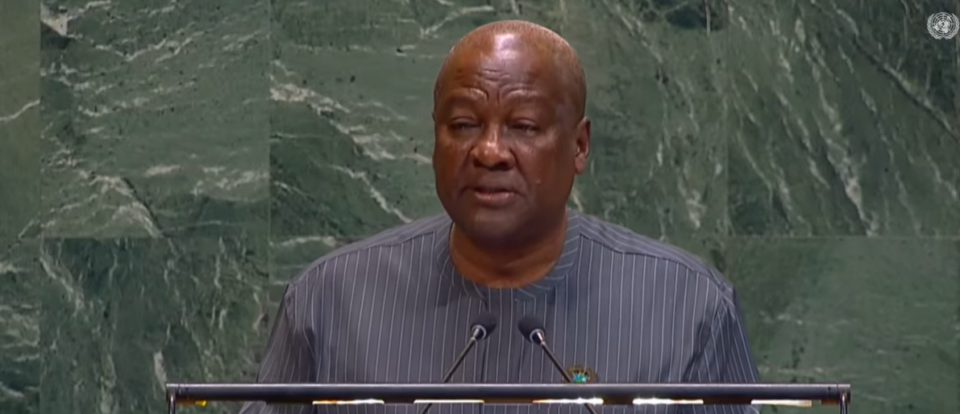
President John Mahama, speaking at the United Nations General Assembly on March 25, called for global unity in recognizing the transatlantic slave trade as one of the gravest crimes against humanity. He urged nations to act in the interest of justice and historical truth, stressing the importance of moral clarity and collective responsibility. Mahama dedicated the day to honouring the estimated 13 million Africans enslaved over centuries, advocating for remembrance through education, storytelling, and global reflection to learn from the past and work towards healing. He recalled that the observance of this day was formally established by the global community in 2007, following a resolution adopted a year earlier.
Representing the African Group, President Mahama highlighted a new initiative to deepen global recognition of slavery's injustice through a draft resolution. This proposal sought to declare "the trafficking of enslaved Africans and racialised chattel enslavement of Africans as the gravest crime against humanity." Mahama explained that this resolution was the product of months of consultations with African institutions, member states, scholars, and legal experts, all working towards a shared position grounded in truth and moral conscience. He emphasized that adopting such a resolution would safeguard historical memory and prevent future generations from forgetting the scale and impact of the transatlantic slave trade, further urging the international community to pursue healing and reparative justice as a turning point in acknowledging past injustices. He called on nations to act with courage and conviction, quoting figures like Theodore Roosevelt and Martin Luther King Jr.
Following this significant diplomatic push spearheaded by Ghana, the United Nations General Assembly subsequently approved a landmark resolution. This resolution formally declares slavery and the transatlantic slave trade as one of the greatest injustices against humanity and explicitly calls for reparations. The vote, concluded on a Wednesday, saw 123 member states in favour, 3 against, and 53 abstentions, marking a significant diplomatic victory for Ghana and reflecting a growing global momentum towards addressing these historical atrocities and their enduring legacies.
The text of the approved resolution unequivocally recognizes the transatlantic slave trade as a horrific tragedy that inflicted centuries of suffering, violence, and economic exploitation upon millions of Africans and people of African descent. It further acknowledges that the enduring legacy of slavery continues to manifest in systemic inequalities, racial discrimination, and developmental deficits that affect African nations and diaspora communities today. A pivotal provision within the resolution demands reparatory justice, urging former slave-trading nations to engage in meaningful dialogue with African states and the African Union to address these historical wrongs. While the resolution refrains from specifying a singular mechanism for reparations, it strongly encourages member states to undertake concrete steps toward atonement, which may encompass financial compensation, debt cancellation, development assistance, and the return of looted cultural artifacts.
Ghana's delegation, under the leadership of President John Mahama, hailed the resolution's passage as a historic milestone in the protracted struggle for recognition and justice. Officials underscored that the resolution establishes a clear moral and political imperative for former colonial and slave-trading powers to confront their past. Speaking in New York, Ghana’s Foreign Minister, Samuel Okudzeto Ablakwa, described the resolution as "a moment of truth for the international community," affirming that "the world has spoken the truth" and that while history cannot be changed, its narrative moving forward can be. The resolution garnered extensive support from across the African continent, the Caribbean, and other regions with substantial populations of African descent, with Caribbean nations, long champions of reparations, notably rallying alongside Ghana. Proponents celebrated the outcome as a turning point, shifting the debate from abstract acknowledgment to actionable demands for justice.