Ghana's Political Firestorm: NPP Delegates Battle for Flagbearer in High-Stakes Primaries
The New Patriotic Party holds its crucial presidential primary today, January 31, 2026, with over 211,000 delegates electing a flagbearer for the 2028 general elections. This historic contest features five aspirants, strict security protocols, and an expanded delegate base, marking a critical test for party unity.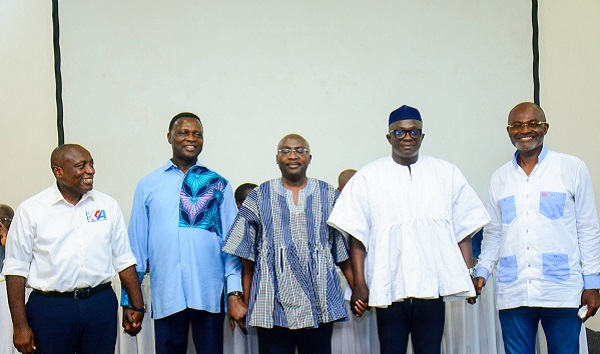
The New Patriotic Party (NPP) is at a pivotal moment in its political history, conducting its presidential primary today, Saturday, January 31, 2026, to elect a flagbearer for the 2028 general elections. This internal contest is described by party officials as one of the largest and most consequential, with over 211,000 accredited delegates participating nationwide. The primaries are being held across all 16 regions, as well as at the national headquarters and selected diaspora voting centres, under stringent security and electoral guidelines.
This critical exercise is not merely about selecting a candidate; it also serves as a significant test of the NPP’s internal cohesion following months of intense campaigning, policy debates, and regional tours by aspirants. Five individuals have successfully filed their nominations to vie for the leadership slot: Kennedy Ohene Agyapong, Dr. Bryan Acheampong, Dr. Mahamudu Bawumia, Dr. Yaw Osei Adutwum, and Kwabena Agyei Agyepong. Party leaders have consistently urged delegates and supporters to uphold the NPP’s long-standing values of discipline, unity, and peaceful competition, explicitly warning against the use of private security or vigilantes that could compromise the credibility of the process.
The delegate base has seen a remarkable transformation since the NPP’s inception in the Fourth Republic. From a modest 1,998 delegates in 1992, the number has surged to a record 211,849 in 2026, reflecting a strategic expansion aimed at broadening the party’s base and decentralising decision-making. This significant growth includes new categories of voters such as former party card-bearing Members of Parliament and Ministers, past National, Regional, and Constituency Executives, TESCON Presidents and Patrons, and External Branch Executives. The largest voting blocs, Greater Accra (40,162 delegates) and Ashanti (36,620 delegates), are expected to be decisive battlegrounds, collectively accounting for over one-third of the total electorate. Other key regions include Eastern (21,598), Central (18,398), and Western (14,122).
Historically, the NPP’s presidential primaries have profoundly shaped its fortunes. Commanding victories, such as John Agyekum Kufuor’s in 1998 and Nana Akufo-Addo’s in 2014, have often translated into stronger national campaigns and electoral success. Conversely, closely contested races have necessitated extensive post-primary reconciliation efforts to maintain party unity. Notable past primaries include Prof. Albert Adu Boahen’s foundational victory in 1992, Kufuor’s emergence in 1996 and 1998, Akufo-Addo’s hard-fought win in 2007 (following Alan Kyerematen’s withdrawal from a potential run-off for unity), and his near-unanimous endorsements in 2010 and 2014. More recently, Dr. Mahamudu Bawumia made history in 2023 by becoming the party’s first Muslim and northern-origin flagbearer, securing 61.4% against Kennedy Agyapong’s 31%.
Logistical and security arrangements for today's election are robust. The Presidential Elections Committee has granted exclusive jurisdiction over security to the Ghana Police Service, explicitly banning all private or unauthorised security arrangements at polling centres. The Electoral Commission (EC) is overseeing the polls. To safeguard ballot secrecy and prevent vote-buying, the party has prohibited mobile phones and other foreign materials from the inner voting perimeters, threatening immediate arrest and criminal prosecution for delegates caught flouting these directives. Delegates must present one of four approved identification documents—Voter’s ID Card, NPP Membership Card, National Passport, or Ghana Card—as vouching is not permitted.
Aspirants have actively engaged in addressing various concerns. Flagbearer hopeful Kennedy Agyapong, through his campaign team, raised concerns about the transportation of ballot papers, alleging that the EC was using unapproved private vehicles in some regions due to a shortage of official ones. He called for heightened vigilance from the EC and Ghana Police Service to ensure electoral integrity and warned against the circulation of old primary videos that could foment disaffection. The EC, however, dismissed these allegations as baseless, asserting its full readiness and commitment to conducting a professional, fair, and transparent election. Meanwhile, Dr. Mahamudu Bawumia’s campaign has been actively addressing what it terms