Following Your Passion Might Be Terrible Career Advice
Telling young people to ‘follow their passion’ might be the worst career advice. Read this Opinion Piece to know why focusing on skills and stability works better.

The first time someone asked me what I was passionate about, I didn’t answer immediately.
Not because I didn’t hear the question, but because I didn’t know which version of the truth was acceptable.
The honest answer was simple: I didn’t know.
But that answer always felt wrong, like admitting failure too early.
Around me, people seemed certain.
One friend loved art. Another wanted to be a lawyer.
Social media was full of young people who had “always known” what they were meant to do. Meanwhile, I liked many things and felt deeply attached to none.
And slowly, the question stopped feeling curious and started feeling accusatory.
What are you passionate about?
By the time career talks started, passion had become a requirement.
Our teachers, online quotes and even motivational speakers repeated it: Do what you love and you’ll never work a day in your life.
But nobody explained what happened if you didn’t love anything like that.
So people picked something not because they loved it, but because they felt they were supposed to. Others waited, convinced that starting without passion was a mistake.
They stayed stuck, afraid of choosing wrong.
What no one said out loud was this: most people don’t begin with passion. They begin with confusion.
I noticed something interesting over time.

The people who enjoyed their work the most weren’t always the ones who started out passionate. They were the ones who had gotten very good at it.
Competence gave them confidence. Confidence made the work more enjoyable.

Enjoyment slowly turned into something that looked a lot like passion.
It was the opposite of what we’d been told.
We were taught to love first, then work. But real life often works backwards: effort leads to skill, skill leads to confidence, and confidence makes room for interest to grow. Waiting for passion before beginning can mean waiting forever.
Mark Cuban, entrepreneur and investor, argues that instead of chasing passion, people should focus on effort and persistence, because passion alone rarely leads to success.
The Reality Passion Doesn’t Address
There was also the part of the advice that felt especially disconnected from reality.
Passion doesn’t pay rent. It doesn’t cover transport, food, or family responsibilities.
Yet “follow your passion” is often delivered as if everyone has the same safety net, the same freedom to fail, the same time to experiment.
For many young people, work isn’t about fulfilment, it’s about stability.
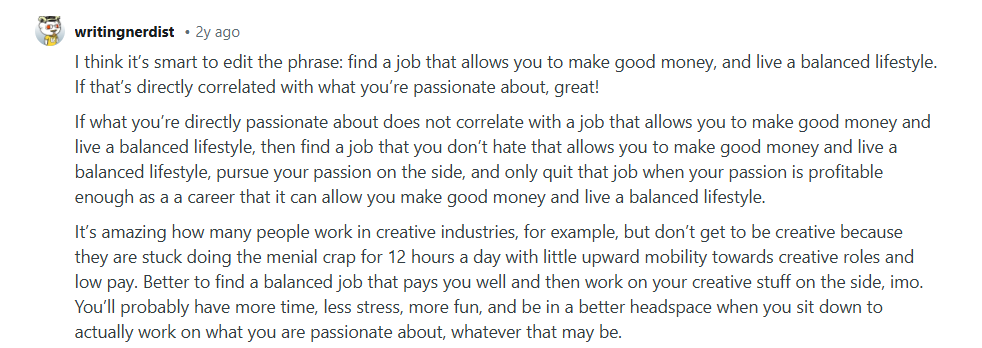
Should Work Become Your Whole Identity?
Another thing I began to notice was how closely work and identity were tied together.
When people are told their job should be their passion, failure feels personal. A bad day at work becomes a judgment on their worth. Burnout feels like betrayal. Quitting feels like losing yourself.
That’s a heavy burden to place on something meant to support your life.
A job can simply be something you do well. It can be a tool. It can fund the parts of your life that give you meaning — relationships, creativity, rest. Purpose doesn’t have to come from your paycheck.
There’s a quiet shame attached to not loving your job.
To choose “good enough.” To find joy outside work instead of inside it.
But some people discover what they love much later. Some never turn their interests into careers. Some keep passion as something sacred, untouched by deadlines and expectations. None of these paths are failures.
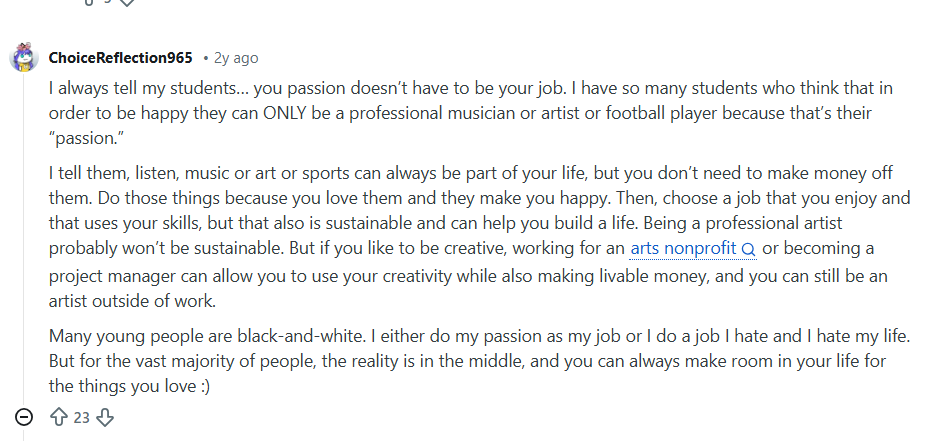
The idea that everyone must turn passion into work flattens the many ways a life can be meaningful.
Eventually, I stopped asking myself what I was passionate about.
I started asking different questions instead.
What am I willing to learn?
What problems don’t exhaust me?
What kind of life do I want this work to support?
What gives me stability right now?
These questions didn’t come with dramatic answers. But they led somewhere. They allowed movement instead of paralysis. And along the way, interests began to form — quietly, without pressure.
Conclusion
You might not agree with me, but “Follow your passion” sounds inspiring, but for many people, it creates anxiety instead of direction.
You don’t need a lifelong calling at eighteen or twenty.
You don’t need to have everything figured out. You are allowed to start without passion. You are allowed to change your mind. You are allowed to build skills first and let meaning catch up later.
Start where you are, build what you can, and let passion grow — if it wants to.