Enterprise AI Heats Up: Glean Reveals Game-Changing Interface Strategy
Glean is emerging as a critical intelligence layer in the competitive enterprise AI landscape, shifting its focus from search to connecting generic LLMs with specific business context. The company's strategy hinges on providing flexible model access, deep system integrations, and a robust, permissions-aware governance framework to empower AI within large organizations.
The landscape of enterprise Artificial Intelligence is witnessing an intensifying battle, with major players aggressively integrating AI capabilities into their offerings. Microsoft is embedding Copilot into Office, Google is integrating Gemini into Workspace, while OpenAI and Anthropic are directly targeting enterprises with their solutions.
Furthermore, nearly every Software-as-a-Service (SaaS) vendor is now launching an AI assistant. Amidst this scramble for the user interface, Glean is strategically positioning itself as a less visible yet crucial component: the underlying intelligence layer.
Seven years prior, Glean initiated its journey with the ambition of becoming the 'Google for enterprise.' This involved developing an AI-powered search tool specifically designed to index and facilitate search across an organization’s entire suite of SaaS tools, encompassing platforms like Slack, Jira, Google Drive, and Salesforce.
However, the company’s strategic focus has evolved significantly. Instead of merely building a superior enterprise chatbot, Glean now aims to establish itself as the critical connective tissue that bridges large language models (LLMs) with complex enterprise systems.
According to Jain, Glean's initial product – an effective search tool – necessitated a deep understanding of people, their workflows, and preferences. This foundational knowledge is now proving indispensable for constructing high-quality AI agents. Jain emphasizes that while LLMs possess immense power, they are inherently generic.
He notes, “The AI models themselves don’t really understand anything about your business. They don’t know who the different people are, they don’t know what kind of work you do, what kind of products you build.” Glean’s core proposition is to supply this missing business context, acting as the intermediary between the reasoning and generative power of AI models and the specific internal data of a company.
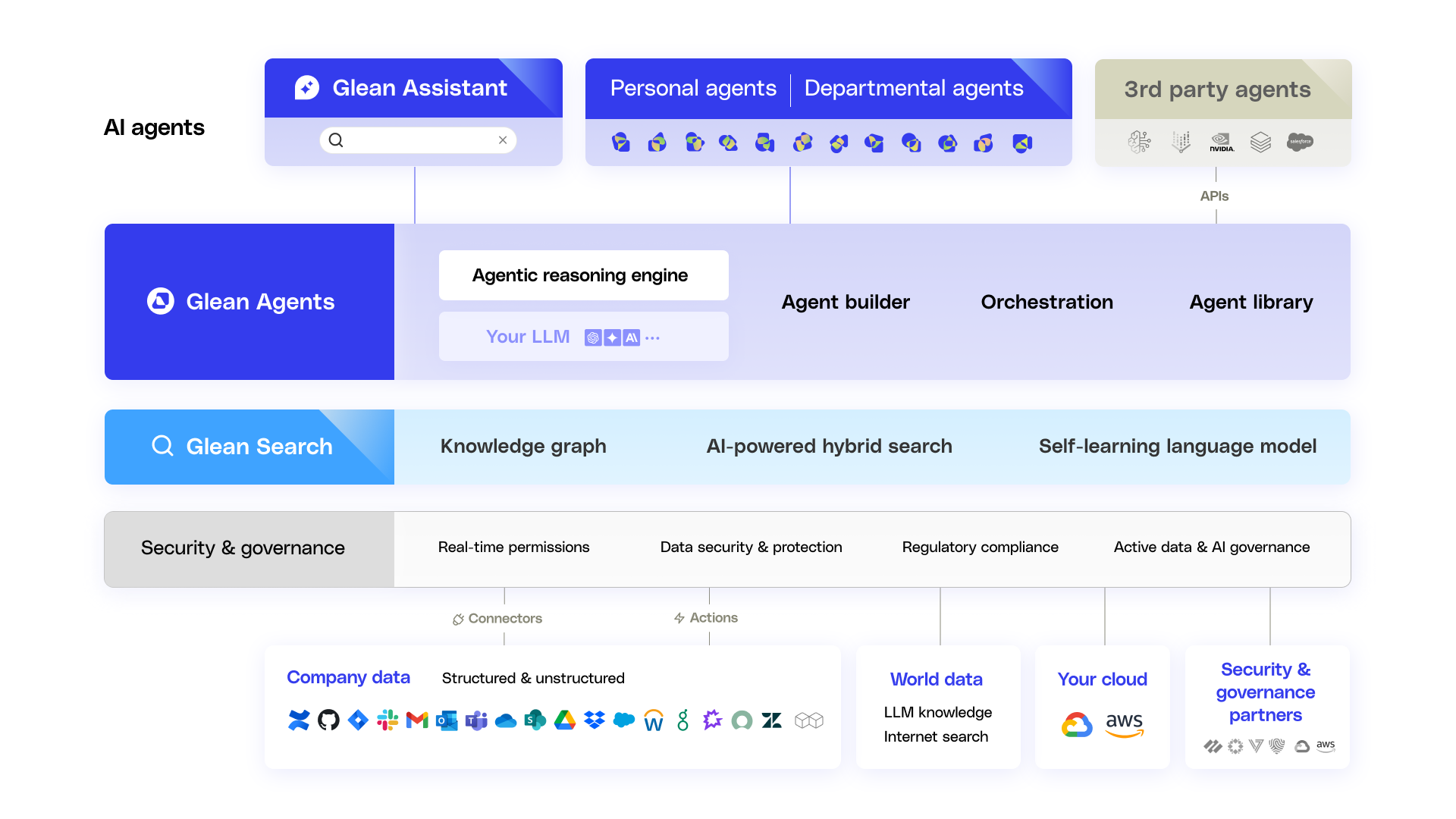
The Glean Assistant frequently serves as the initial point of interaction for customers. It presents a familiar chat interface that leverages a combination of leading proprietary models, such as ChatGPT, Gemini, and Claude, alongside open-source alternatives.
Crucially, this assistant is grounded in the company’s own internal data. However, Jain contends that what truly retains customers is the sophisticated infrastructure operating beneath this user-facing assistant.
The first pillar of Glean’s offering is its innovative approach to model access. Rather than compelling companies to commit to a single LLM provider, Glean functions as an abstraction layer. This design allows enterprises the flexibility to switch between or combine various models as their capabilities advance.
Jain therefore views companies like OpenAI, Anthropic, and Google not as direct competitors, but rather as invaluable partners. He states, “Our product gets better because we’re able to leverage the innovation that they are making in the market.”
The second crucial component involves Glean’s extensive connectors. The platform integrates deeply with a wide array of enterprise systems, including Slack, Jira, Salesforce, and Google Drive. These integrations are engineered to meticulously map the flow of information across these diverse tools, thereby empowering AI agents to execute actions directly within those applications.
Perhaps the most critical element, the third pillar, is governance. Jain underscores the necessity of building a “permissions-aware governance layer and retrieval layer that is able to bring the right information, but knowing who’s asking that question so that it filters the information based on their access rights.”
In large organizational environments, this governance layer is often the decisive factor determining whether AI solutions can progress from piloting to being deployed at scale. Jain cautions against simply loading all internal data into an AI model with a simple wrapper, emphasizing that robust governance is paramount.
Ensuring that AI models do not hallucinate is another critical aspect addressed by Glean. Jain explains that the system rigorously verifies model outputs against their original source documents, generating line-by-line citations to maintain accuracy. Furthermore, it ensures that all responses strictly adhere to existing access rights, bolstering data security and compliance.
A pertinent question arises regarding the longevity of such a middle layer, especially as dominant platform giants continue to expand deeper into the enterprise technology stack. Microsoft and Google already exert significant control over much of the enterprise workflow surface area and are actively seeking to expand it further.
If their integrated solutions like Copilot or Gemini gain equivalent access to internal systems and permissions, the need for a standalone intelligence layer could be challenged. However, Jain counters this by arguing that enterprises typically prefer to avoid being locked into a single model or productivity suite.
Instead, they would gravitate towards a neutral infrastructure layer that offers flexibility, rather than a vertically integrated assistant controlled by a single vendor.
Investors have clearly endorsed this thesis, demonstrated by Glean’s successful Series F funding round in June 2025, which raised $150 million.
This investment nearly doubled the company’s valuation to an impressive $7.2 billion. Unlike many frontier AI laboratories, Glean does not necessitate massive compute budgets to operate. Jain affirms that Glean maintains a “very healthy, fast-growing business,” signaling strong market confidence in its strategic direction.