Earth's Secrets (Part 3): The Lake That Turns Animals to Stone
Discover Lake Natron, Tanzania’s eerie alkaline lake that “turns animals to stone.” Learn the real science behind this natural phenomenon, its role in flamingo survival, and why this deadly lake matters to life on Earth—and beyond.
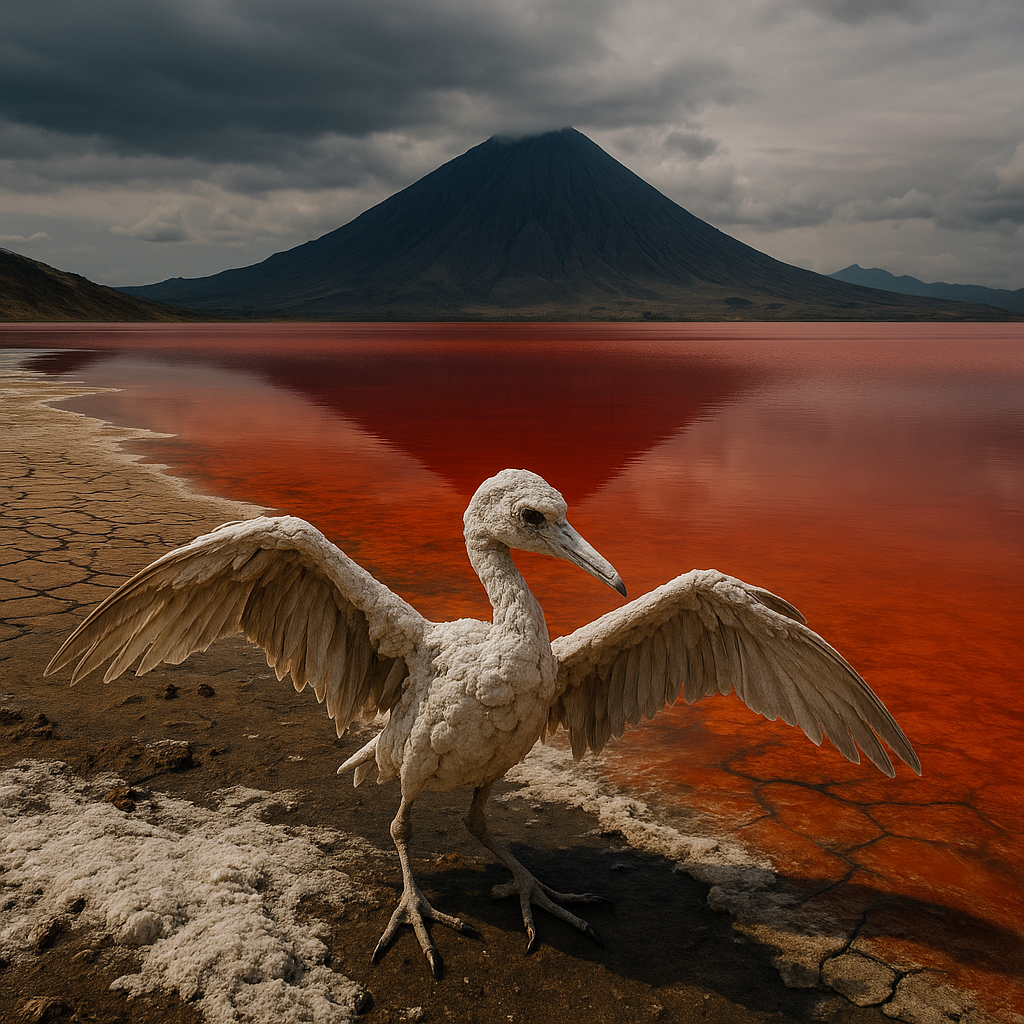
In the remote stretches of northern Tanzania, nestled near the Kenyan border and shadowed by the ominous peak of Ol Doinyo Lengai—the Mountain of God—lies a lake so extreme, so surreal, that it has birthed legends of petrification.
This is Lake Natron, often dubbed “the lake that turns animals to stone.” But how much of that is fact, and how much is myth? Beneath the shocking surface lies a story of harsh chemistry, survival against the odds, and an ecosystem that flips the script on everything we know about life near water.

A Harsh Mirror of Death and Beauty
From above, Lake Natron glows red, orange, or even bright pink depending on the season. Its eerie hue and cracked surface seem like something pulled from a dystopian science fiction film.

Stretching about 57 kilometers long and 22 kilometers wide at its broadest, the lake sits in the East African Rift Valley—a region famous for its geothermal and seismic activity.
The name “Natron” comes from a naturally occurring compound composed primarily of sodium carbonate and baking soda (sodium bicarbonate), which is deposited in the lake from volcanic ash and surrounding mineral-rich rocks.
Over time, high evaporation rates concentrate these salts, making the lake’s waters extremely alkaline, often reaching a pH of 9 to 10.5—close to the strength of ammonia or bleach.
But the lake’s reputation is rooted in its terrifying effect on animal remains.
Do Animals Really Turn to Stone?
The phrase “turning animals to stone” isn’t entirely accurate, but it isn’t pure myth either. What actually happens is far more fascinating.
When birds or small animals die in or around the lake, their bodies are often preserved with unnerving detail due to the extreme alkalinity and high salt content. Photographer Nick Brandt famously captured this phenomenon in haunting images that went viral across the world. He found the calcified remains of birds—especially doves, flamingos, and other small fowls—washed ashore and posed them in lifelike positions for his 2013 photo series Across the Ravaged Land.
According to Brandt, the animals likely died from crashing into the lake due to its glass-like reflective surface, mistaking it for open sky. Once submerged or partially exposed, the intense chemistry of the lake preserved their carcasses in such pristine detail that they appeared almost sculpted from stone.
This preservation is due to a process called calcification—not literal petrification, but a form of desiccation and mineral deposition that dries out tissues and encases them in soda and salt. The effect is startling and immediate in the arid climate of the lake’s surroundings.
Why Is Lake Natron So Alkaline?
The alkalinity of Lake Natron stems from its unique geological context. The region’s volcanoes, particularly Ol Doinyo Lengai, emit lava that is unusually rich in natrocarbonatite—a rare form of volcanic rock that is low in silica but high in sodium and potassium carbonates.

As water flows into the lake (from nearby hot springs and seasonal streams) but has no outlet, it carries minerals that accumulate over time.
Because the climate is hot and dry, the lake loses most of its water through evaporation. This process intensifies the concentration of salts and raises the pH level, effectively transforming the lake into a caustic brine.
In summer, temperatures at Lake Natron can exceed 60°C (140°F) on the surface. Combined with the caustic water chemistry, this creates a habitat that is deadly to most life forms—but not all.
A Paradox of Life: Where Flamingos Thrive
Despite its fearsome environment, Lake Natron is a critical breeding ground for lesser flamingos (Phoeniconaias minor), a species near-threatened on the IUCN Red List. More than 2.5 million flamingos—roughly 75% of the world’s population—rely on this harsh lake to raise their young.
Why here?
The answer lies in evolutionary advantage. The toxic waters of Lake Natron offer protection from predators, many of whom cannot tolerate the lake’s chemical makeup. The flamingos, however, feed on cyanobacteria (Spirulina) that thrive in the salty, alkaline conditions. These blue-green algae not only survive but flourish, giving the water its bright reddish tint.
The flamingos' legs and skin are adapted to withstand the caustic environment, and the mudflats provide safe nesting sites—isolated, desolate, but ironically perfect for hatching life.
A Living Laboratory of Extremophiles
Lake Natron is also a hub for extremophiles—microorganisms that thrive in conditions once thought uninhabitable. These include halophilic (salt-loving) bacteria and alkaliphilic microbes, some of which hold promise for biotechnology and medical research.
These life forms have adapted specialized proteins and cellular structures that resist the corrosive effects of high pH and salt saturation. Their existence challenges our understanding of life and even fuels scientific models of what extraterrestrial organisms might be like.
NASA and other research institutions have studied Lake Natron as an analog for Martian environments due to its dryness, salinity, and high alkalinity. In other words, understanding this lake helps us imagine life on other planets.
Deadly to Some, Sacred to Others
Lake Natron’s reputation is a complex tapestry of fear and reverence. For some local Maasai communities, the lake is spiritually significant, believed to be touched by the divine or the dead.
The nearby Ol Doinyo Lengai, still an active volcano, is the only one in the world that erupts natrocarbonatite lava—a slow, grey-black flow that looks like oil and cools quickly.
In Maasai cosmology, Ol Doinyo Lengai is a sacred mountain where the gods reside, and Lake Natron’s eerie silence and blood-red surface only enhance the mythic aura of the region.
However, traditional beliefs also warn of the lake’s power. Stories abound of animals dying mysteriously or people avoiding its shores during certain times of the year.
Tourism, Conservation, and Controversy
Despite its otherworldly allure, Lake Natron faces threats from human activity. Plans for dam construction on the Ewaso Ng’iro River, which feeds the lake, and proposed soda ash mining have sparked international outrage from conservationists.
If the lake’s delicate water balance is disrupted, it could spell ecological disaster for the flamingos and microbial life that rely on its extreme conditions. Activists argue that short-term economic gain could jeopardize one of East Africa’s most unique ecosystems.
Fortunately, strong opposition from environmental organizations and local communities has so far prevented large-scale industrial development. The lake is now part of a Ramsar Site—a designation given to wetlands of international importance.

Eco-tourism is slowly emerging in the region, with guided trips to see flamingo colonies, the salt flats, and the surreal colors of the lake. But access is difficult, and only the most determined travelers make the journey—a fitting parallel to the life that thrives there.
More Than a Curiosity
Lake Natron is more than a geographical oddity or viral sensation. It’s a testament to nature’s ability to adapt, preserve, and mystify. It challenges our assumptions about where life can exist and how ecosystems evolve.
It’s a lake that "turns animals to stone" only in metaphor—but in reality, it’s a living, breathing chemical laboratory where death and life coexist in startling balance.
Its legacy stretches from ancient volcanoes to future Martian exploration, from flamingo nests to calcified wings, from the myths of Tanzania to the microscopes of the world’s scientists.
If there’s one thing Lake Natron teaches us, it’s that nature doesn't always conform to our expectations. Sometimes, the most dangerous places are also the most vital—and the most unforgettable.