World’s Tallest Church Reaches Full Height After 144 Years in Barcelona
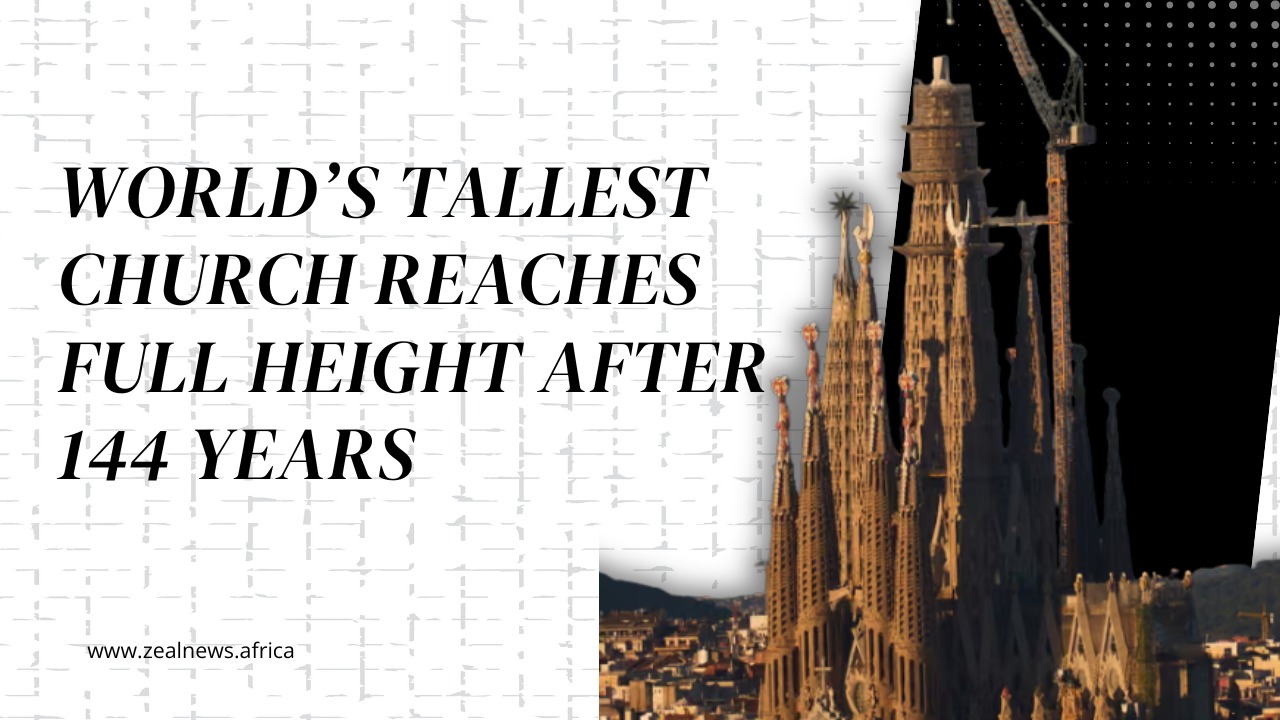
World’s tallest church, Barcelona’s Sagrada Família, is now fully complete at 566 ft after 144 years of construction and decades of Gaudí’s vision.
In a city defined by its silhouettes, one structure has always refused to be finished.
Now, after 144 years of continuous construction, the exterior of the Basílica de la Sagrada Família has reached its most decisive milestone yet.
The final structural component atop the central Tower of Jesus Christ has been installed, bringing the church to its full architectural height of 172.5 meters (566 feet). With that, the tallest church in the world stands externally complete.
For Barcelona, it is the end of an era of cranes. For architectural history, it marks the culmination of one of the longest-running construction projects in the modern world.
For the Catholic faithful and admirers of design alike, it is the near-fulfillment of a 19th-century vision that outlived its creator by a century.
The Final Ascent: Crowning the Tower of Jesus Christ
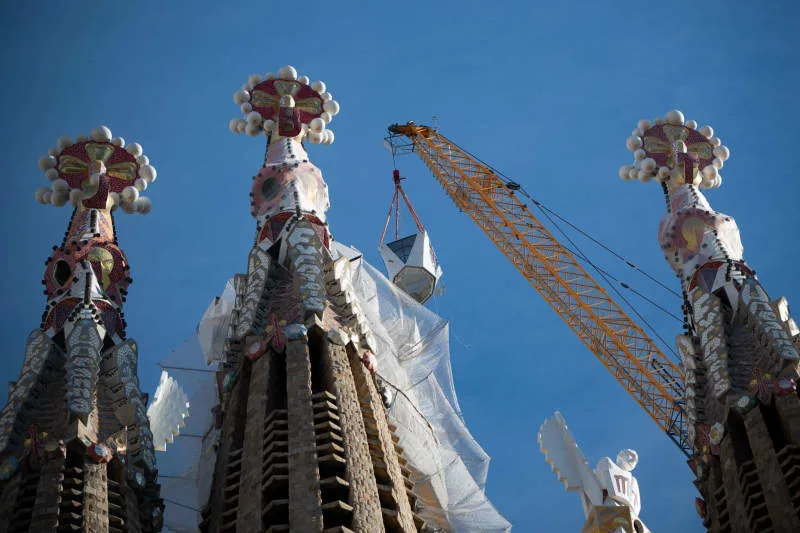
The defining moment came with the placement of the upper arm of a monumental four-armed cross atop the Tower of Jesus Christ. The cross itself rises approximately 17 meters (56 feet) and is clad in white enameled ceramic and glass.
Its final segment, nearly 4.5 meters tall, was hoisted into position by crane, completing the grouping of six central towers that dominate the basilica’s skyline.
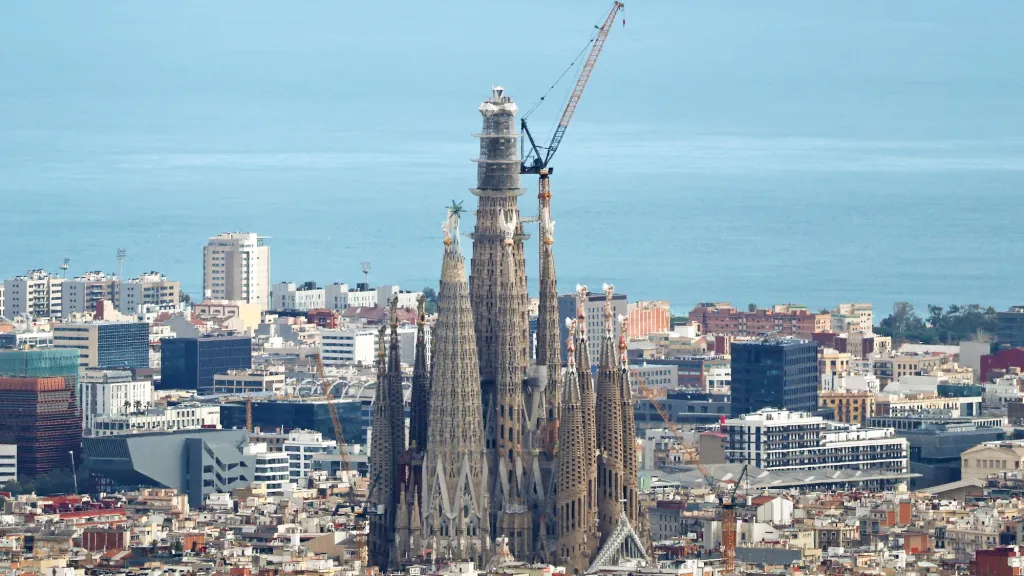
With that installation, the church achieved its full designed height. At 172.5 meters, it now surpasses Germany’s Ulm Minster as the tallest church building in the world.
The cross was not fabricated entirely in Spain. It was constructed in Germany, using materials that include white enameled ceramic tiles, stone interiors, and glass produced in Catalonia.
The sections were transported by ferry and truck to Barcelona before being assembled high above the city. The international collaboration reflects the global scale the project has acquired; far beyond its local devotional origins.
The cross’s geometry is not merely decorative. Its double-twisted form contains a spiral staircase within and is designed to channel light through embedded glazing.
This luminous intention was central to the thinking of the basilica’s chief architect, Antoni Gaudí, who imagined a structure that would “shine day and night.”
A Project Born in 1882
Construction on the Sagrada Família began in 1882. It was conceived as an expiatory temple; funded entirely through private donations rather than state or ecclesiastical coffers. That funding model would shape its destiny.
Unlike medieval cathedrals financed by monarchies or wealthy dioceses, this basilica has depended on public generosity for over a century. Financial slowdowns, political unrest, and technological limitations repeatedly extended its timeline.
The Spanish Civil War interrupted progress and led to the destruction of original plans and models. Reconstruction required painstaking interpretation of surviving fragments.
Gaudí assumed leadership of the project in 1883 and dedicated the last 43 years of his life to it. By the time he died in 1926, after being struck by a tram in Barcelona, less than a quarter of the structure had been completed.
He was buried in the church’s crypt, beneath the evolving monument he had reshaped into something radically different from its initial Neo-Gothic conception.
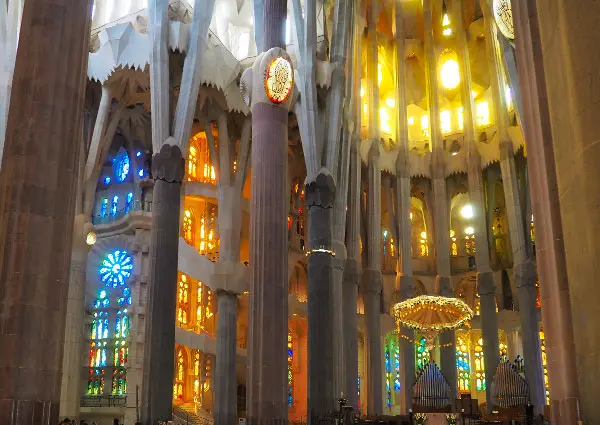
His architectural language blended Gothic verticality with Art Nouveau fluidity, infused with mathematical precision. Columns branch like trees. Vaults follow hyperbolic and parabolic geometries.
Facades narrate biblical events in sculptural stone. Gaudí’s approach was not ornamental excess; it was structural symbolism.

The basilica was consecrated as a minor basilica in 2010 by Pope Benedict XVI, formally recognizing its liturgical significance within the Catholic Church. That moment symbolized institutional validation of a project long sustained by lay devotion.
Engineering Faith Across Generations
The Sagrada Família is not simply an architectural artifact; it is a multi-generational engineering experiment.
Following Gaudí’s death, his discipleDomènec Sugrañes took overconstruction until 1938. Despite his willingness, during the Spanish Civil War there was afire in the crypt, which also affected the provisional schools and the workshop where Antoni Gaudí had left all of the plans and models for others to conclude his work.
This information was not entirely recovered, so we will never fully see what the architect had envisaged.
Successive architects have translated Gaudí’s geometric models, many originally constructed using hanging chain systems, into modern computational design.
Digital modeling, advanced stone-cutting techniques, and 3D fabrication methods have accelerated progress in the 21st century.
Despite the completion of its exterior massing, the basilica remains unfinished in detail. Over the next several years, decorative programs, sculptural installations, and cladding on the arms of the cross will be completed.
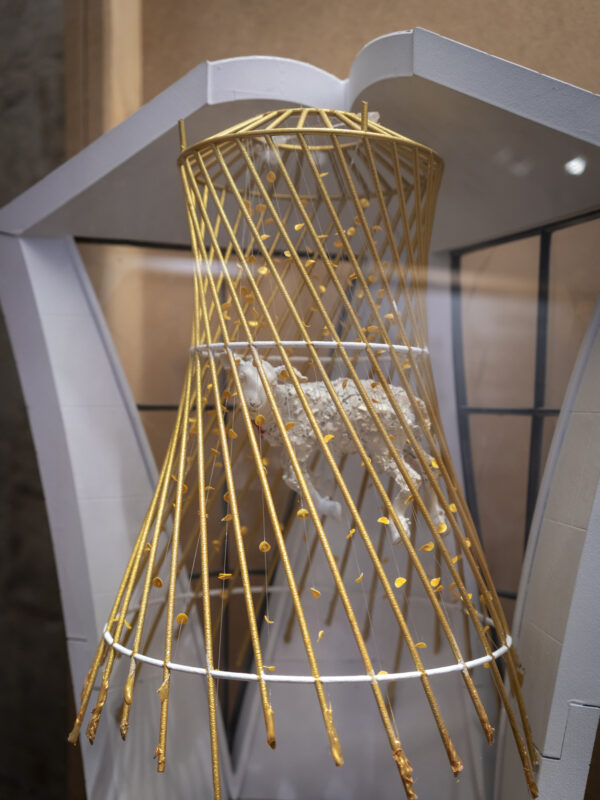
One of the most anticipated additions is the Agnus Dei (Lamb of God), designed by Italian artist Andrea Mastrovito after winning an international competition.
His proposal envisions a hollow glass lamb covered in glass fragments, suspended beneath the cross within a gilded hyperboloid form, an installation intended to evoke theological relationships between matter and divinity.
The projected timeline for full completion extends into the next decade, with 2034 frequently cited as a target date.
The World’s Tallest Church, And a Different Kind of Monument
At 172.5 meters, the Sagrada Família’s central tower redefines ecclesiastical scale. Yet its height is symbolically calibrated. Gaudí intentionally designed it to be slightly shorter than Montjuïc hill in Barcelona, reflecting his belief that human creation should not surpass God’s natural work.
This deliberate restraint reveals the philosophical core of the project. The basilica is ambitious without being triumphalist. Monumental without being imperial.
Its completion coincides with the centenary of Gaudí’s death in 1926. Commemorative events throughout the year aim to honor his legacy and sustain philanthropic support. What began as a neighbourhood devotional project has become one of the most recognized architectural enterprises on earth.
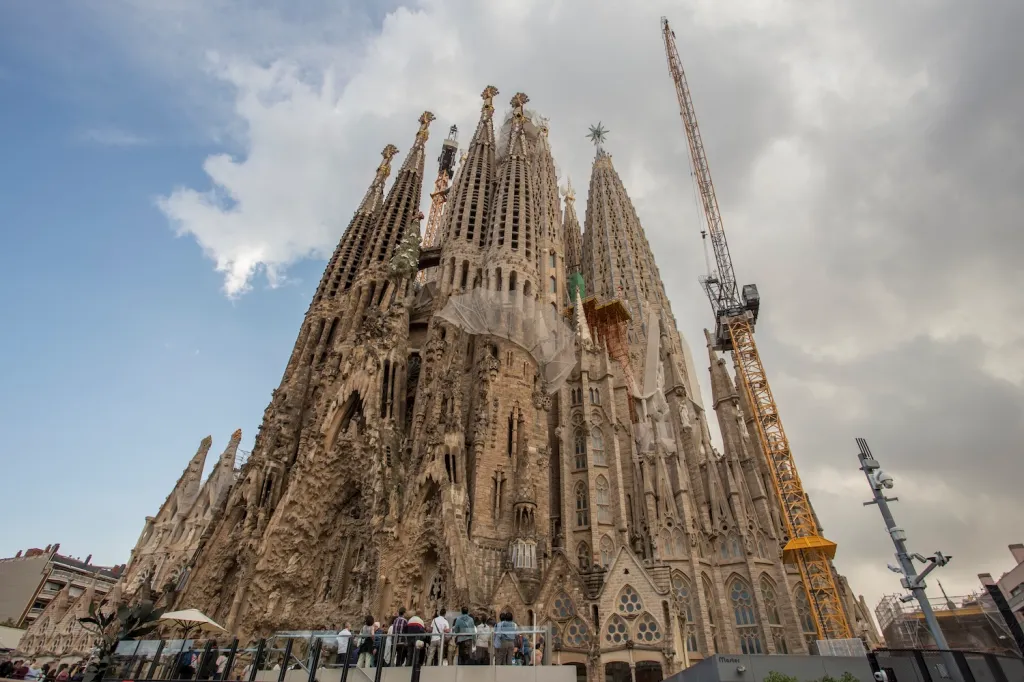
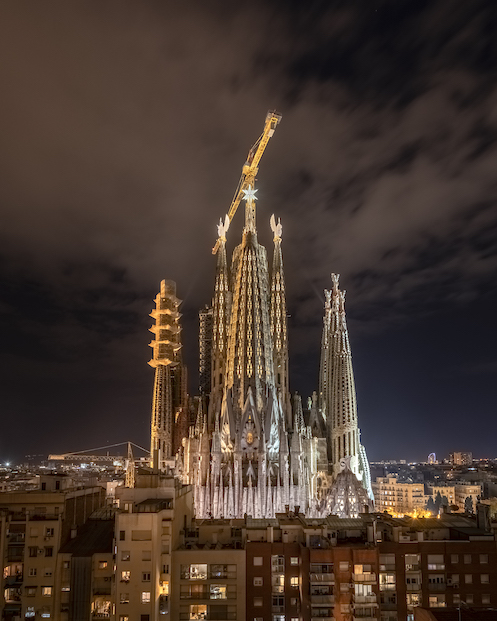
Today, the Sagrada Família defines Barcelona’s skyline. Its 18 planned towers, representing the Twelve Apostles, the Virgin Mary, the Four Evangelists, and Jesus Christ, compose a theological diagram rendered in stone.
A Skyline Finally Unburdened
For decades, tourists photographed the basilica framed by cranes. Construction scaffolding became part of its identity. That visual interruption is now largely gone.
The church stands externally whole; its towers piercing the Mediterranean light without industrial appendage. Internally and ornamentally, work continues. But structurally, the ascent is complete.
What began in 1882 as a modest devotional effort has evolved into one of the most studied architectural works of modernity. Its completion is neither abrupt nor absolute; it is a threshold moment in a project defined by time itself.
When Gaudí took over the design, he reportedly remarked that his client was not in a hurry—referring to God. One hundred years after his death, the skyline suggests that patience has finally touched the clouds.