The Animals That Almost Live Forever
From jellyfish that reverse aging to 500 year old clams, nature has a strange relationship with time.
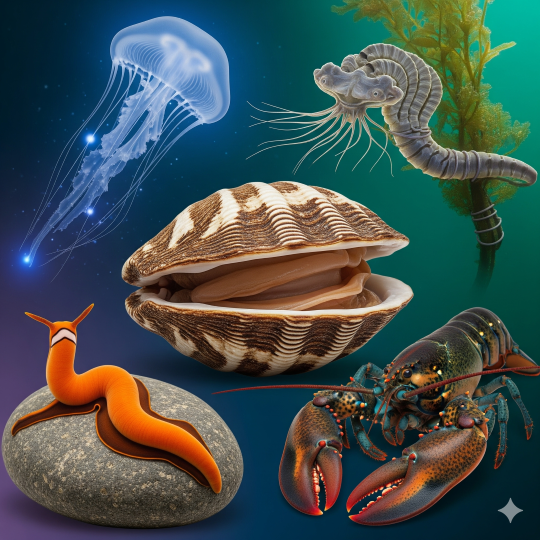
We humans have long been obsessed with immortality. From the epic of Gilgamesh to Silicon Valley biohacking labs, the desire to live forever has haunted and inspired us. And while no human has ever achieved such a feat, nature may already have found the secret—and quietly tucked it into the deep sea, the freshwater pond, and the muddy ocean floor.
Biological immortality is not science fiction. A handful of strange, often overlooked creatures seem to experience life on a completely different timeline—or, in some cases, no timeline at all. These animals either escape aging altogether or sidestep it in such bizarre ways that their biological clocks seem irrelevant.
Here are five such species that might just be the closest thing we have to immortals.
The Jellyfish That Turns Back Time

Image Credit: Earthly Mission
In the warm, quiet waters of the Mediterranean Sea, a tiny jellyfish no larger than your fingernail quietly performs one of the most extraordinary biological tricks ever recorded: it reverses its aging process.
Turritopsis dohrnii, often dubbed "the immortal jellyfish," has become something of a celebrity in the scientific world. Discovered in the late 1800s, it wasn’t until the 1990s that researchers realized just how strange this creature really is.
Most jellyfish follow a one-way trajectory: from larva to polyp, to medusa (the classic jellyfish shape), and eventually to death. But Turritopsis can cheat death by reversing its life cycle. When injured, stressed, or otherwise threatened, the jellyfish reverts from its mature medusa form back to a polyp—the juvenile stage—starting the entire process over again.
It’s as if a butterfly, rather than dying, turned back into a caterpillar. Scientists call this process transdifferentiation, where specialized cells transform into entirely different types of cells. While this doesn’t make the jellyfish invincible—predators and disease still exist—it does make it potentially biologically immortal.
“We have never seen an animal do anything quite like this,” says marine biologist Stefano Piraino. “It’s not just aging slowly. It’s reversing development entirely.”
Lobsters: Ageless Bottom-Dwellers?

Image Credit: Vital Choice
Lobsters don’t just get bigger as they age—they also seem to sidestep aging entirely. These crustaceans have become the stuff of scientific folklore, with tales of centuries-old lobsters lurking in the deep. While those claims are difficult to prove, there's something undeniably strange about how lobsters grow old.
Unlike humans and most other animals, lobsters don’t experience senescence, the gradual deterioration of function with age. They keep growing, reproducing, and regenerating for as long as they live. The secret lies in an enzyme called telomerase, which repairs the protective caps on the ends of chromosomes—called telomeres—that typically shorten with each cell division in most organisms. In lobsters, telomerase stays active throughout their lives, allowing cells to keep dividing without degrading.

In theory, this could mean lobsters could live indefinitely. But in practice, they face a catch-22: molting. As lobsters grow, they must shed their exoskeleton and grow a new one—a process that becomes more energy-intensive with age. Eventually, older lobsters die from complications related to molting or simple exhaustion.
So, while lobsters might not be immortal in the strictest sense, they are a remarkable case of negligible senescence—they age so slowly, it’s practically imperceptible.
Hydra: The Freshwater Time Machine

If immortality had a mascot, it might be the unassuming hydra. These tiny freshwater creatures—named after the mythical beast that grew two heads for every one severed—are masters of regeneration.
Hydras are part of the same phylum (Cnidaria) as jellyfish and corals, but unlike their relatives, they never seem to age. In fact, in 1998, a landmark study by Daniel Martínez declared, “Hydra do not undergo senescence.” More recent research has only confirmed the hydra’s extraordinary biology.
The key to their youthful existence lies in a constant stream of stem cell activity. Hydra bodies are essentially cellular recycling plants, constantly renewing themselves. Most of their cells are replaced every 20 days, including neurons and reproductive cells.
This cellular renewal, paired with their ability to regenerate entire bodies from small fragments, gives hydras what biologists describe as a form of cellular immortality. In laboratory conditions, some hydra colonies have been observed for over four years with no signs of aging—unheard of in the animal kingdom.
It’s not just that hydras don’t age. They might truly be age-less.
Planarian Flatworms: Masters of Regeneration

f immortality is about the ability to cheat death, then planarian flatworms are among the greatest escape artists in nature. These simple-looking worms are famous for one thing: regeneration.
Cut one in half, and you’ll get two fully formed worms. Cut it into ten pieces, and you might get ten. This isn’t some magic trick; it’s the power of totipotent stem cells, which make up about 20% of their bodies. These cells can become any other type of cell, allowing planarians to rebuild entire organs, heads, and nervous systems.
What’s even more bizarre is that some species of planarians reproduce asexually through a process called fission, essentially cloning themselves by splitting and regenerating. This constant self-renewal, coupled with high telomerase activity, means that their cells don't accumulate the damage that typically causes aging.
While planarians in the wild have a range of lifespans (and natural predators), in the lab, some have lived for years, regenerating over and over without signs of degradation. One could argue that each “copy” is a continuation of the original—making them a form of potential immortality through cloning.
The Ocean Quahog: The 500-Year-Old Clam

Image Credit: Sea History
It doesn’t look like much—just a round, hard-shelled clam buried beneath the mud off the coast of Iceland. But one individual Arctica islandica, known as “Ming”, lived for 507 years before it was accidentally killed by researchers trying to study it.
Unlike hydras or jellyfish, the ocean quahog doesn’t regenerate or reverse time. Instead, it wins the longevity game through extreme metabolic slowdown. Living in cold, deep waters, these clams grow slowly, reproduce late, and conserve energy—habits that seem to promote cellular stability over centuries.
Studies show that ocean quahogs maintain stable proteins and low levels of cellular damage even into their 400s. There’s even some evidence that they have better cellular maintenance systems than other long-lived species.
While not technically immortal, the ocean quahog is likely the longest-lived non-colonial animal ever recorded.
What These Creatures Can Teach Us
Each of these animals challenges our assumptions about aging. Some, like the hydra and immortal jellyfish, effectively sidestep aging altogether. Others, like the lobster and ocean quahog, take such slow, deliberate approaches to life that death seems like a long-neglected appointment rather than an inevitable end.
Of course, these creatures live in environments very different from ours: deep oceans, freshwater ponds, frigid seabeds. But they may hold the key to understanding the biology of aging—and perhaps, in time, even extending human life.
For now, though, immortality remains a trick of biology performed by a select few of Earth’s most curious creatures. We may never live forever, but it’s comforting—and a little humbling—to know that something out there already does.