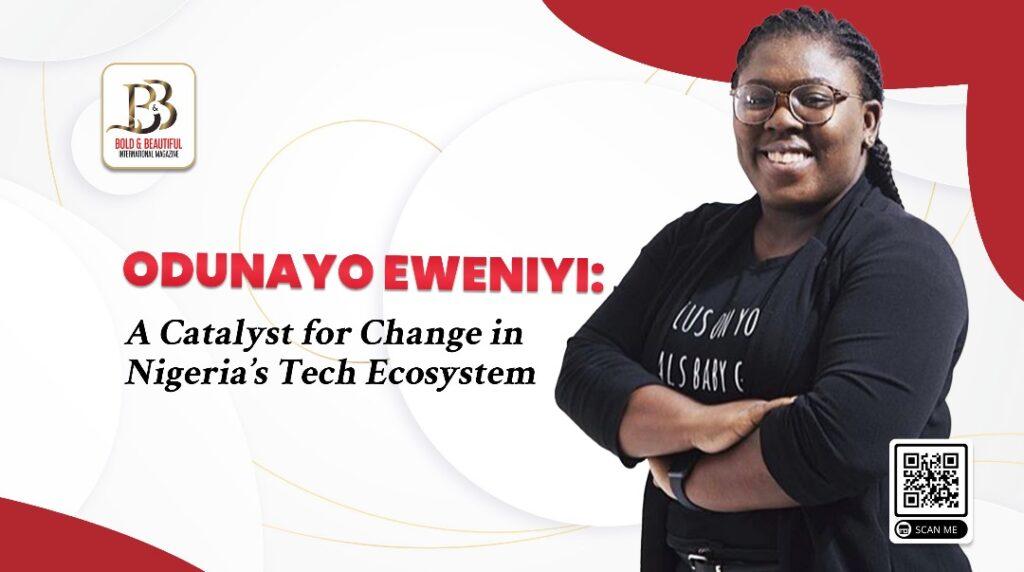
Odunayo Eweniyi: The Girl Who Built a School Out of Refusal
Odunayo Eweniyi, co-founder of PiggyVest, Feminist Coalition, and FirstCheck Africa embodies Africa’s new spirit of leadership. Her story is one of resilience, innovation, and refusal to wait for permission.

Because sometimes saying no is the only way to build.
She didn’t wait for permission, she built anyway. Odunayo Eweniyi’s journey from a frustrated graduate to co-founding PiggyVest,Feminist Coalition, and FirstCheck Africa is a story of quiet rebellion and the new face of African leadership.
A refusal to apologize for being ambitious in a world that still struggles to imagine women as architects of its future.
For Odunayo Eweniyi, that refusal became a blueprint, one written not in manifestos, but in the quiet power of consistent building.
She was born in Abeokuta, Ogun State, and studied Computer Engineering at Covenant University, graduating top of her class. But her story didn’t begin in the glow of Silicon Valley optimism; it began in a country where unemployment, sexism, and bureaucracy often choke potential before it breathes.
Eweniyi and two friends; Joshua Chibueze and Somto Ifezue decided to rewrite that script. In 2016, they launched PiggyVest, an online savings and investment platform that encouraged Nigerians to save money in small, manageable bits. Within five years, it became one of Africa’s most trusted fintech platforms, helping over five million users save billions of naira.


The spark wasn’t luck. It was frustration turned into functionality.
Nigeria’s banking system had long punished small savers with fees and discouragement. PiggyVest flipped that logic on its head: saving should be simple, digital, and inclusive. It wasn’t just a startup; it was a statement that young Nigerians didn’t need permission to create solutions for their realities.
Her hunger to build didn’t stop there. In 2021, she co-founded FirstCheck Africa, a venture capital fund designed to back early-stage startups founded or co-founded by African women. At its heart, it’s not just about investment; it’s about access because too many brilliant women have ideas but not the gate pass to funding rooms still dominated by men. FirstCheck Africa has since supported a new wave of female founders building solutions in finance, health, and education turning capital itself into a tool of liberation.
When the #EndSARS protests erupted in 2020, a youth-led movement against police brutality, Eweniyi’s entrepreneurial spirit collided with her activist heart. She co-founded the Feminist Coalition, a group of young women who organized emergency funds, legal aid, food, and shelter for protesters across the country.
They raised hundreds of thousands of dollars in days, channelling it transparently through crypto and local networks when government accounts were frozen. Their work earned them recognition from outlets like BBC and TIME, positioning them among the vanguard of a new African feminism, pragmatic, collective, and unafraid.
But every act of defiance carries a cost.
The coalition faced intense scrutiny, online harassment, and state hostility. Still, Odunayo and her peers refused to retreat. In interviews, she said she wasn’t interested in heroism; she was interested in systems in making things work for ordinary people. “We weren’t trying to be revolutionary,” she told TIME Magazine, “we were just trying to help.”
Yet, in a nation where empathy is often treated as rebellion, that kind of help was revolutionary.
What makes Odunayo’s story remarkable isn’t just success, it’s structure.
While many startups fade after the funding hype, PiggyVest quietly kept building, expanding into micro-investments, insurance, and financial education. The company became a case study in how African tech could scale by focusing on local behavior, not imported models.
Her leadership style, though understated, reflects a wider continental shift. Across Africa, women are not merely “joining” leadership, they’re redefining its architecture. From fintech founders like Tamarah Fakhoury in Ghana to civic-tech leaders like Juliet Ehimuan in Nigeria, a generation of women are building ecosystems where community sits at the center of innovation.

Critics have sometimes accused these new movements of elitism that feminism or digital entrepreneurship in Lagos, Nairobi, or Accra serves only the educated few. But Odunayo’s response has been through practice, not press releases.
Her company employs and mentors young Nigerians from diverse backgrounds, runs open internship programs, and invests in digital literacy precisely because technology without accessibility becomes another gatekeeper.
She doesn’t call herself an activist in the conventional sense. Yet her life’s work blurs those boundaries where code becomes civic duty, and apps become tools for justice.
On social media, young Africans often quote her speeches during women’s conferences or tech panels. One user on X (formerly Twitter) recently wrote, “Odunayo is proof that you can be radical without raising your voice, you just keep building until they can’t ignore you.”
It captures the quiet thunder that defines her public persona. She rarely dramatizes; she organizes.
Her rise also reveals the contradictions of being young, female, and powerful in Nigeria’s patriarchal economy. For every headline celebrating her achievements, there’s a backlash questioning her tone, her competence, or her “feminist agenda.”
But she keeps building unfazed, unbothered, unwavering.
Beyond the glitter of tech conferences and awards, Odunayo represents something more layered: the ordinary radicalism of women who refuse to wait for permission.
In a continent where politics often disappoints and leadership feels outsourced, these builders entrepreneurs, journalists, artists, activists are creating parallel systems of progress. They aren’t waiting for the state to function; they are functioning despite it.
As Odunayo once said at the Africa Fintech Summit, “We can’t build the future by copying it. We have to build it by living it.”
That statement isn’t slogan-worthy, it’s survival logic.
Today, PiggyVest’s success has inspired dozens of spinoffs across Africa startups for farming, rent saving, and health funding, all founded by young people who grew up seeing chaos but chose structure.
Meanwhile, the Feminist Coalition continues to fund education, healthcare, and women’s empowerment projects quietly across Nigeria, long after the protests faded from the news cycle.
The story is no longer just Odunayo’s; it’s continental. It’s the tale of Africans who are tired of waiting for better headlines, so they’re writing their own.
The truth is, Odunayo Eweniyi didn’t “make it” in the typical sense.
She made space for women, for youth, for a new kind of African logic that believes progress isn’t imported; it’s built from the ground up.
Her journey is a reminder that every system that ignores women does so at its own peril because women have always known how to build without blueprints.

And maybe that’s the quiet revolution of our time:
that Africa’s next headline isn’t about saviors or crises or foreign interventions.
It’s about ordinary people who refuse to wait and build anyway.