Ethiopia Is Betting on Artificial Intelligence to Transform Policing
Ethiopia has introduced Africa’s first AI-powered unmanned smart police service, but will digital policing improve efficiency and public trust, or deepen concerns around access, privacy, and inclusion?

Artificial Intelligence is no longer confined to laboratories, tech companies, or Silicon Valley boardrooms, it is steadily integrating itself into the policing sector of the Ethiopian government.
Across the globe, public sector reforms are becoming synonymous with digital transformation and Ethiopia is not planning to be left out in that transformation.
The country recently unveiled what it describes as Africa’s first fully unmanned smart police service, an AI-powered facility designed to allow citizens to report crimes, traffic incidents, and related complaints without direct human interaction.
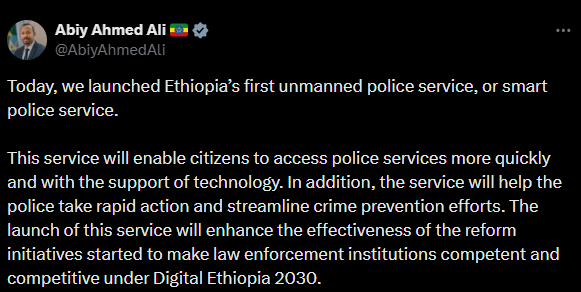
Prime Minister Abiy Ahmed introduced the initiative as part of a broader modernization agenda, developed in partnership with the Ethiopian Artificial Intelligence Institute under the framework of the Digital Ethiopia 2030 strategy.
At the very basis, the concept is straightforward and clear, automating routine police services to reduce bureaucratic delays, limit friction between citizens and officers, and increase efficiency.
Instead of waiting in queues, filling out paperwork, or navigating tense face-to-face encounters, citizens can interact with digital systems designed to log complaints, process information, and trigger responses.

Globally, similar models have been tested in parts of China and the United Arab Emirates, where AI-assisted policing has been integrated into broader smart-city ecosystems.
Ethiopia’s adoption signals an ambition to position itself as a technological leader on the continent, leveraging innovation not only for economic growth but for institutional reform.
The promise is efficiency and the plain message is modernization, but the deeper question is what this shift means for policing itself.
Efficiency or Distance? What AI Policing Means for Citizens and the State

On the surface, AI-driven policing appears progressive—faster reporting could translate into quicker response times, automated logging may reduce paperwork errors, digital systems can create audit trails, theoretically enhancing transparency and reducing opportunities for petty corruption.
For the Ethiopian police force, this could represent operational transformation. Officers may spend less time on administrative intake and more time on investigative or field responsibilities.
Data analytics could help identify crime patterns, allocate resources strategically, and predict high-risk areas. In theory, crime prevention becomes proactive rather than reactive.
For the government, the initiative aligns neatly with digital governance objectives. A streamlined police interface reinforces Ethiopia’s ambition to modernize state institutions and attract investment by signaling technological readiness.
It strengthens the narrative that the country is serious about innovation-led reform.
But technological optimism must be balanced with structural realities and we all need to face it.

The first thing to note here is that digital infrastructure gaps remain significant. Internet penetration and digital literacy vary widely between urban and rural areas.
If reporting a crime requires digital access that many citizens lack, the system risks deepening exclusion rather than improving accessibility.
A smart police station in Addis Ababa may function smoothly, the question is whether citizens in less connected regions will feel equally served and included.

Also the human dimension of policing cannot be ignored. Law enforcement is not merely a transaction, it is often an emotional and social encounter—citizens need to feel fully attended to and their issues resolved.
Victims reporting domestic violence, assault, or community disputes may require empathy, reassurance, and contextual understanding, elements that AI systems struggle to replicate.
Removing face-to-face interaction may reduce friction, but it may also reduce perceived compassion.
Also we cannot ignore the fact that there are legitimate concerns about surveillance and data governance.
AI-powered systems depend on data collection, storage, and analysis, without strong data protection frameworks, cybersecurity measures, and independent oversight, digitized policing could expose citizens to privacy risks.
Algorithmic decision-making, if opaque, can also reinforce biases embedded within datasets.
For citizens, the central question is simple: will this make them feel safer and heard?
If response times genuinely improve and reporting becomes easier, public trust could strengthen. However, if the system feels impersonal, inaccessible, or intrusive, skepticism may grow.
Policing, especially in developing democracies, depends heavily on public confidence and in this context technology cannot substitute legitimacy.
There is also a workforce implication, as automation expands, the role of frontline officers may shift.
While AI may not eliminate jobs outright, it may redefine responsibilities, requiring new digital competencies within the force. Training and institutional adaptation become critical.
In short, AI in policing is neither inherently progressive nor inherently problematic, its impact will depend on implementation, oversight, and inclusivity.
Between Innovation and Inclusion: The Broader African Context

Ethiopia’s move must be understood within a continental wave of digital governance reform. African governments are increasingly integrating AI into tax systems, health registries, and public services.
Kenya, for example, has advanced digital government platforms under its e-citizen framework, streamlining public service delivery while exploring AI applications in public administration.
The broader lesson is clear: digital transformation works best when infrastructure, regulation, and public trust evolve simultaneously.
Ethiopia’s smart police initiative represents ambition, it reflects a willingness to rethink traditional state functions and test emerging technologies in sensitive domains.
That in itself is notable. Public safety is not a peripheral service; it is foundational to national stability.
But modernization must remain people-centered and that is what Ethiopia is trying to do.
If AI reduces corruption, accelerates reporting, and improves crime response, it could mark a turning point in how African countries conceptualize law enforcement.
If, however, digital gaps widen inequality or data governance lags behind deployment, the system may struggle to achieve legitimacy.
Ultimately, the success of Ethiopia’s AI policing experiment will not be measured by how advanced the technology appears, but by how effectively it balances efficiency with empathy, automation with accountability.
Technology can streamline systems but it cannot replace trust and in policing, trust is the most critical infrastructure of all.