Trump Drops Bombshell: US Demands Europe Repay All Ukraine Aid
Former US President Donald Trump demanded that European nations repay American aid to Ukraine, while separately addressing US military munition capabilities. Concurrently, the World Health Organization confirmed a third attack on one of its main humanitarian warehouses in Ukraine, underscoring a worrying trend of strikes on aid facilities across the country.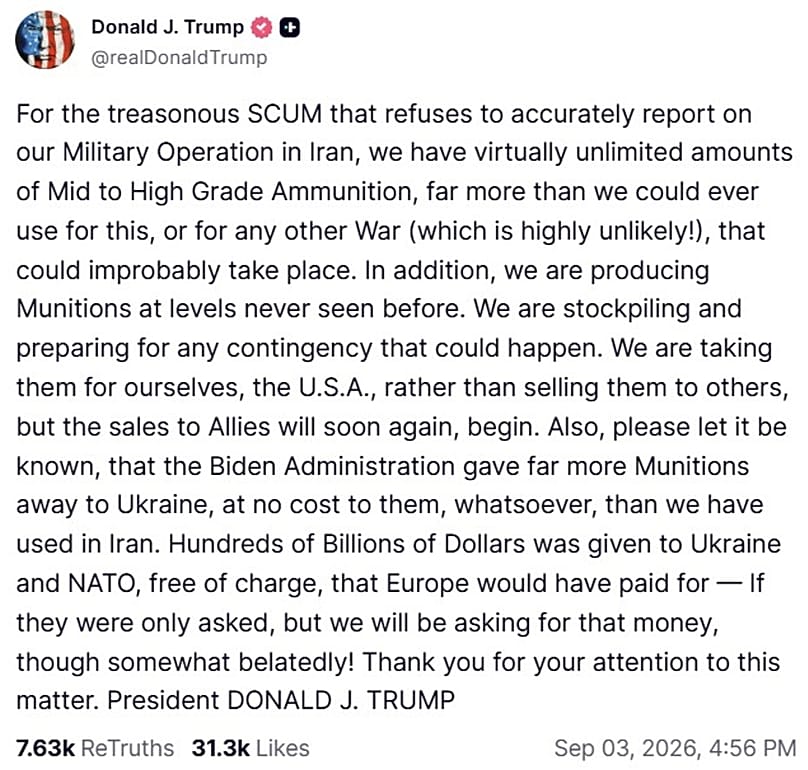
Former US President Donald Trump announced on Thursday his intention to demand that European nations reimburse the United States for the aid provided to Ukraine during the administration of his predecessor, Joe Biden. Trump, who has consistently advocated for Europe to bear a greater share of the financial burden for supporting Ukraine in its conflict with Russia, articulated his position on his Truth Social platform. He stated, "Hundreds of Billions of Dollars was given to Ukraine and NATO, free of charge, that Europe would have paid for - If they were only asked, but we will be asking for that money, though somewhat belatedly!" While the American president did not specify which particular countries he expected to repay the funds, his sentiment highlighted a long-standing demand for increased European financial contribution.
The United States has provided substantial military assistance to Ukraine since the conflict began. The US State Department reported in March of the previous year that Washington had allocated $66.9 billion in military aid since Russia's full-scale invasion of Ukraine on February 24, 2022. This figure rises to approximately $69.7 billion in military assistance since Russia's initial invasion of Ukraine in 2014. Furthermore, the department noted that the emergency Presidential Drawdown Authority had been utilized 55 times since August 2021, providing Ukraine with military assistance totaling approximately $31.7 billion from Department of Defense stockpiles. Despite Europe having significantly increased its aid allocations to Ukraine earlier in the year, the continent continues to heavily rely on weapons from the US for its military support, according to the Kiel Institute for the World Economy's Ukraine Support Tracker.
In a separate statement on his Truth Social account on September 4, 2026, Trump also refuted reports suggesting that the US military was experiencing a shortage of munitions. He claimed, "We have virtually unlimited amounts of Mid to High Grade Ammunition," asserting that munitions production was at "levels never seen before." Trump added that Washington was actively building up stockpiles and preparing for various contingencies. He mentioned a temporary suspension of overseas arms sales, stating, "We are taking (munitions) for ourselves, the U.S.A., rather than selling them to others, but the sales to Allies will soon again, begin."
Meanwhile, the World Health Organization (WHO) reported on Friday that one of its primary warehouses in Ukraine was impacted by an overnight air attack. This incident marks the third such occurrence involving a WHO warehouse in Ukraine within a span of three months. Christian Lindmeier, a WHO spokesman, informed reporters in Geneva that the air attack in Kyiv Oblast affected a main WHO warehouse used for storing humanitarian medical needs and supplies. Access to the site remained restricted due to heavy smoke and safety concerns, with ongoing assessments to determine the extent of possible damage and stock losses. Fortunately, no WHO personnel were affected during the incident.
Lindmeier emphasized that these attacks are indicative of a broader pattern affecting humanitarian operations across Ukraine. In 2026 alone, at least 20 attacks have targeted warehouses storing humanitarian supplies, with 15 of those specifically holding health-related humanitarian provisions. Over the past three months, three warehouses utilized by the WHO in different regions of Ukraine have been damaged by airstrikes, leading to the destruction of essential medical supplies intended for frontline and hard-to-reach areas. Two weeks prior to this latest incident, an attack destroyed a humanitarian warehouse in Dnipro, resulting in the loss of half of its medical supplies and equipment, which were meant to support an estimated 225,000 people. Additionally, another WHO-used warehouse in the Kyiv Oblast sustained damage during a large-scale wave of attacks on the capital and wider region in July.
The WHO spokesperson highlighted that all UN and WHO locations, including warehouses, are typically "deconflicted," meaning their precise locations are clearly communicated to all parties involved in an armed conflict. The WHO systematically verifies and records attacks on healthcare facilities but refrains from attributing blame, as it operates as an observation agency rather than an investigative body. Since Russia's full-scale invasion began in February 2022, the UN agency has verified over 3,000 attacks in Ukraine. International humanitarian and rights law affords protection to health facilities and the broader health system.