The Strategy That Made MTN Africa's Biggest Telecom Success Story
How did MTN become Africa's biggest telecom company? A closer look at the business strategy, timing, expansion, and fintech playbook behind its dominance

In August 2001, a Yellow-branded network went live in Lagos and changed what it meant to own a cell phone in Nigeria. Two decades later, that same company, MTN, sits as Africa's largest telecommunications operator, present in roughly 20 countries and carrying hundreds of millions of subscribers on its network.
Understanding how MTN built this position, and why it has proven so difficult to dislodge even amid regulatory clashes and nationalist pressure, says as much about business strategy as it does about telecom infrastructure.
How MTN Entered Nigeria at the Right Moment
MTN's Nigerian story began with deregulation. In 2001, under President Olusegun Obasanjo, the Nigerian government auctioned digital mobile licenses for $285 million each, ending the state telecom monopoly held by NITEL.
MTN and Econet Wireless (now Airtel) both won licenses and launched services within days of each other, with Econet making the country's first GSM call and MTN following almost immediately after.
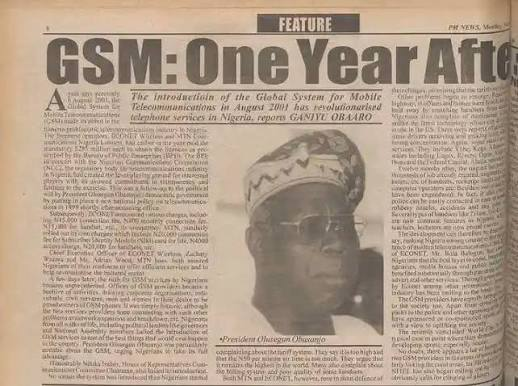
For roughly two years, these two operators effectively controlled a market of over 100 million people who had never owned a functioning phone line. SIM cards sold for tens of thousands of naira which was the equivalent of over $100 at the time.
Voice calls were charged at N50 per minute regardless of how briefly you spoke. Owning a mobile line became a status symbol reserved for the wealthy but that changed in 2003.
Globacom entered as Nigeria's first indigenous operator, introducing per-second billing and cheaper SIM cards, forcing MTN and its rivals to finally compete on price.
One thing to note here is that MTN being early into a deregulating and underserved market let MTN acquire millions of loyal, habit-forming customers before competition arrived to correct pricing.
That early subscriber base and the brand recognition built during those first two years, became the gap competitors have spent over twenty years trying to close.
The Underserved Market Playbook Across the Continent
MTN's expansion pattern across Africa followed a deliberate pattern.First, chase markets where telecom penetration was low and the government appetite for private investment was high.
That was how the company's first international move came in Uganda in 1996, followed swiftly by entries into Rwanda, Cameroon and Swaziland by 2000.
In many of these markets, MTN was not fighting other mobile networks for share. It was replacing the near-total absence of communication infrastructure, in some countries reaching populations where over 70% of people had never made a phone call.
This is a classic emerging-market strategy: enter where friction is highest and competition is lowest, absorb the early cost of building networks from scratch and let scale advantages compound once demand catches up.
MTN backed this with capital raised from its 1995 Johannesburg Stock Exchange listing and later cemented its footprint through the 2006 acquisition of Investcom, which pushed the group into new African and Middle Eastern markets and turned it into a genuinely multinational operator.
Why Banning MTN Is Harder Than It Sounds
MTN's South African ownership has periodically drawn nationalist criticism in countries where it operates, including calls in some markets to remove foreign telecom dominance, with rise in these calls duringxenophobic attacks in South Africa.
However, structurally, removing MTN from a market like Nigeria would be far more disruptive than symbolic politics suggest and the company's own regulatory history explains why.
In 2015, Nigeria's Communications Commission fined MTN $5.2 billion for failing to disconnect over 5 million improperly registered SIM cards. This penalty was tied to national security concerns after terrorist attacks.
The fine was eventually negotiated down to roughly $1.7 billion, but as part of the settlement, MTN was compelled to list a portion of MTN Nigeria on the Nigerian Stock Exchange in 2019. That single regulatory outcome fundamentally changed MTN's relationship with the country.

Nigerians now hold shares in MTN Nigeria directly which means the company's fortunes are tied to local investors, pension funds and retail shareholders, not just Johannesburg headquarters.
If we include the physical footprint built over two decades, towers, fibre routes, base stations, and mobile money agent networks, alongside the tens of thousands of jobs the company supports, MTN would start to be seen as less of foreign visitor and more embedded infrastructure.
Pulling MTN out of Nigeria, or any major market, would strand billions in sunk capital, disrupt millions of local shareholders, and cut off mobile money services underbanked populations now depend on.

The Fintech Pivot That Deepens the Lock-In
MTN has also made itself harder to replace by moving beyond voice and data into fintech. Its mobile money product now operates in 14 of the 21 markets where MTN runs telecom services, with tens of millions of active users relying on it for savings, transfers and merchant payments in economies where formal banking access remains limited.
This is a defensive and growth strategy combined. A subscriber who only makes calls can switch networks easily. A subscriber whose savings and business transactions run through MTN's mobile money platform faces real switching costs, and that protects the market share more effectively than pricing ever could.
What MTN's Playbook Teaches Other African Businesses
MTN's rise was not accidental. It combined first-mover timing in deregulating markets, patient capital deployed into underserved populations and a willingness to embed itself so deeply into national economies, through stock listings, employment, and financial infrastructure, that removing it becomes an economic decision, not just a political one.
Even MTN's continued $10 billion pan-African investment pledge through 2030, spread across 13 countries including Nigeria, Ghana, and Uganda, signals a company betting that depth of entrenchment is what protects market leadership long term.
For founders and business strategists studying African markets, the real lesson is that durable dominance rarely comes from beating competitors on price alone. It comes from becoming infrastructure people cannot easily live without, the kind of presence a government can regulate, fine, and tax but struggles to simply remove.