Six Professions You Depend On Without Giving Much Thought to the People Behind Them
Six professions behind everyday experiences, from weather forecasting and Nollywood post-production to crop research, global connectivity, and transport coordination.
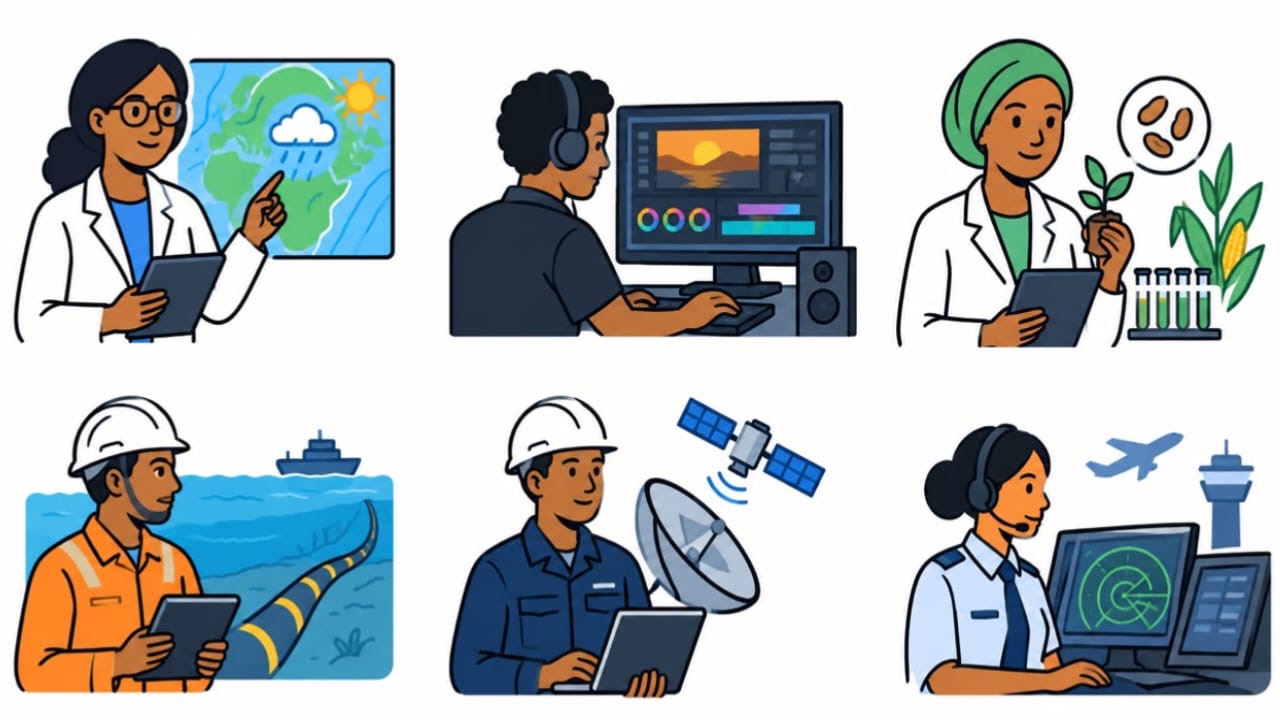
There are professions whose work we see almost every day.
We see doctors attending to patients, lawyers arguing cases in court, and teachers standing in front of classrooms. We can often see what these professionals do and how their work produces results.
But there are other professions whose work we also benefit from, even though we pay far less attention to the people doing it. We see the weather forecast, enjoy the finished film, eat food grown from improved crop varieties, and use communication services without giving much thought to the specialists who help make these things possible.
Their work is part of our everyday lives, but the people behind it are not always familiar to us. Here are six professions worth knowing a little better.
1. Meteorologists and Weather Forecasters
A weather forecast can influence whether a farmer begins planting, an airline adjusts its operations, or someone postpones an outdoor event. Producing that forecast takes more than looking at the sky.
Meteorologists study atmospheric conditions and analyse weather observations to estimate what is likely to happen.
In Nigeria, the Nigerian Meteorological Agency (NiMet) publishesseasonal climate predictions and agricultural advisories covering rainfall, temperature and other weather patterns.
For farmers, seasonal forecasts can help inform decisions about planting periods. Aviation operators also use weather information when assessing conditions for flights.
The short update we check on our phones is the result of work that begins with observing and analysing the atmosphere.
2. Film Colourists and Foley Artists
The finished Nollywood film audiences watch is not always exactly what came out of the camera. During post-production, specialists work on details that shape how the film looks and sounds.
Film colourists adjust colours, brightness, and visual consistency to establish a particular atmosphere and give scenes a cohesive appearance. Foley artists recreate everyday sounds, including footsteps, clothing movements and objects being handled, to match the action on screen.
These details influence the viewing experience. The colours can help establish the mood of a scene, while carefully matched sounds make actions feel more convincing.
Audiences may remember the actors, dialogue and storyline without knowing who worked on these parts of the finished production.
3. Crop Breeders and Seed-Quality Specialists

Long before maize is harvested or rice reaches a market, agricultural researchers have been working to improve the crops farmers can grow.
Crop breeders develop plant varieties with desired characteristics, such as resistance to particular diseases or improved performance under certain growing conditions.
Seed-quality specialists assess whether seeds meet relevant standards, including those relating to purity and germination.
In Nigeria, the Institute for Agricultural Research at Ahmadu Bello University, Zaria, is among the institutions involved in crop improvement. Research into crop varieties can give farmers more options when deciding what to plant.
A successful harvest still depends on rainfall, soil conditions, access to farm inputs, and other factors. But the varieties available to farmers are partly shaped by research carried out well before planting begins.
4. Submarine Cable Engineers and Technicians
Much of the international data travelling between countries moves through fibre-optic cables laid along the seabed. These cables carry internet traffic, financial information, video calls and other data between continents.
Specialist teams install, maintain and repair this infrastructure.
According to the International Telecommunication Union,submarine cables carry more than 99 per cent of international data traffic, making them a major part of global digital communications.
The cables connect with landing stations and terrestrial networks that carry data onwards to internet providers, businesses and users. Maintaining them requires specialised equipment and technical expertise, particularly when a damaged section needs to be located and repaired.
When we communicate with someone overseas or access a service hosted in another country, these undersea connections may be part of the infrastructure carrying our data.
5. Satellite Engineers and Operations Specialists
Satellite technology can help provide communication services in places where extending conventional ground-based infrastructure is difficult. But getting those services to users requires more than putting a satellite into orbit.
Satellite engineers and operations specialists work on the systems and ground infrastructure needed to operate satellites and monitor their performance.
In Nigeria, the Nigerian Communications Satellite Limited (NIGCOMSAT) operates NigComSat-1R and offers satellite-based services, including broadband and broadcasting.
Satellite services are not responsible for every internet connection. Their usefulness depends on the satellite’s capabilities, coverage, equipment, and the service being provided. Where available, they can give communities and organisations additional ways to access communications, including in some locations where terrestrial networks are limited.
6. Air Traffic Controllers and Railway Signalling Professionals
Aircraft and trains operate in different environments, but both depend on coordination to manage their movements safely.
Air traffic controllers communicate with pilots and help manage aircraft movements within the airspace and at airports under their control. Their work involves coordinating movements and maintaining the required separation between aircraft according to established procedures. In Nigeria, the Nigerian Airspace Management Agency provides air navigation services that support flight operations.
Railway signalling professionals have a different responsibility. They install, inspect, test, and maintain equipment used to manage train movements and routes.
The Nigerian Railway Corporation lists train control and signalling, route planning, and safety of train operations among its responsibilities.
Controllers and signalling specialists work alongside other professionals, including pilots, train drivers and technical teams. Their contribution is part of the coordination that allows air and rail transport to operate in an orderly manner.
These are just six examples of professions whose work deserves more recognition. There are many others contributing to the services, technology, and everyday experiences we often take for granted.
Which of these professions had you never really paid attention to, even though you enjoy the results of their work?