SHE100: From One Woman in the Room to Thousands in Tech — The Judith Owigar Story
In a room where women were nearly invisible, Judith Owigar chose not to fit in; she built Akirachix instead, training young women from underserved communities into developers, founders, and engineers, and reshaping who gets a future in Africa’s tech industry.

It was 2010, and the room was buzzing. Nairobi's iHubwas opening its doors for the very first time, a shiny new nerve centre for Kenya's growing tech community. Developers, designers, and founders packed the space, excited and electric. Judith Owigar walked in, scanned the room, and felt something shift inside her.
Not excitement. Discomfort. Almost every face in that room was male.She was not surprised. She had felt this way her entire career. But that evening, something moved from quiet frustration to a decision. If the table was full of the wrong people, she was going to build a new one.
As we celebrate women in March through the SHE100 series, Judith Owigar represents a particular kind of courage: the kind that does not wait for permission, does not pitch to investors, and does not build for profit first.
She built a movement for the girl who did not know she could code, the young woman from a low-income estate who had never imagined a future in tech, and the generation of female engineers Africa was quietly losing before they even got started.
A Computer Scientist Who Almost Never Was
Judith Owigar grew up in Nairobi and credits her older brother for nudging her toward technology. He told her it was a field with great potential. She listened, chose Computer Science at the University of Nairobi, and discovered a love for mathematics that carried her through a Bachelor's degree, a Master's in Applied Computing, and eventually a PhD in Information Systems.
Her early career was grounded and practical. She worked as a tech support specialist at Turnkey Africa, a Nairobi-based firm serving banks and insurance companies across the continent.
She then moved to Ibid Labs as a developer, and also worked with the Japan Center for Conflict Prevention. These were not glamorous titles, but they were formative. She was learning how technology actually worked inside institutions, how it served people, and more importantly, who it was leaving out.
By the time she walked into iHub's launch event in 2010, she had already tried to start two businesses that never took off. She did not consider herself an entrepreneur.
What she did consider herself, as she later said, was a visionary and a doer.And that iHub room, with its overwhelming sea of male faces, gave her the clearest vision she had ever had.

Building AkiraChix: Tech Training for the Girls Being Left Behind
In April 2010, Judith and three fellow developers, Angela Oduor, Linda Kamau, and Marie Githinji, co-founded AkiraChix. All four had met through Nairobi's developer scene, three of them at the same web development firm, and all four had lived the same experience: being the only woman, or one of very few, in every tech space they entered. AkiraChix was their answer.
The name carries intent. The organisation's vision was clear from day one: to nurture generations of women who use technology to develop innovations and solutions for Africa.
But what made AkiraChix different from similar initiatives elsewhere was who it chose to focus on. Not university graduates. Not women already adjacent to tech. AkiraChix went directly to young women from low-income communitiesin Nairobi who had neither the access nor the exposure to imagine a career in technology.
The flagship programme, CodeHive, is a fully-funded, one-year residential training programme for women aged 18 to 24 from under-resourced backgrounds. It covers full financial assistance, technical training, internship placement, and preparation for tech employment and leadership.
Graduates have gone on to become mobile app developers, web developers, and founders. AkiraChix also runs outreach programmes at primary schools, high schools, and universities, catching girls at every stage before they are talked out of the field.
The early years were difficult. Funding was scarce, administrative resources were thin, and AkiraChix was not yet a government-accredited institution.
To get around that, they partnered with the Institute of Software Technologies to issue graduates with industry-recognised certificates.
The first major grant came from Googlein early 2012, after just one rejection, and the momentum has held since. Judith herself secured over $800,000 in grant fundingand built partnerships with organisations including the GitLab Foundation and the US Embassy.
Juakali, the UN, and a Career That Refuses to Stay in One Lane
Judith's ambitions were never confined to AkiraChix alone. In 2012, she founded Juakali Workforce Limited, an online and mobile platform connecting skilled manual workers from Kenya's informal sector with employment opportunities in construction and related industries.
The name, drawn from the Swahili phrase meaning 'fierce sun' and colloquially used for Kenya's informal artisan economy, was deliberate.

Juakali addressed a gap that tech circles rarely discussed: the millions of skilled tradespeople with no digital presence, no formal employment pipeline, and no way to prove their value to larger employers.
In 2016, she was appointed an ICT Advisor to the UN-HabitatUrban Basic Services Branch. She has since deepened that relationship significantly.
Today, she serves as a Smart and Electric Mobility Consultant for UN-Habitat, working on climate change, rapid urbanisation, and the integration of technology into sustainable city development.
It is a long way from a campus printing business or a developer's desk in Nairobi, and it speaks to the range of a mind that has never been comfortable staying in one place.
She has also held board positions with the Swedish Program for ICT in Developing Regions (SPIDER), Lumen Labs, and the Africa WeTech Leadership Council.
In 2007, she was named the best female engineer at the Institute of Electrical and Electronic Engineers students' exhibition. She was later named one of CNN's 10 African voices to follow on Twitter.
What Judith Owigar Built That You Cannot Put in a Pitch Deck
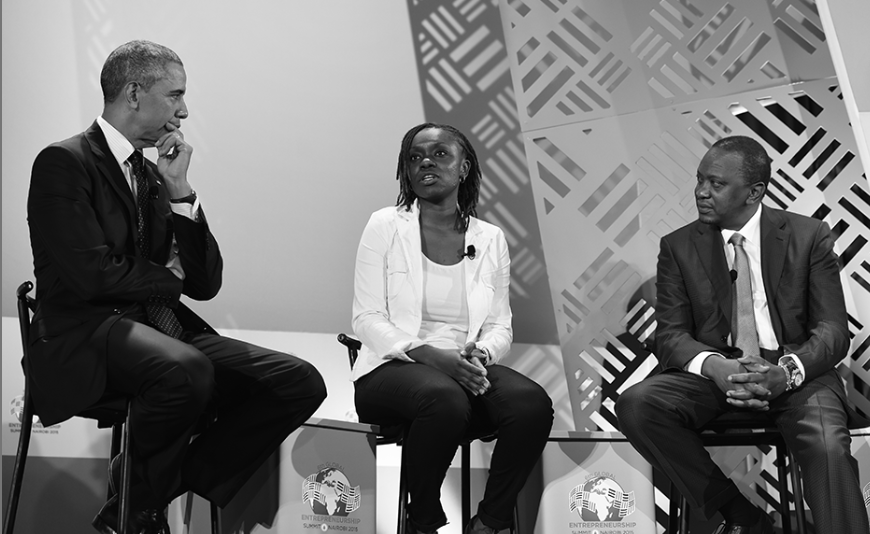
In 2014, Forbesnamed Judith one of Africa's 10 Female Tech Founders to Watch. In 2015, she stood sandwiched between President Barack Obama and President Uhuru Kenyatta at the Global Entrepreneurship Summitin Nairobi, addressing a global audience about AkiraChix's work.

She has spoken at the renowned Grace Hopper Celebration of Women in Computing, the largest gathering of women technologists in the world. She is an East Africa Acumen Fellow, an International Focus Fellow, and holds the Anita Borg Change Agent ABIE Award.
But the most important thing Judith Owigar has built cannot be quantified in awards or funding rounds. It lives in the women who walked into AkiraChix from Mathare, Kibera, and Korogocho with no formal tech background and walked out as developers, founders, and engineers. It lives in every Kenyan girl who now sees a path into technology that she could not see before.
She has been doing exactly that for over fifteen years. That is what SHE100is about.