Scandal Unfolds: N33.7BN Social Intervention Funds Queried Amidst Poverty Crisis
New concerns have emerged over a $1 billion federal cash transfer program following the Auditor-General's inability to verify N33.75 billion disbursed to 3.29 million households in 2023. The report alleges obstruction by officials and violations of financial regulations, amidst rising poverty and calls for stringent accountability before further disbursements.
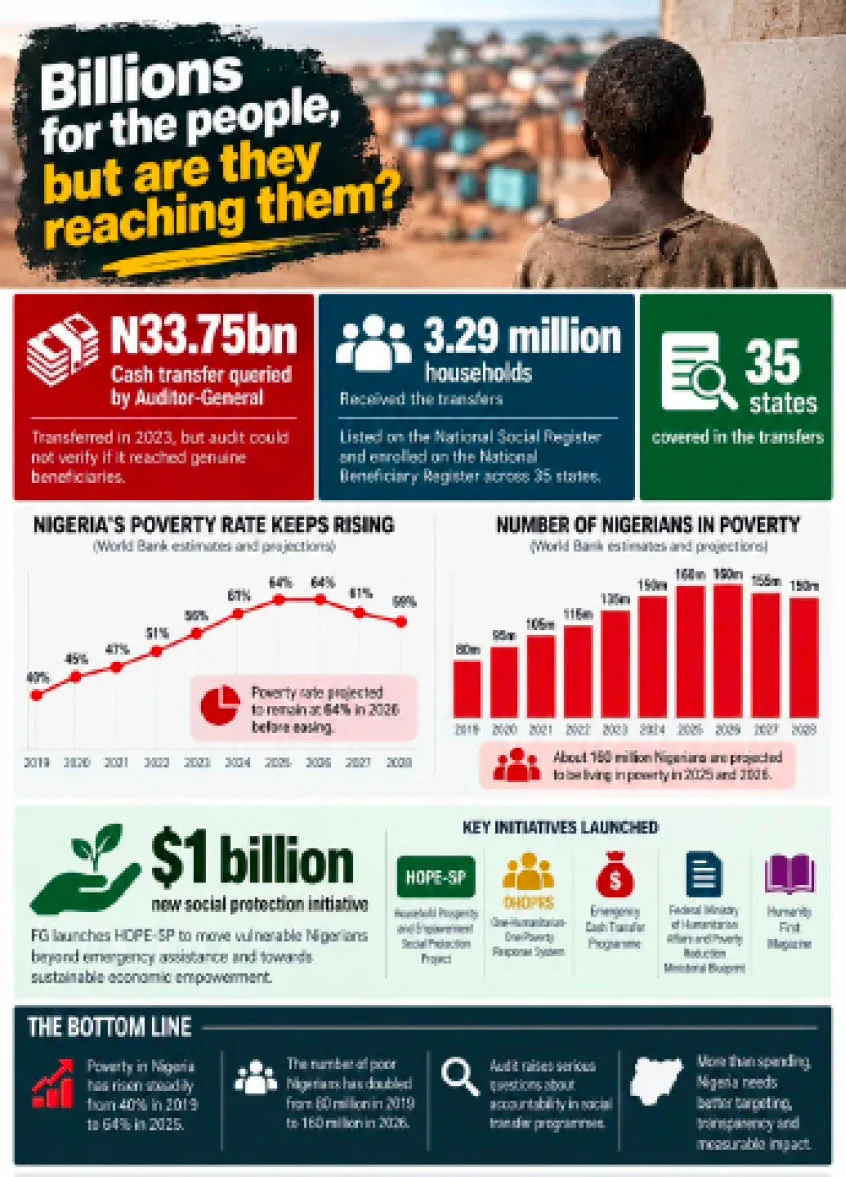
Fresh concerns have emerged regarding a recently launched $1 billion cash transfer programme by the federal government of Nigeria. This follows a query from the Auditor-General for the Federation (AuGF) concerning N33.75 billion transferred to over 3.29 million households in 2023, where verification of genuine beneficiaries remains impossible.
The Auditor-General's reservations are detailed in the 2024 Annual Report on Non-Compliance and Internal Control Weaknesses in Ministries, Departments and Agencies (MDAs).
This report specifically scrutinised transactions of the National Cash Transfer Office (NCTO) in Abuja for the 2023 financial year.
The report highlighted that N33.751 billion was electronically transferred to 3,295,207 households and beneficiaries listed on the National Social Register and enrolled on the National Beneficiary Register across 35 states.
However, auditors stated that the NCTO failed to provide adequate records to confirm the identities of recipients or to reconcile the payments with official beneficiary registers.
Auditors further elaborated that payment vouchers lacked complete beneficiary details, and crucial records required for verification were withheld.
The NCTO was specifically faulted for not producing a Remita statement, which would show the actual recipients of the funds versus those listed on the registers.

This obstruction, allegedly by NCTO accounts staff, "hindered the authentication of the payments and made it difficult to ascertain whether the beneficiaries who received the funds were genuine," frustrating the audit process.
These findings were deemed contrary to the Financial Regulations (FR) 2009, specifically paragraphs 613 and 603(i), which mandate paying officers to verify recipients' authorisation and require vouchers to contain full particulars supported by relevant documents.
This audit comes as the federal government launched the Household Prosperity and Empowerment Social Protection Project (HOPE-SP), a $1 billion social protection programme aimed at transitioning vulnerable Nigerians towards economic empowerment, alongside four other initiatives.
The backdrop includes past controversies, such as state governors requesting the disbandment of the social register in 2023 due to credibility concerns, though it was initially deemed a starting point for review.
More recently, in January 2024, President Bola Tinubu suspended all programmes under the National Social Investment Programme Agency (NSIPA) amid ongoing corruption investigations within the Ministry of Humanitarian Affairs and Poverty Alleviation, which led to the suspension of the then minister, Beta Edu.
Meanwhile, the World Bank's Nigeria Development Update (April 2026) revealed a significant surge in poverty, reaching an estimated 63 percent in 2025, up from 40 percent in 2019.
The number of poor Nigerians escalated from about 80 million in 2019 to 150 million in 2024, projected to hit 160 million in 2025 and 2026. Extreme poverty also surged from approximately 30 million in 2019 to about 78 million in 2025 and 2026.
Despite a projected average real GDP growth of 4.2 percent between 2026 and 2028 and moderating inflation, the current poverty figures underscore the critical need for effective and transparent social intervention programs.
The reactions to the AuGF's report have been sharp. Dr. Umar Yakubu, Executive Director at the Center for Fiscal Transparency and Public Integrity (CEPTI), described the findings as evidence of "impunity among civil servants."
He stated that the inability to verify N33.75 billion in digital disbursements and the obstruction of auditors point to "institutionalized impunity that actively shields corruption from public scrutiny." Dr. Yakubu advocated for technology-driven oversight, rigorous transparency indices, and independent verification frameworks to ensure accountability in public spending.
Similarly, Chancellor of the International Society for Social Justice and Human Rights (ISSJHR), Dr. Jackson Omenazu, called the AuGF's inability to verify a "serious warning."
His organization demanded full disclosure of the N33.7 billion transfers before any further commitment to the new $1 billion social protection package.

ISSJHR urged the immediate publication of details, including beneficiaries and amounts, an independent forensic audit, and unrestricted access for oversight bodies.
They also called for suspending additional disbursements until accountability questions are resolved and, if the $1 billion package proceeds, implementing robust safeguards such as transparent procurement, beneficiary verification, independent monitoring, periodic public reporting, and prosecution for misappropriation of funds.