Pink Flamingo Uprising: Thousands Flood Tirana in Anti-Government Fury
Tens of thousands have gathered in Tirana for the 35th consecutive day, protesting plans for a Trump-linked luxury tourist resort in Albania's Zvërnec protected area. What began as an environmental outcry has escalated into an 'anti-government revolution,' demanding Prime Minister Edi Rama's resignation amidst violent clashes with security forces and growing human rights concerns.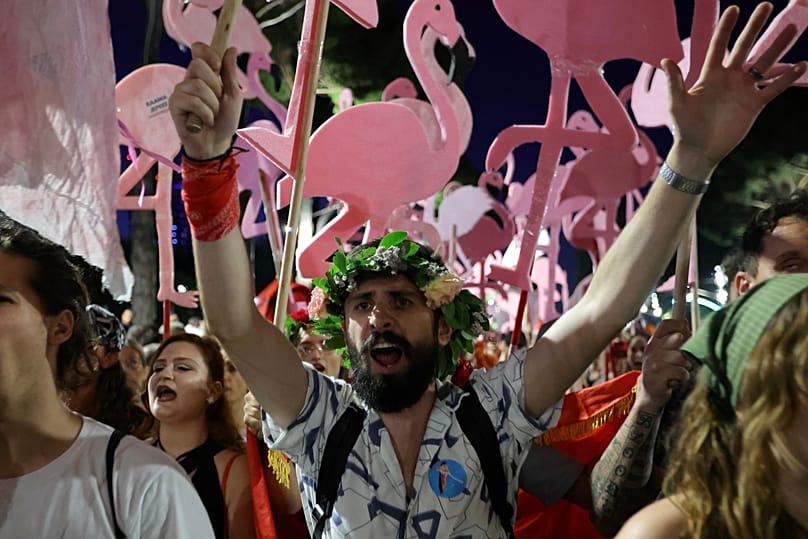
Tens of thousands of people gathered in Tirana for the 35th consecutive day on Saturday, protesting against plans to construct a tourist resort linked to the Trump family. This demonstration is believed to be the largest since protests began in late May, opposing the building of a luxury hotel connected to Ivanka Trump, daughter of former US President Donald Trump, and her husband Jared Kushner, who advises and negotiates on behalf of the president. The proposed development is situated in the protected area of Zvërnec, located in southwestern Albania.
What initially started as an environmental protest has significantly escalated, transforming into a major anti-government movement. Protesters are now accusing the government of widespread corruption and are demanding the resignation of Prime Minister Edi Rama, who gave his approval to the Kushner-Trump project. As protester Alketa Ademi told AFP, “What began as the ‘pink flamingo revolution’ has turned into widespread public discontent. The lack of transparency, the arrogance – enough! The prime minister has to go.”
During the mass rally, many protesters carried giant pink flamingos as they marched towards the country's parliament building on Tirana's main boulevard. One group notably carried a large concrete cake, a symbolic gesture referencing both Prime Minister Edi Rama’s 62nd birthday and the plans to pave over protected ecosystems with concrete. Protesters also erected and then toppled a bust of Edi Rama using a rope, an action deliberately reminiscent of the iconic overthrow of communist dictator Enver Hoxha’s statue in 1991, which marked the end of his oppressive rule.
On Saturday evening, a significant group of demonstrators broke away from the main march and headed towards a police station where 19 protesters were being held. These individuals had been arrested during Thursday’s march near the parliament building. The protesting crowd smashed the windows of the police precinct and were met with a violent response from security forces, who reportedly deployed tear gas and water cannons to disperse them. Protesters were heard shouting, “Release the kids,” while some carried banners with messages such as “Albania is not for sale” and “Repeal the law on protected areas.” The latter referred to the legislation that enabled the government to fast-track procedures for building such tourist resorts in protected zones.
These violent incidents stand in stark contrast to the generally peaceful nature of the gatherings that have characterized the movement since its inception, drawing thousands of citizens from across the country. In the previous week, large groups of demonstrators had gathered outside parliament, attempting to block lawmakers from accessing the building. Hundreds broke through a police-installed security cordon, leading to clashes with officers who pushed them back, resulting in dozens of arrests. Eyewitnesses reported that police also used tear gas and water cannons to disperse those crowds, while some protesters retaliated by throwing eggs, stones, and other objects at security forces. Officials later confirmed that 15 police officers were injured and 25 protesters were detained in those earlier clashes.
The Albanian Helsinki Committee (AHC), a prominent human rights organization, expressed its grave concern on Saturday over “the escalation of the situation.” The AHC stated, “Individual acts of violence cannot justify the disproportionate use of force,” condemning the use of tear gas without warning, as well as batons and beatings by law enforcement officers against protesters. The committee called for a swift and independent investigation into these incidents.
The movement has been widely dubbed the 'Pink Flamingo Revolution', a direct reference to the migratory birds that pass through the protected area designated for the tourist complex. Protesters vehemently argue that the luxury hotel complex, estimated to cost $4.6 billion (€4.02 billion) and slated for construction in a protected area on the Adriatic Sea, poses a severe threat to the fragile ecosystem of the neighboring lagoon. Investors, conversely, aim to transform the uninhabited island of Sazan, a former military base from the communist era, into a high-end tourist destination. The project has faced strong opposition since its initial announcement in 2024. The latest surge in protests was triggered by the appearance of barbed-wire fencing and excavators on nearby beaches in late May, signaling to the public that their concerns were being ignored and that the development would proceed against their will.