Only 6% of Nigerians Feel Financially Secure as Savings Collapse and Inflation Bites Harder
The PiggyVest 2025 report reveals only 6% of Nigerians feel financially secure as savings rates collapse to 40% and emergency funds disappear. In Part 2 of the Zeal money Series,, you will get to see what Nigeria's financial survival really looks like.
This is Part 2 of the Zeal Money Series examining the 2025 PiggyVest Savings Report.
If you missed Part 1, which explored how 74% of Gen Z Nigerians depend on a single income and earn below ₦100,000, you can read it here.
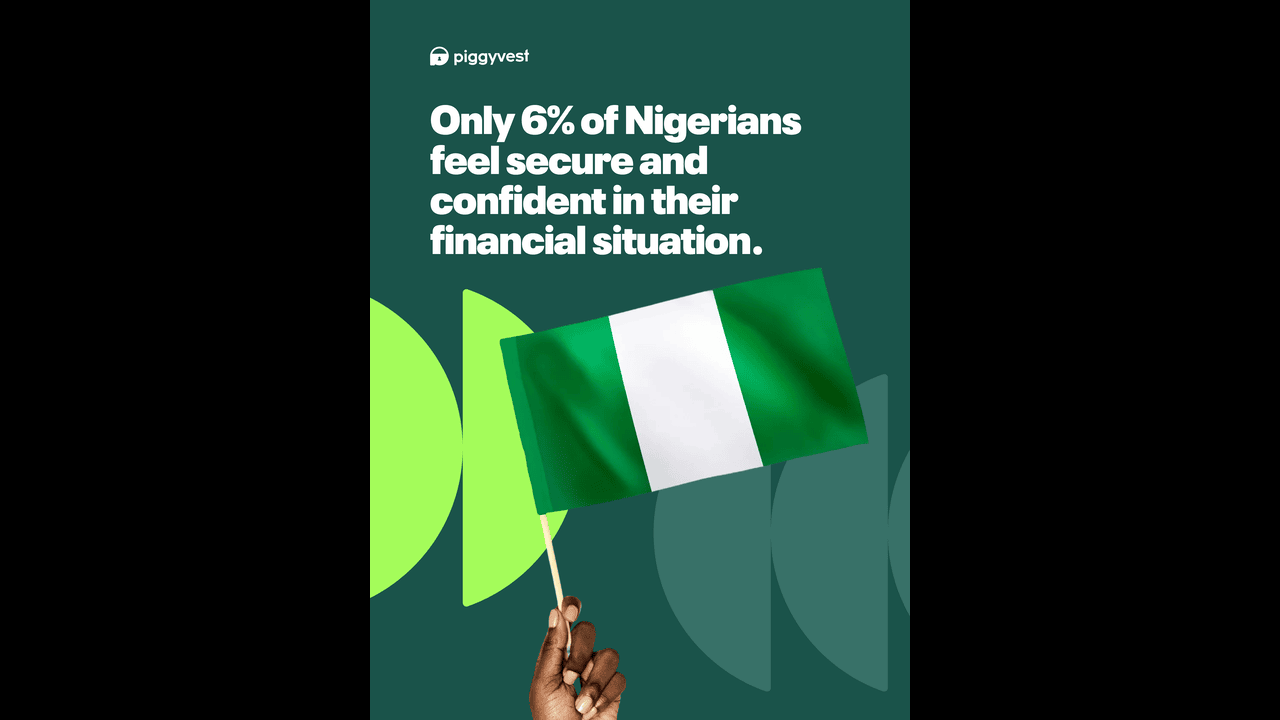
Start with a number on the title of this article and it would probably make you feel uneasy if it's truly accurate. Six per cent.
That is the number of about 26,000 Nigerians surveyed by PiggyVest in 2025 who say they feel secure and content with their financial situation.
The remaining 94% whether accurately true or not exist, somewhere on a spectrum of financial strain.
According to the 2025 Piggyvest report about 31% say they often feel stressed or constrained by their finances. Another 29% describe their situation as one they are extremely unhappy with.
A further 22% was classified to be afloat in a neutral space, neither satisfied nor distressed, that offers no real cushion against the next economic shock.
Nigeria's GDP is growing, headline inflation has moderated from a 2024 peak of above 33% to roughly 15% following an economic rebasing exercise in August 2025.
Foreign reserves have crossed $42 billion and the IMF has praised the country's reform trajectory. None of that shows up in the remaining 94% of the population according to the Piggyvest report.
When Savings Become a Luxury Nigerians Can No Longer Afford
The collapse in savings behaviour is not a 2025 development. It is a three-year trend, and the 2025 PiggyVest report captures its most severe chapter yet.
In 2023, 64% of respondents saved monthly. By 2024, that figure had dropped to 47%. In 2025, it fell again to just 40%. The share of Nigerians who do not save at all has moved in the opposite direction, rising from 21% in 2023 to a staggering 53% in 2025.
More than half of Nigeria's population, surveyed across urban, peri-urban, and rural settlements for the first time at this scale, no longer saves.
The explanation is not laziness or indifference, though 21% of non-savers admit they do not care about saving and 19% say they do not know how.
The dominant driver is income, among those who report being unable to save, 60% say they simply do not earn enough. Over 57% of that group have no monthly income at all, while another 29% earn below ₦100,000. These are not people making trade-offs. They are people for whom saving is structurally impossible.
The problem here if to be argued is not a savings problem, it is a systems problem. People are being forced to redirect what little they have toward food, fuel, rent, and school fees.
These are not discretionary expenses that can be cut and when savings decline broadly, households become more fragile, the economy loses domestic capital, and inequality deepens, not just between the rich and the poor, but within the same income brackets.
Emergency Funds Are Disappearing and the Numbers Tell a Grim Story

If the savings data signals a structural problem, the emergency fund data confirms it is already becoming a crisis.
Six in ten Nigerians surveyed have no emergency funds set aside for unexpected expenses, medical bills, a sudden job loss, car repairs, or the kind of unforeseen events that arrive without warning.
Only four in ten have any emergency buffer at all. Among those who do, most can cover just one to three months of expenses. Only 15% have reserves that can last six months or more, the minimum threshold financial planners typically recommend.

Year-on-year, the picture has worsened. A large share of respondents report having had emergency savings in 2024 that have since declined or disappeared entirely.
Inflation and rising prices are the primary reasons cited, named by 53% of those saving less for emergencies. Changes in employment status account for 40%, while new financial responsibilities, marriages, children, and family obligations, explain another 20%.
The generational breakdown deepens the concern. Only 31% of Gen Z respondents, Nigeria's youngest working adults, have any emergency savings, compared with 52% of Gen X respondents.
These are the people entering adulthood during the most financially volatile period in recent Nigerian history, the least protected against the shocks that are most likely to derail them.
Whether you know it now or not, an emergency fund is the most basic financial safety net. It is what stands between a person and financial ruin when the unexpected happens. In Nigeria, the unexpected is not rare, it is just a regular Tuesday.
Financial Security Is Not About Income. It Is About Behaviour.

Perhaps the most counterintuitive finding from the 2025 PiggyVest report is what it reveals about the 6% who do feel financially secure.
They are not clustered at the top of the income pyramid. Only 12% of the financially secure group earns ₦5 million or more per month.
Meanwhile, 14% earn below ₦100,000, and one in ten currently has no monthly income at all. Read that again, people with no monthly income who describe themselves as financially secure.
What separates them from the majority is habit and obligation. Among those who feel financially secure, 54% consistently save a fixed portion of their income every month, the single strongest predictor of perceived financial stability identified in the entire report.
They also tend to carry lighter family obligations, more than half still pay black tax regularly, but a larger share than the general population are exempt from that drain.
The data from Chapter 6 of the report is unambiguous on this point: financial satisfaction is shaped not only by income but by stability, predictability, and the ability to absorb shocks without derailing progress.
More than 1 in 2 Nigerians enters each month uncertain whether their earnings will cover basic expenses. That statistic sits alongside the IMF's projections for continued disinflation with a quiet indictment. The reforms are real. Their benefits have not reached the household level.
EFInA's own research reinforces this reality. Only 16% of Nigerian adults were classified as financially healthy in 2023, down from 28% in 2020.
In that same year, 84% of adults ran out of money at least once, 58% sometimes went without food, and 78% could not raise emergency funds within a week. That data preceded the full weight of 2024's inflation peak.
The 2025 PiggyVest report measures what comes after, not collapse, and not recovery. Something harder and more silent that we are not listening to—a population adapting, enduring, and building the smallest of buffers against a system that keeps making it harder to hold on.
The Zeal Money Series continues, WATCH OUT FOR PART 3