Networking Is Just Classism in Disguise (And We Need to Admit It)
Networking isn’t the neutral career hack everyone claims—it’s a system built on inherited social capital. Explore why access, class, and privilege shape who gets ahead and how we can rethink networking for equity.

Have you ever sat through a career counseling session, scrolled through LinkedIn, or watched a YouTube video about "landing your dream job," you heard some version of the same advice: network?
You are told to go to the events, slide into DMs, build yourpersonal brandand get alumni connections.
It sounds simple enough until you realize that for a whole lot of people, that advice is not just unhelpful. It is tone-deaf.
The truth is networking, as we know it, is a system built on access and access has never been equally distributed.
It's Not About Who Works Harder
We love to tell ourselves that the job market is based on merit. Work hard, put yourself out there, and opportunities will come.
But that story falls apart pretty fast when you actually look at how most people land their jobs.
Studies consistently show that somewhere between 70 to 80 percent of jobs are filled through personal connections not through applications, not through job boards, not through talent alone.
Which means the game was never really about your CV. It was about who you already know.
And who do you already know depends almost entirely on where you grew up, what school you went to, what neighborhood you lived in, and whether your parents had professional networks of their own to pass down to you.
If your parents are doctors, lawyers, or executives, you have probably had dinner table conversations about entire industries. You have been introduced to their colleagues.
You probably have had internships lined up before you even declared a major. That is not something you earned, an inherited social capital, and it is incredibly powerful.

The "Just Go to the Event" Problem
Now, when career advisors tell you to "just show up," they are imagining a pretty specific person. Someone with the time, the money, and the cultural fluency to walk into a room full of strangers and work it.
But think about what networking actually requires. You need a professional wardrobe. You need to be able to afford the ticket to the event, or at minimum, the commute.
You need to be free in the evenings, which is hard when you are probably working two jobs. You need to know how to make small talk in a way that reads as confident and charming rather than awkward and that is a skill that is heavily shaped by the social environments you grew up in.
Many young people that have historically been excluded from professional spaces often describe networking events as deeply alienating.
It is not just uncomfortable. It is like being handed a rulebook in a language you were never taught.
Class shapes your comfort level in these spaces in ways that are almost invisible to people who grew up in them.
The LinkedIn Illusion
Then there is online networking, which everyone promises has "leveled the playing field." Has it though?
LinkedIn is essentially a platform where the more elite your background, the louder your presence. The more prestigious your university, the more recognizable your internship, the more likely you are to get responses to your cold messages.

For people whose resumes don't already have the "right" names on them, breaking through is exponentially harder.
And the whole concept of a personal brand, building a following, sharing your hot takes, positioning yourself as a thought leader, requires a kind of confidence and cultural capital that not everyone was socialized to have.
It rewards extroversion, self-promotion, and a certain polished version of professionalism that is, let's be honest, coded in class and race.
What We're Not Talking About
The most dangerous part of "just network" as advice is that it places the entire burden on the individual while completely ignoring the structural imbalances that make networking so unequal in the first place.
It lets companies and institutions off the hook. If you didn't get the job, maybe you just didn't network hard enough. It reframes a systemic problem as a personal failure.
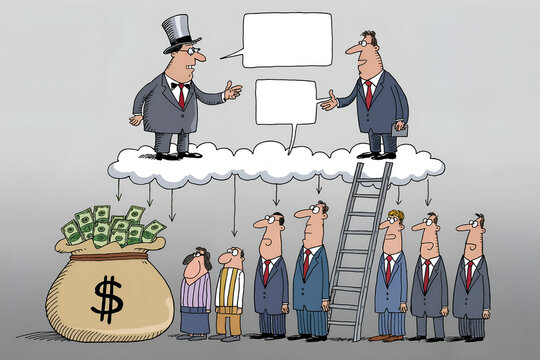
And that is the classismpart. It is not always intentional or malicious but rather deeply embedded in the assumption that everyone is starting from the same place and just needs to try a little harder.
So What Do We Actually Do?
Acknowledging the problem doesn't mean networking is useless. It means we need to be honest about whose advice actually applies to you, and stop pretending that the same strategies work equally for everyone.
For those who do have access, use it. Advocate for people who don't. Refer people from underrepresented backgrounds.
Mentor someone who doesn't have the same connections you do. Open the door instead of just walking through it.
For those without the inherited network, build community over contacts. Find people who are on the same climb, not just people already at the top. Peer networks are underrated and often more genuine.
Networking is not going away. But until we stop pretending it is a neutral skill that anyone can just pick up and run with, we are going to keep mistaking inherited advantage for earned success and that is a lie that costs people real opportunities.