Long Island's Grid Upgrade Sparks Fierce Debate Over Costs, Benefits and Community Impact
Long Island's electric grid urgently requires upgrades, leading to the contentious Propel NY Energy project. While proponents highlight improved reliability and significant cost savings, critics raise concerns over private profits, public financial risks, extensive construction disruption, environmental impacts, and safety issues.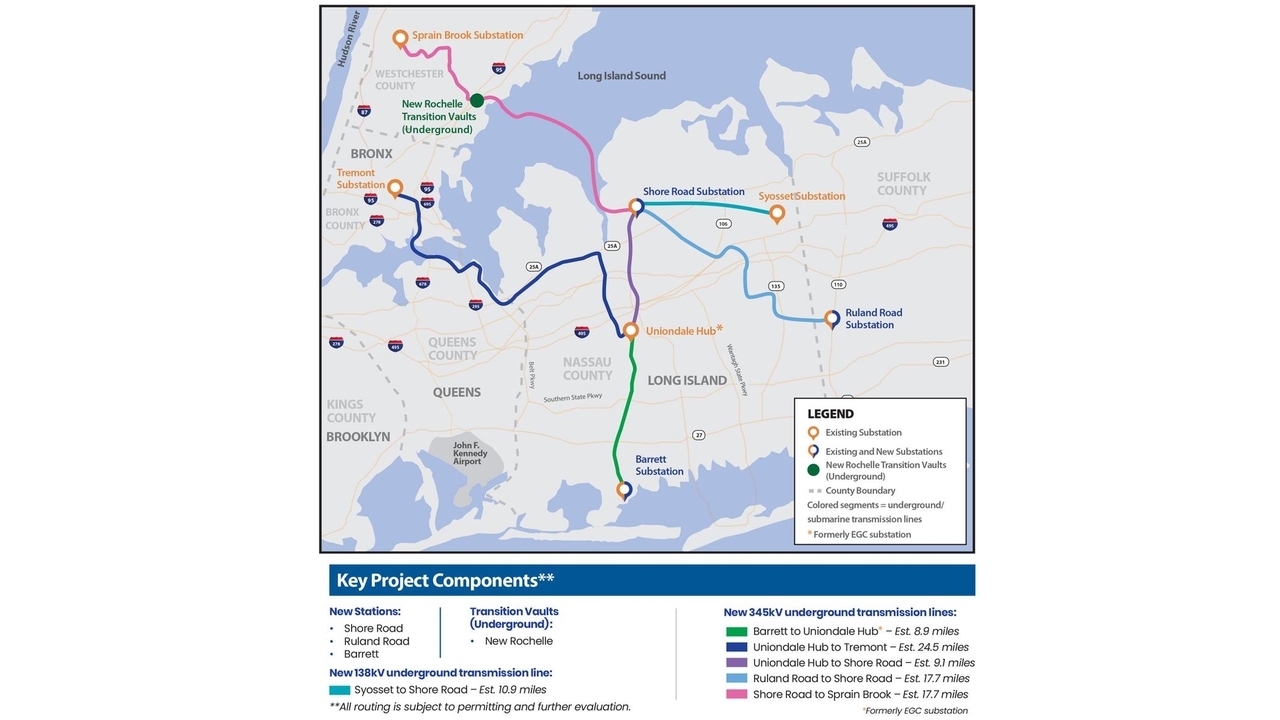
Long Island's aging electricity grid is under growing pressure as demand rises and extreme weather events become more frequent. Energy experts warn that transmission constraints are increasing reliability risks and driving up electricity costs, prompting calls for major infrastructure upgrades.
At the centre of the debate is Propel NY Energy, a proposed $3.26 billion underground transmission project jointly developed by the New York Power Authority (NYPA) and New York Transco.
The project would install nearly 90 miles of underground and submarine transmission lines across Long Island, New York City and Westchester to strengthen grid reliability, improve resilience and expand electricity delivery capacity.
The project remains under review through New York's Article VII permitting process.
Supporters argue that the investment is becoming increasingly urgent.
Bob Catell, chairman of the Advanced Energy Research and Technology Center at Stony Brook University, said Long Island's transmission network has not undergone a significant expansion in more than three decades despite rapidly growing electricity demand.
Catell noted that transmission bottlenecks contributed to significantly higher electricity prices during periods of peak demand, preventing cheaper electricity generated elsewhere in New York from reaching Long Island efficiently. He argues that expanding transmission capacity would reduce congestion, improve reliability and lower long-term energy costs for consumers.
Propel NY Energy's developers also estimate the project will improve access to lower-cost electricity while strengthening the region's resilience during severe weather.
Supporters also say the project would improve power reliability for hospitals, emergency services, schools and businesses while creating thousands of construction-related jobs during implementation. Although construction will inevitably cause disruption, Catell believes the long-term economic and reliability benefits outweigh the temporary inconvenience.
Critics, however, argue that the project raises serious financial, environmental and community concerns.
Bruce Kennedy, a Glen Cove resident and Sea Cliff Village administrator, contends that NY Transco—a consortium whose owners include utility affiliates such as National Grid and Con Edison—is positioned to earn regulated returns on the investment while ratepayers shoulder much of the project's overall cost.
He argues the financial model privatizes profits while shifting significant risks onto consumers.
Kennedy is also concerned about the project's local impact. Most of the transmission lines would be installed beneath public roads, requiring years of excavation, traffic diversions, lane closures and construction staging in densely populated communities.
He warns that prolonged roadworks could disrupt daily commuting, delay emergency response times and hurt local businesses.
Environmental concerns have also featured prominently during the permitting process.
Opponents argue that sections of the route crossing Hempstead Harbor could disturb marine habitats and sediments that communities have spent years restoring. Kennedy has also called for more comprehensive assessments of electromagnetic field (EMF) exposure, road restoration standards and long-term infrastructure maintenance, arguing that these issues deserve closer scrutiny before construction begins.
Project developers maintain that extensive environmental reviews, public consultations and route modifications have already been incorporated into the proposal following community feedback. Several preferred routes were revised after consultations with municipalities, civic organisations and residents.
The New York State Public Service Commission has not yet issued a final decision on the project. Public hearings and regulatory reviews remain ongoing as officials weigh the project's potential economic and reliability benefits against its financial, environmental and community impacts.