From Lagos Streets to $1B: Wemimo Abbey’s Journey Through 300 Rejections and $100K Debt
A Nigerian immigrant once rejected by U.S. banks built a $1B fintech that forces America’s credit system to count rent. Here’s how Wemimo Abbey turned financial exclusion into Esusu, and changed credit access for millions.
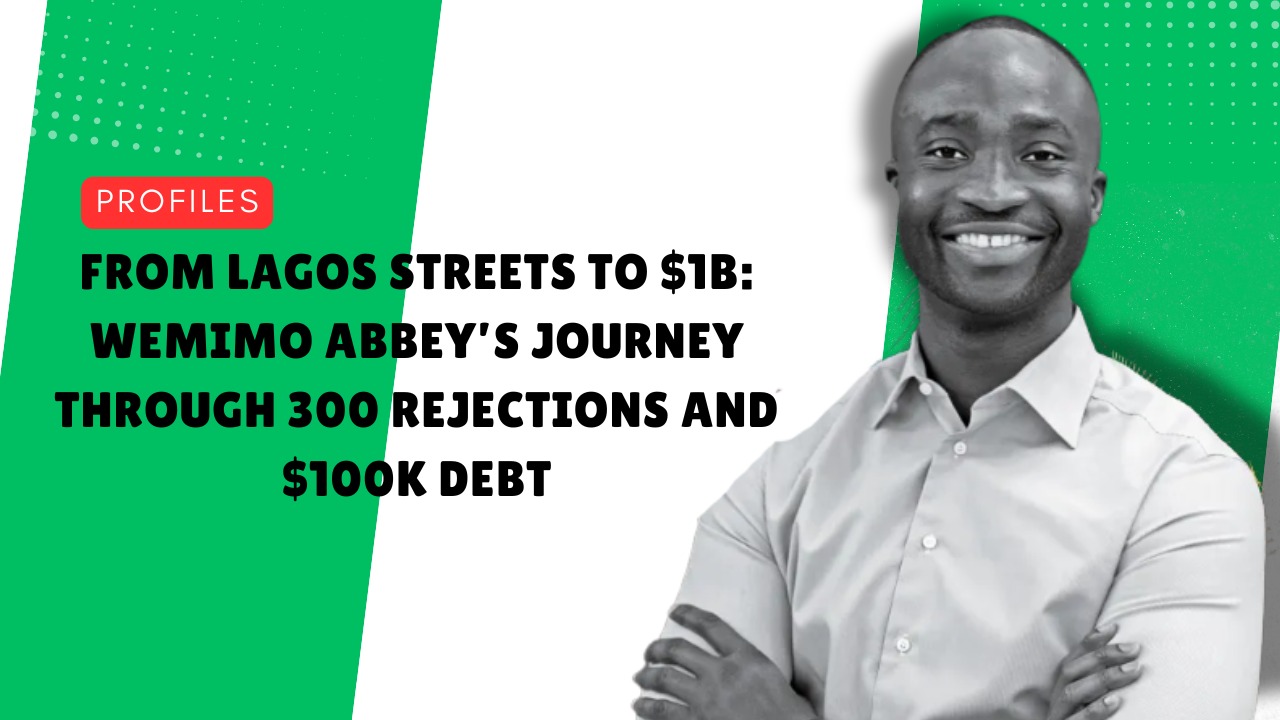
When Wemimo Abbey moved from Lagos to the United States as a teenager, he encountered a system that assigned value before it assigned opportunity. In the U.S., credit history functions as economic identity.
Without it, renting an apartment, securing a loan, or even accessing certain jobs becomes structurally harder. Abbey had no credit file. He was what regulators call “credit invisible.”
That early encounter with financial exclusion did not merely frustrate him. It exposed a design flaw in one of the world’s most sophisticated financial systems.
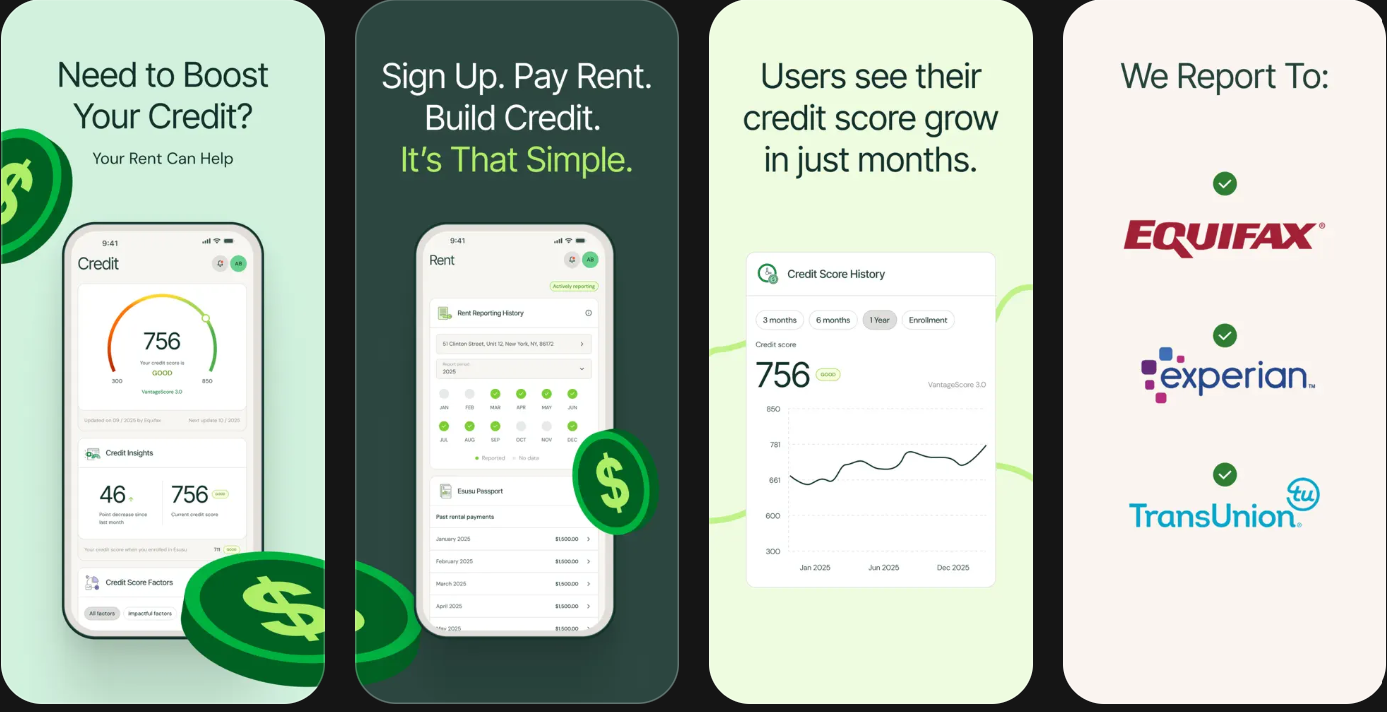
Years later, he would co-found Esusu, a company that inserts rental data into mainstream credit scoring, altering the architecture of how financial trust is calculated in America.
In 2022, Esusu reached a valuation of approximately $1 billion following a $130 million Series B round led by Softbank Vision Fund 2 in January, positioning Abbey among the few Black founders to lead a fintech unicorn in the United States.
But valuation alone understates the structural implications of what the company does.
Lagos: Formation in Constraint
Abbey was born in 1992 and raised in Lagos, Nigeria. He lost his father at age two. His mother, prioritizing education despite limited resources, anchored the family’s stability around academic performance and discipline. That emphasis became decisive.

Unlike many founder narratives that romanticize adversity, Abbey’s early life reflects something more measurable: exposure to systemic limitation. Lagos in the 1990s and early 2000s was economically dynamic but uneven.
Access to capital, infrastructure, and institutional trust often depended on informal networks rather than formal systems. That tension between potential and exclusion would later shape his thinking about financial infrastructure.
Profiles from the World Economic Forum and Ashoka confirm Abbey immigrated to the United States as a teenager. The transition introduced a new kind of barrier because in America, opportunity is algorithmic.
Without a credit score, financial institutions treat you as high risk, regardless of character or income. For immigrants, this creates a paradox; financially responsible behavior prior to arrival carries no institutional memory.
Academic Trajectory and Analytical Training
Abbey graduated magna cum laude with a Bachelor of Science in Business Management from the University of Minnesota. He later earned a Master of Public Administration from New York University’s Robert F. Wagner Graduate School of Public Service, and participated in the Queen’s Young Leader Leading Change program at Cambridge University.
Before launching Esusu, Abbey built exposure to high-level financial systems through roles at:
PwC: working on mergers and acquisitions transactions collectively valued in the tens of billions of dollars.
Accenture: advising on operational and financial strategy.
Goldman Sachs: gaining insight into capital markets and risk modeling.
These environments are instructive. They revealed how capital is priced, how risk is modeled, and how institutional trust is quantified. Esusu would later challenge one of those quantification methods.
The Birth of Esusu: Turning Challenges into Solutions
Wemimo Abbey’s own experiences with financial exclusion drove him to co-found Esusu in 2018 alongside Samir Goel, though the concept had been brewing since 2015.
Both young professionals navigating the barriers of the financial system, they imagined a platform that could help immigrants and low-income renters establish credit and build financial credibility.

Esusu started by digitizing traditional African savings practices, but the team soon pivoted to rent reporting after spotting a critical gap in credit-building solutions.
“No matter where you come from, the colour of your skin, or your financial identity, it shouldn’t determine where you end up,” Wemimo emphasized.
Their mission was clear: use data to narrow the racial wealth gap and promote financial inclusion.
The early journey was anything but smooth. Abbey and Goel faced more than 300 investor rejections, drained their personal savings, and racked up $100,000 in credit card debt.
At one point, they were so strapped for cash that they worked overnight shifts at a Denny’s to avoid hotel expenses. Yet, they pressed on, eventually landing their first major contract with the University of Minnesota.
Capital, Scale, and Unicorn Status
In 2022, Esusu raised approximately $130 million in Series B funding, bringing total funding above $145 million and pushing its valuation to roughly $1 billion.
The funding round included participation from institutional investors and strategic backers, signaling confidence not just in product-market fit but in regulatory durability.
Black founders receive a disproportionately small share of venture capital in the United States often cited at under 2 percent of total VC funding in recent years. Within fintech, that share narrows further.
Esusu’s unicorn status therefore represents both commercial validation and a demographic anomaly in venture ecosystems.
Esusu has been recognized on CNBC’s Disruptor 50 list and featured in major publications analyzing financial inclusion and housing policy.
Wemimo Abbey’s Personal Achievements
Wemimo Abbey’s leadership and innovation have earned him significant recognition. He has been featured on Forbes’ BLK 50 list, Forbes’ 30 Under 30, TIME100 Next, and Fortune’s 40 Under 40 lists.
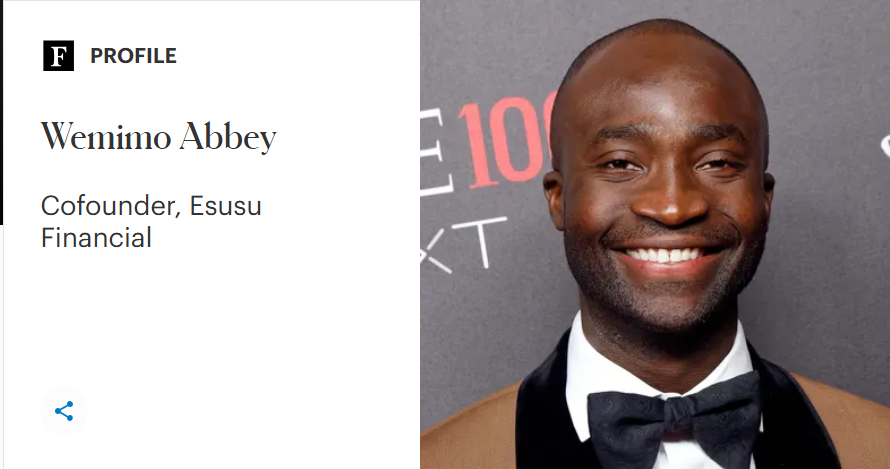
He was also named EY Entrepreneur of the Year and recognized by Goldman Sachs as one of the 100 Most Intriguing Entrepreneurs.
Despite his achievements, Wemimo Abbey remains grounded. He continues to advocate for financial inclusion and mentor aspiring entrepreneurs.
He often credits his success to the sacrifices of his mother, the resilience of his co-founder, and the support of early believers who took risks on Esusu when others doubted its potential.